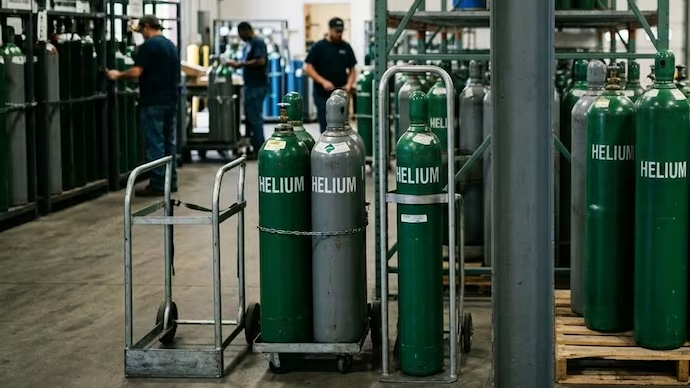
China has imposed a ban on helium exports, marking another significant step in its efforts to tighten control over strategic resources amid escalating global technology and geopolitical tensions. The move is expected to impact industries ranging from semiconductor manufacturing and healthcare to aerospace and scientific research, all of which rely heavily on helium for critical applications.
Helium is one of the world’s most important industrial gases due to its unique physical properties. It is used in manufacturing advanced semiconductor chips, cooling MRI machines, supporting space launches, fiber-optic production, welding, and scientific research. China’s decision to restrict exports could reshape global supply chains and increase pressure on countries seeking reliable sources of the gas.
China Tightens Control Over Strategic Resources
The export ban reflects China’s broader strategy of strengthening oversight of critical materials considered essential to national security and advanced manufacturing.
Key highlights include:
- China has banned the export of helium.
- The measure is aimed at strengthening domestic supply security.
- Helium is classified as a strategically important industrial resource.
- The decision could affect multiple high-tech industries worldwide.
- Global buyers may need to diversify their sourcing strategies.
The restriction comes as major economies increasingly view critical minerals and industrial materials as strategic assets.
Why Helium Is So Important
Although helium is commonly associated with balloons, its industrial importance is far greater.
Major applications include:
- Semiconductor manufacturing.
- MRI scanners and medical imaging.
- Aerospace and rocket propulsion.
- Fiber-optic cable production.
- Scientific laboratories.
- Welding and advanced manufacturing.
- Cryogenic cooling for research and industrial equipment.
Because helium is chemically inert and remains liquid at extremely low temperatures, it is difficult to replace in many high-tech applications.
Impact on Global Supply Chains
China’s export restriction could create challenges for manufacturers that rely on imported helium.
Potential consequences include:
- Higher global helium prices.
- Supply shortages for industrial users.
- Increased procurement costs for semiconductor manufacturers.
- Pressure on healthcare providers using MRI equipment.
- Greater emphasis on helium recycling and conservation.
- Diversification of supply chains toward alternative producers.
Companies may increasingly seek long-term supply agreements to reduce exposure to geopolitical risks.
Who Could Benefit?
Countries with significant helium production may gain from shifting trade flows.
Major helium-producing nations include:
- United States.
- Qatar.
- Algeria.
- Canada.
- Australia.
These producers could see increased demand as global buyers look for alternative sources outside China.
Growing Resource Nationalism
The helium export ban is part of a broader global trend in which countries are exercising greater control over critical resources.
Recent years have seen tighter restrictions on:
- Rare earth elements.
- Gallium.
- Germanium.
- Graphite.
- Antimony.
- Other strategic minerals and industrial materials.
Governments are increasingly using export controls as economic and geopolitical policy tools while seeking to secure domestic supply chains.
Challenges for High-Tech Industries
Industries that depend on helium may need to adapt through greater efficiency and innovation.
Companies are expected to focus on:
- Improving helium recycling systems.
- Reducing waste during manufacturing.
- Diversifying suppliers.
- Building strategic inventories.
- Investing in alternative cooling technologies where feasible.
However, for many advanced applications, helium currently has few practical substitutes.
What Investors Will Watch
Market participants will closely monitor:
- Global helium prices.
- Supply responses from major producing countries.
- Impact on semiconductor manufacturing.
- Healthcare sector procurement costs.
- New investments in helium production projects.
- Government policies related to strategic resource security.
These developments could influence industries ranging from electronics and healthcare to aerospace and industrial manufacturing.
Outlook
China’s ban on helium exports highlights the growing importance of strategic industrial resources in an increasingly fragmented global economy. As countries compete to secure critical supply chains for advanced technologies, export controls are becoming a more common policy tool with far-reaching economic consequences.
For businesses, the development underscores the need to diversify sourcing strategies, strengthen supply chain resilience, and invest in resource efficiency. In the long term, the move could accelerate investment in new helium production, recycling technologies, and alternative supply networks as industries adapt to a changing global trade landscape.
Get the day’s top stories in your inbox
One concise email. No spam, unsubscribe anytime.