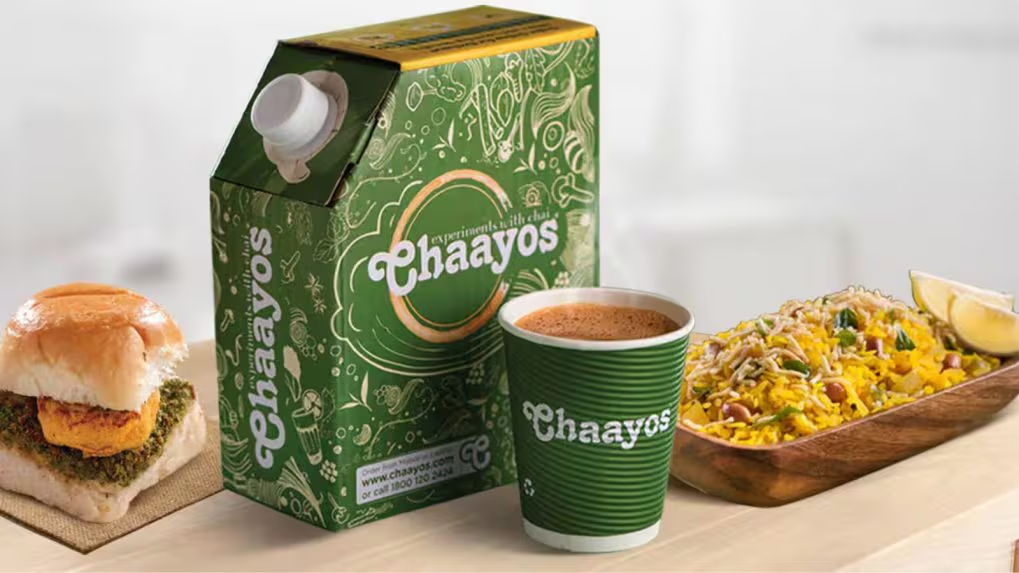
The Central Consumer Protection Authority (CCPA) has imposed a ₹50,000 penalty on tea café chain Chaayos for automatically adding a service charge to customers’ bills, holding the practice to be an unfair trade practice under the Consumer Protection Act, 2019. The authority also directed the company to discontinue the practice, modify its billing system to ensure service charges are not added by default, and refund the service charge collected from the complainant.
The action follows consumer complaints received through the National Consumer Helpline (NCH), supported by invoices showing that the service charge had been added automatically. The CCPA reiterated that service charges are voluntary and cannot be imposed on customers without their explicit consent.
CCPA Penalises Chaayos for Default Service Charge
The order reinforces the regulator’s crackdown on mandatory service charges in restaurants and cafés.
| Key Highlights | Details |
|---|---|
| Company | Chaayos |
| Regulator | Central Consumer Protection Authority (CCPA) |
| Penalty | ₹50,000 |
| Violation | Default levy of service charge |
| Action ordered | Refund, discontinue practice, modify billing software |
The regulator held that automatically adding a service charge infringes consumer rights and amounts to an unfair trade practice.
Why the Penalty Was Imposed
According to the CCPA, Chaayos violated consumer protection guidelines by:
- Automatically adding a service charge to bills.
- Treating the charge as mandatory rather than optional.
- Following a billing practice contrary to CCPA guidelines.
- Adopting an unfair trade practice under the Consumer Protection Act, 2019.
CCPA’s Directions to Chaayos
The authority has instructed the company to:
- Refund the service charge collected from the consumer.
- Stop levying service charges by default.
- Modify its billing software so service charges are not automatically added.
- Ensure compliance with CCPA guidelines going forward.
What the Rules Say
| CCPA Guidelines | Requirement |
|---|---|
| Default service charge | Not permitted |
| Payment of service charge | Must be voluntary |
| Refusal to pay | Cannot result in denial of service |
| GST on service charge | Should not be levied when the charge is added by default |
The guidelines, issued in July 2022 and later upheld by the Delhi High Court, make it clear that restaurants cannot compel customers to pay service charges.
Wider Crackdown on Restaurants
Chaayos is part of a broader enforcement drive by the CCPA.
The regulator has:
- Initiated action against multiple restaurants across India.
- Acted on complaints received through the National Consumer Helpline.
- Ordered refunds where mandatory service charges were collected.
- Imposed penalties of up to ₹50,000 on non-compliant establishments.
What Consumers Should Know
Customers have the right to:
- Refuse payment of a service charge added by default.
- Request removal of the charge from the bill.
- File complaints through the National Consumer Helpline if restaurants refuse to comply.
- Receive services regardless of whether they choose to pay a voluntary tip.
Outlook
The CCPA’s action against Chaayos reinforces the regulator’s stance that service charges must remain voluntary and cannot be imposed automatically on restaurant bills. The order also signals stricter enforcement of consumer protection rules following the Delhi High Court’s affirmation of the CCPA’s service charge guidelines.
For restaurants and café chains, the decision serves as a reminder to review billing systems and ensure compliance with consumer protection laws. Businesses that continue to levy mandatory service charges risk penalties, refund orders, and further regulatory action.
What It Means for Consumers and Restaurants
The order strengthens consumer rights by making it clear that tipping is a matter of personal choice rather than a compulsory payment. Consumers are entitled to ask for the removal of any automatically added service charge without fear of being denied service.
For the hospitality industry, the ruling underscores the need for transparent billing practices and software systems that comply with CCPA guidelines. As enforcement intensifies, restaurants are expected to place greater emphasis on customer consent and clear communication regarding optional service charges.
Get the day’s top stories in your inbox
One concise email. No spam, unsubscribe anytime.