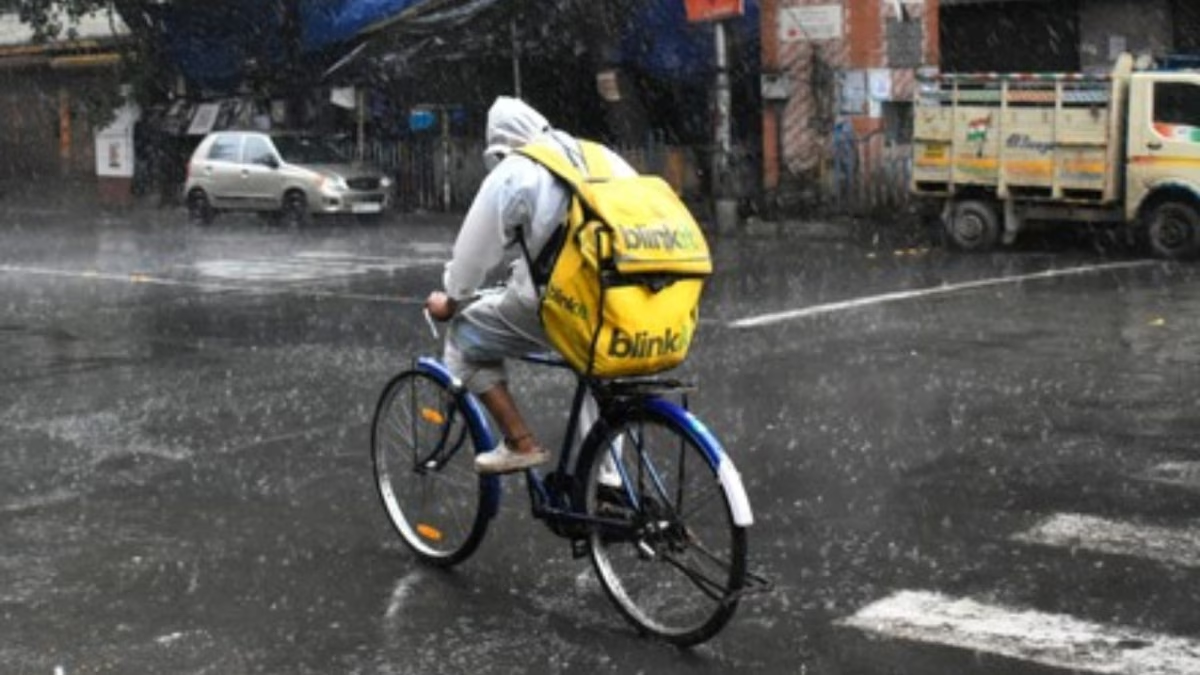
Solidifying its position at the absolute apex of India’s instant retail landscape, Blinkit now commands nearly 50% of the country’s rapid delivery market.
The milestone was confirmed by Deepinder Goyal in a comprehensive interview detailing the sector’s evolving unit economics. According to disclosure metrics, the Zomato-owned pioneer generated a staggering quarterly Net Order Value (NOV) of approximately ₹18,000 crore ($2.15 billion)—a massive figure that effectively matches the combined processing output of all its market competitors combined.
Crucially, the platform has achieved this scale while charting a definitive line toward financial sustainability, distinguishing itself from a hyper-competitive field historically defined by deep capital erosion.
1. The “Burn-to-Earn” Contrast
The most striking aspect of Blinkit’s 50% market capture is its divergence from the operating playbooks of its closest rivals, such as Zepto, Swiggy Instamart, and newer ecosystem entrants like Flipkart Minutes and Amazon.
Goyal characterized competing platforms as remaining heavily locked within a volatile “burn-to-earn mode,” collectively spending an estimated $2 billion in aggressive capital incentives to chase roughly $5 billion to $6 billion worth of net order volume
Blinkit has systematically pulled back on broad subsidies, avoiding zero-fee delivery promotions and deep discount campaigns. By shifting the consumer value proposition from “cheap goods” to sheer reliability and catalog depth, Blinkit is actively generating positive cash flows at scale while its peers continue to leverage heavy venture capital lines to fund basic consumer acquisition.
2. Unpacking the Financial Engine
The market share milestone aligns with an exceptional financial performance sheet registered during the March quarter, showcasing sharp structural improvements in core profitability:
- Adjusted EBITDA Explosion: Blinkit’s adjusted EBITDA surged over 9X to reach ₹37 crore for the quarter, up from a baseline of ₹4 crore in Q3 FY26. This marks an enormous structural turnaround from the year-ago quarter, which saw an adjusted EBITDA loss of ₹178 crore.
- Hyper-Growth in Volume: The platform’s Net Order Value experienced a blistering 95.4% year-on-year expansion to touch ₹14,386 crore within the audited cycle, supported heavily by aggressive geographic and local density optimization.
- The Dark Store Blitz: To insulate its 10-minute delivery promise, Blinkit deployed 216 net new dark stores in the last quarter alone, bringing its active nationwide fulfillment infrastructure to 2,243 dark stores.
3. The 80,000-SKU Moat: Moving Beyond Groceries
The structural secret behind Blinkit’s ability to generate profit while expanding its footprint lies in its comprehensive inventory transformation. The platform has completely shed its legacy identity as an online “neighborhood grocer” dealing strictly in daily essentials like milk, bread, and eggs.
In high-density mature markets like the Delhi National Capital Region (NCR), Blinkit has scaled its active digital storefront to host up to 80,000 unique SKUs (Stock Keeping Units), doubling the 35,000 items it managed just a year ago.
By utilizing highly sophisticated, regional inventory intelligence, individual dark stores dynamically rotate stock to match local demographics. Residential zones prioritize premium beauty, organic produce, and baby care, while corporate hubs are heavily stocked with high-margin electronics, chargers, lifestyle gear, and apparel.
This inventory expansion into premium, high-ticket categories has driven the platform’s Average Order Value (AOV) higher. Because delivering a premium skincare product or an electronic accessory costs virtually the exact same in terms of rider logistics as delivering a carton of milk, these high-margin transactions allow mature markets to close in on steady-state margins of 5% to 6%, handing Blinkit an infrastructure moat that traditional e-commerce giants are finding nearly impossible to cross.
Get the day’s top stories in your inbox
One concise email. No spam, unsubscribe anytime.