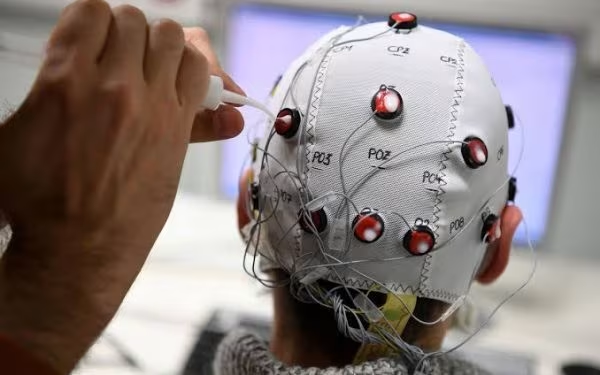
Artificial intelligence tools are becoming deeply integrated into everyday life, but some neuroscientists and cognitive health experts are warning that excessive reliance on AI could reduce mental engagement over time, potentially increasing the risk of cognitive decline if people consistently outsource thinking, memory, and problem-solving. While there is no conclusive evidence that AI directly causes dementia, experts caution that overdependence on AI for routine cognitive tasks may weaken the mental stimulation that helps maintain brain health, particularly among older adults.
Researchers emphasize that AI should be viewed as a tool to augment, rather than replace, human thinking. Activities that challenge the brain—such as learning new skills, solving problems, reading, social interaction, and physical exercise—remain among the most effective ways to support long-term cognitive health.
Experts Warn Against Excessive AI Dependence
Health specialists say the concern is not AI itself, but how people use it.
| Key Highlights | Details |
|---|---|
| Topic | AI and cognitive health |
| Main concern | Overreliance on AI may reduce mental engagement |
| Proven link to dementia? | No direct scientific evidence |
| Expert advice | Use AI to assist, not replace, thinking |
| Best approach | Balance AI use with regular cognitive activity |
Experts stress that current concerns are precautionary rather than definitive scientific conclusions.
Why Cognitive Engagement Matters
The human brain benefits from regular mental stimulation.
Activities linked to healthier cognitive aging include:
- Reading books and articles.
- Learning new languages or skills.
- Solving puzzles and mathematical problems.
- Social interaction.
- Writing and creative work.
- Physical exercise.
Consistently challenging the brain is associated with better cognitive resilience as people age.
How AI Could Affect Mental Habits
Experts suggest excessive AI use may encourage:
- Reduced independent problem-solving.
- Less reliance on memory.
- Fewer opportunities for critical thinking.
- Passive information consumption.
- Greater dependence on automated decision-making.
These changes could reduce the frequency of mentally stimulating activities if AI replaces rather than supports cognitive effort.
What Science Says Today
| Claim | Current Evidence |
|---|---|
| AI directly causes dementia | No evidence |
| Mental stimulation supports brain health | Strong evidence |
| Cognitive inactivity may contribute to decline | Supported by research |
| AI overuse increasing dementia risk | Hypothesis requiring more research |
Researchers say long-term studies will be needed to understand how widespread AI use influences cognition over many years.
Benefits of AI Should Not Be Ignored
AI also offers significant advantages when used appropriately.
Potential benefits include:
- Faster access to information.
- Educational support.
- Improved workplace productivity.
- Assistance for people with disabilities.
- Personalized learning.
- Healthcare support tools.
The objective is to use AI to enhance human capabilities rather than replace them.
How to Use AI Responsibly
Experts recommend maintaining a healthy balance by:
- Solving problems before asking AI.
- Reading original sources instead of only summaries.
- Continuing to write, calculate, and reason independently.
- Exercising regularly.
- Staying socially active.
- Using AI as a learning partner rather than a substitute for thinking.
These habits help preserve cognitive engagement while benefiting from AI-assisted productivity.
Challenges for Researchers
Several questions remain unanswered.
These include:
- How AI changes long-term thinking habits.
- Whether younger generations will develop different cognitive patterns.
- The impact of AI on memory formation.
- Differences between educational and passive AI use.
- Long-term neurological effects of heavy AI dependence.
Further research will be needed before drawing firm conclusions.
Outlook
The growing popularity of AI has sparked important discussions about its long-term impact on human cognition. While experts caution that excessive dependence on AI could reduce opportunities for independent thinking and mental exercise, there is currently no scientific evidence showing that AI use directly causes dementia. Instead, the concern centers on maintaining habits that keep the brain active and engaged.
As AI becomes a routine part of education, work, and daily life, researchers are expected to study how these technologies influence memory, reasoning, and learning over time. The challenge will be finding the right balance—leveraging AI’s productivity benefits without allowing it to replace the cognitive activities that support long-term brain health.
What It Means for Society
The discussion highlights a broader shift in how people interact with technology. Just as calculators changed arithmetic and GPS changed navigation, AI is transforming how individuals search for information, solve problems, and make decisions. Ensuring these tools complement rather than replace human thinking will be important for education, workplaces, and healthcare.
For individuals, the message is not to avoid AI but to use it thoughtfully. Maintaining lifelong learning, critical thinking, physical activity, and social engagement remains among the most evidence-based ways to support cognitive health, regardless of advances in artificial intelligence.
Get the day’s top stories in your inbox
One concise email. No spam, unsubscribe anytime.