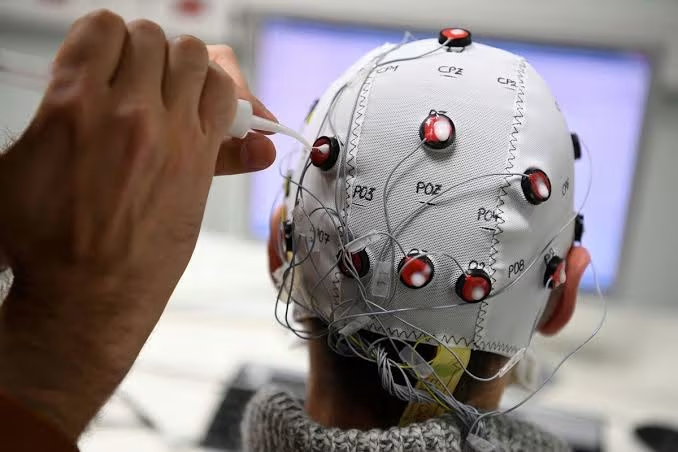
China has completed its first commercial brain-computer interface (BCI) implantation using a device developed by Neuracle Technology, marking a significant milestone in the country’s neurotechnology industry. The implant was successfully placed in a patient as part of the commercial deployment of the company’s BCI system, moving beyond laboratory research and clinical trials toward real-world medical applications.
The achievement positions China among a small group of countries advancing implantable brain-computer interfaces, alongside companies such as Neuralink, Synchron, and Precision Neuroscience. It also reflects Beijing’s growing investment in advanced medical technologies and next-generation human-machine interaction.
China Completes First Commercial BCI Implant
The procedure marks the country’s transition toward commercial brain-computer interface technology.
| Key Highlights | Details |
|---|---|
| Country | China |
| Company | Neuracle Technology |
| Milestone | First commercial BCI implantation |
| Technology | Implantable brain-computer interface |
| Primary goal | Restore communication and motor functions |
The implantation represents an important step in translating BCI research into clinical practice.
What Is a Brain-Computer Interface?
A brain-computer interface enables direct communication between the brain and external devices.
Potential applications include:
- Restoring movement after paralysis.
- Controlling computers using brain signals.
- Communication for patients with severe disabilities.
- Robotic limb control.
- Neurorehabilitation.
- Medical research.
BCIs interpret electrical signals generated by the brain and convert them into digital commands.
About Neuracle’s Technology
While technical specifications remain limited, the company’s platform is designed for:
- High-resolution neural signal recording.
- Real-time brain signal decoding.
- Medical rehabilitation.
- Human-machine interaction.
- Long-term clinical use.
The commercial implantation suggests the technology has progressed beyond early-stage experimental development.
Why This Matters
| Area | Significance |
|---|---|
| Healthcare | New treatment options for neurological disorders |
| Neurotechnology | Commercial deployment of implantable BCIs |
| AI | Improved brain signal interpretation |
| China | Expands leadership in advanced medical technology |
The procedure highlights growing global competition in brain-computer interface development.
Global Race in BCI Technology
Several companies and research organizations are advancing implantable BCIs.
Major players include:
- Neuralink.
- Synchron.
- Precision Neuroscience.
- Neuracle Technology.
- Academic research institutions.
The industry is focused on improving safety, wireless connectivity, signal quality, and long-term reliability.
Potential Medical Applications
Commercial BCI systems could eventually support:
- Patients with spinal cord injuries.
- Stroke rehabilitation.
- ALS (amyotrophic lateral sclerosis).
- Parkinson’s disease research.
- Severe motor impairments.
- Assistive communication technologies.
Many of these applications remain under active clinical development.
Challenges Ahead
Despite rapid progress, several hurdles remain.
These include:
- Long-term implant safety.
- Regulatory approvals.
- Device durability.
- Surgical complexity.
- Ethical considerations.
- Data privacy and security.
Broad clinical adoption will require continued testing to demonstrate long-term effectiveness and reliability.
Outlook
China’s first commercial brain-computer interface implantation represents a significant milestone in the country’s neurotechnology ambitions. By moving beyond research into commercial clinical use, Neuracle Technology joins a growing group of companies seeking to develop practical BCI systems that can improve the lives of patients with severe neurological conditions.
As advances in artificial intelligence, neuroscience, and medical engineering continue to converge, brain-computer interfaces are expected to become an increasingly important area of healthcare innovation. While widespread adoption will depend on clinical evidence, regulatory approvals, and long-term safety, the latest development underscores the accelerating pace of global investment in next-generation neurotechnology.
What It Means for the Neurotechnology Industry
The commercial implantation signals that brain-computer interfaces are gradually transitioning from experimental research to real-world medical applications. Countries and companies are competing to develop systems that are safer, more accurate, and easier to deploy across a wider range of neurological conditions.
For the broader healthcare sector, advances in BCI technology could open new possibilities for restoring communication and mobility for patients with severe disabilities. For the technology industry, the achievement highlights the growing convergence of AI, neuroscience, and medical devices in shaping the future of human-machine interaction.
Get the day’s top stories in your inbox
One concise email. No spam, unsubscribe anytime.