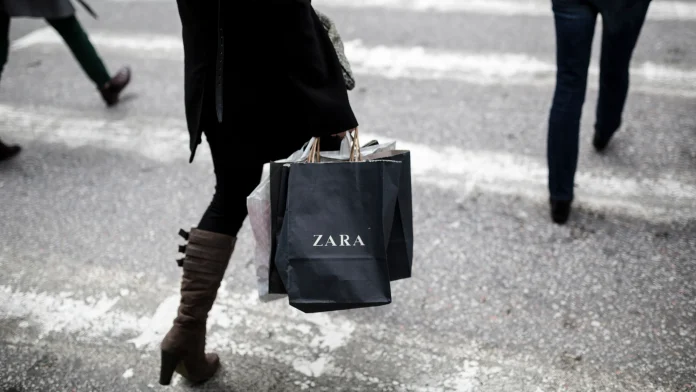


Signaling a sharp structural slowdown for international apparel giants operating in India’s premium retail sector, global fast-fashion powerhouse Zara has posted a 31.9% drop in its domestic net profit for the financial year ended March 31, 2026.
According to the latest integrated annual report published by Tata Group’s retail arm, Trent Ltd, Zara’s localized net profit plummeted to ₹204.14 crore in FY26. This marks a severe contraction from the ₹299.84 crore net profit recorded by the brand during the previous fiscal cycle, representing Zara’s weakest financial performance in the Indian market since the pandemic-disrupted years.
Topline Contraction: Sales Face Post-Pandemic Floor
The earnings report highlights that the fast-fashion pioneer is hitting a distinct structural plateau in India, where years of rapid, double-digit growth are giving way to flatlining sales:
- Operating Revenue Slide: Total revenue from operations slipped by 1.1% year-on-year to finish at ₹2,749.28 crore for FY26, down from the ₹2,782.06 crore baseline established in FY25.
- Total Income Inversion: Total income for the year compressed to ₹2,767.75 crore, compared to ₹2,839.50 crore clocked in the prior twelve-month cycle.
- Footprint Stagnation: The brand’s retail engine currently navigates the country through a highly selective, conservative network of just 22 active flagship stores.
Market analysts attribute the performance dip to a combination of intensifying competitive pressures and premium real estate headcounts. While Zara has deliberately avoided mass-market expansions to protect its premium positioning, global fast-fashion rivals like Sweden’s H&M and Japan’s Uniqlo have been aggressively building out physical stores and digital pipelines across tier-1 and tier-2 Indian metro hubs. Concurrently, premium digital-first domestic brands and homegrown boutique labels are eating into urban discretionary fashion spending.
Corporate Realignment: Trent Pares Down Joint Venture Stake
The sharp operational downturn directly coincided with a significant corporate restructuring between Zara’s parent entity and its domestic partner.
The brand is managed in India via Inditex Trent Retail India Private Limited (ITRIPL)—a long-standing joint venture between Spain’s fashion retail conglomerate Inditex and the Tata Group’s Trent Ltd. During the course of FY26, ITRIPL executed a formal equity buyback scheme. Trent opted to participate in the buyback program, tendering 94,900 equity shares back to the venture.
Consequently, Trent has systematically reduced its financial stake in ITRIPL down to a flat 20%. In its disclosures, the Tata retail firm noted that because primary merchandise sourcing, product selection, and brand architecture decisions remain completely at the discretion of Inditex’s headquarters in Spain, the joint venture is viewed primarily as a financial investment portfolio rather than a core strategic operating asset.
The Premium Paradox: Massimo Dutti Defies the Trend
Interestingly, Inditex’s secondary luxury asset in India completely decoupled from Zara’s downward trend to register a highly profitable fiscal year.
Massimo Dutti India Private Limited—the separate joint venture brand focused on high-end, quiet luxury premium tailoring where Trent also maintains a tight 20% stake—staged an aggressive growth sprint:
- Massimo Dutti Revenues: Surged by an exceptional 27.97% year-on-year to touch ₹128.45 crore.
- Massimo Dutti Profits: Escalated by 13.86% to settle at ₹11.66 crore for the fiscal year ended March 2026.
The divergence between the two sister brands suggests a distinct polarization occurring within Indian malls. While the mid-to-high fast-fashion segment handled by Zara is feeling the pinch of hyper-competition and shifting Gen-Z shopping alternatives, ultra-premium, high-ticket lifestyle concepts like Massimo Dutti are successfully drawing continuous interest from high-net-worth urban consumers.
Moving into the latter half of 2026, Inditex plans to adapt its domestic strategy by introducing alternative sister labels like Bershka and Zara Home to diversify its footprint and reclaim its historic retail dominance.