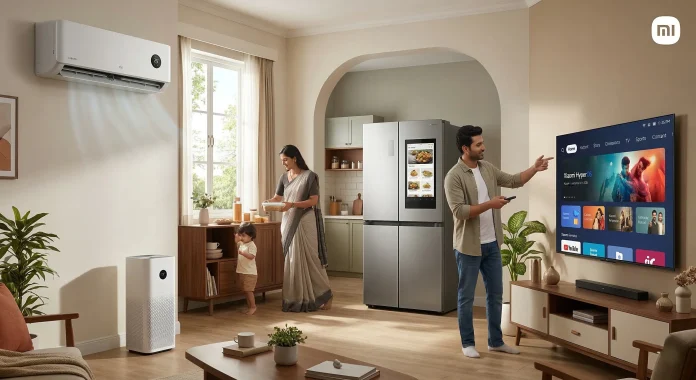


To combat slowing growth and saturation in its core smartphone business, Xiaomi is initiating a strategic pivot in India by officially entering the large home appliances market.
The company is scaling up its ecosystem beyond smartphones, tablets, and smart TVs, targeting India’s rapidly growing consumer durables market with a major localization and restructuring campaign.
1. The Product Roadmap: Smart Large Appliances
While Xiaomi has previously sold smaller smart home products (like air purifiers and robot vacuums) in India, its upcoming push focuses heavily on large home appliances, slated to hit the market in the second half of 2026.
- The Portfolio: The expansion will introduce smart air conditioners, refrigerators, and washing machines—categories where Xiaomi already commands a massive market share in China and parts of Southeast Asia.
- The Ecosystem Edge: Xiaomi aims to differentiate itself from traditional brands through its tech-first approach. The appliances are expected to feature AI-driven energy optimization, high-end touchscreen interfaces (such as cross-door refrigerators with internal cameras), and seamless integration via its unified HyperOS smart home ecosystem.
2. Setting Up an Indian “South Asia” Headquarters
To support this expansion and streamline execution, Xiaomi has restructured its regional corporate architecture:
- The New Command Hub: India has been elevated to serve as the operational headquarters for Xiaomi’s entire South Asia region, taking over administrative duties that were previously managed directly out of Beijing. This hub will oversee business operations across India, Bangladesh, Sri Lanka, and Nepal.
- Leadership Transition: Xiaomi has appointed Alex Tang (formerly GM of Southeast Asia) as the new General Manager for South Asia. Tang was specifically chosen because he successfully spearheaded Xiaomi’s large appliances expansion across Southeast Asia—the first market outside China where the company localized its heavy home electronics.
3. The Local Manufacturing Shift
Unlike past attempts to introduce niche ecosystem products via imports—which often faced regulatory delays and supply chain friction—Xiaomi is emphasizing a strict localization mandate for this rollout.
- EMS Partnerships: The company’s product teams are actively vetting local Electronics Manufacturing Services (EMS) partners in India.
- Technology Transfer: Xiaomi plans to execute full technology transfers to enable domestic partners to manufacture complex large appliances within India, helping the brand stay price-competitive and comply with local manufacturing policies.
- Testing for Indian Conditions: To prepare for the launch, the company is conducting localized product testing to ensure its heavy appliances can handle unique domestic challenges, including extreme weather climates and frequent power voltage fluctuations.
4. The Competitive Battleground
Xiaomi’s entry sets up an aggressive corporate battle in India’s consumer durables market, which is projected to reach nearly ₹3 lakh crore by FY29.
The company will face direct competition on two main fronts:
- Entrenched Legacy Giants: Established market leaders like LG, Samsung, Voltas, Havells, and Godrej possess deeply rooted distribution networks and robust after-sales service infrastructures that have taken decades to build.
- The Value Sector Realignment: Other global giants are simultaneously resetting their strategies. For example, BSH Home Appliances (Bosch and Siemens) has fundamentally lowered its entry-level pricing structure and raised localization targets to 90% to aggressively target the exact mid-market and Tier-2/Tier-3 town consumers Xiaomi hopes to capture.