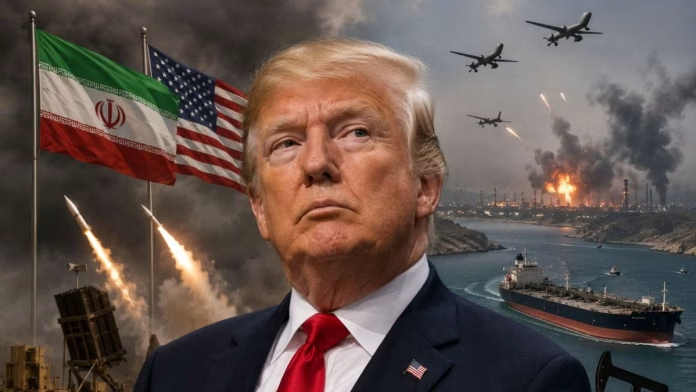


U.S. President Donald Trump has warned that the United States will impose its own maritime tolls in the Strait of Hormuz if a final, comprehensive peace deal with Iran is not hammered out within the designated 60-day window.
The threat, delivered via a series of social media posts, has injected fresh volatility into global energy markets just days after Washington and Tehran signed a landmark 14-point memorandum of understanding (MOU) to halt active military hostilities and lift the naval blockade.
The “Guardian Angel” Provision
Trump sought to counter domestic political pushback regarding the terms of the interim agreement, specifically addressing critics who pointed out that the MOU only guarantees toll-free transit for the immediate 60 days.
- The Stance: Trump clarified that while there will be no tolls during the ceasefire or after the 60 days if a final deal is locked in, the U.S. reserves the right to levy its own transit fees if negotiations collapse.
- The Justification: Trump stated that any subsequent U.S.-imposed tolls would serve as reimbursement for “services rendered as the Guardian Angel to the countries of the Middle East,” citing past, present, and future American military expenditures to keep the strategic waterway secure.
A Fragile 60-Day Countdown
The toll threat comes as high-level diplomatic delegations converge on Switzerland to begin hammering out a permanent treaty. Led by Vice President JD Vance alongside top negotiators Jared Kushner and Middle East Special Envoy Steve Witkoff, the upcoming technical talks are slated to tackle highly intricate geopolitical friction points:
- The Nuclear Priority: Washington is demanding strict, upfront caps and verifiable rollbacks on Iran’s nuclear enrichment capabilities.
- Sanctions vs. Performance: While initial sanctions waivers on Iranian oil transportation and insurance have gone into effect, a proposed $300 billion international reconstruction fund for Iran remains strictly “tied to performance” and compliance.
- Regional Ceasefires: The broader framework is heavily contingent on a sustained cessation of hostilities across the region, putting immense pressure on the highly fragile truce between Israel and Hezbollah in Lebanon.
Escalation on the Water
Underscoring just how tense the region remains, Iran’s Islamic Revolutionary Guard Corps (IRGC) separately declared the Strait of Hormuz “closed” over the weekend, alleging Israeli violations of the Lebanon truce and claiming the U.S. failed to enforce initial ceasefire terms.
Despite Iran’s rhetorical closure and warnings for merchant vessels to stay away, U.S. Central Command (CENTCOM) confirmed that American naval assets successfully escorted 55 commercial ships through the passage on Saturday alone—safeguarding the transit of more than 17 million barrels of crude oil.
While the interim deal has successfully restarted commercial shipping lanes and brought oil prices down from their wartime peaks, Trump’s explicit ultimatum establishes a rigid, two-month clock for negotiators. The global shipping industry now faces the unprecedented prospect of paying direct military toll fees to the U.S. Navy to pass through the world’s most critical energy chokepoint come August if diplomacy fails.