
Thinking Machines Lab, the AI startup founded by former OpenAI CTO Mira Murati, has officially released Inkling, its first open-weight foundation model. The launch marks the company’s debut in the frontier AI model race, positioning Inkling as a customizable alternative to proprietary systems from OpenAI, Anthropic, and Google, while also competing with open-weight models from Chinese AI labs.
Inkling is a 975-billion-parameter Mixture-of-Experts (MoE) model, though only 41 billion parameters are activated for each inference, significantly reducing computational costs while maintaining strong performance. The model supports text, image, audio, and video inputs, and its weights are publicly available, allowing developers and enterprises to download, fine-tune, and deploy the model on their own infrastructure.
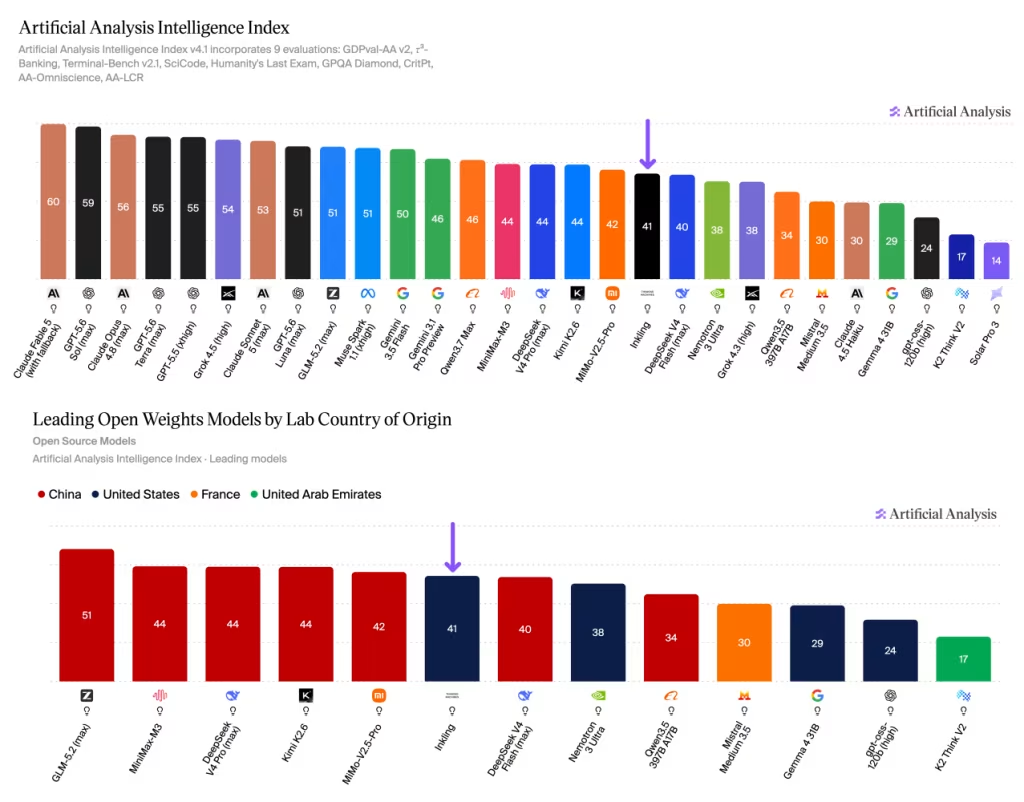
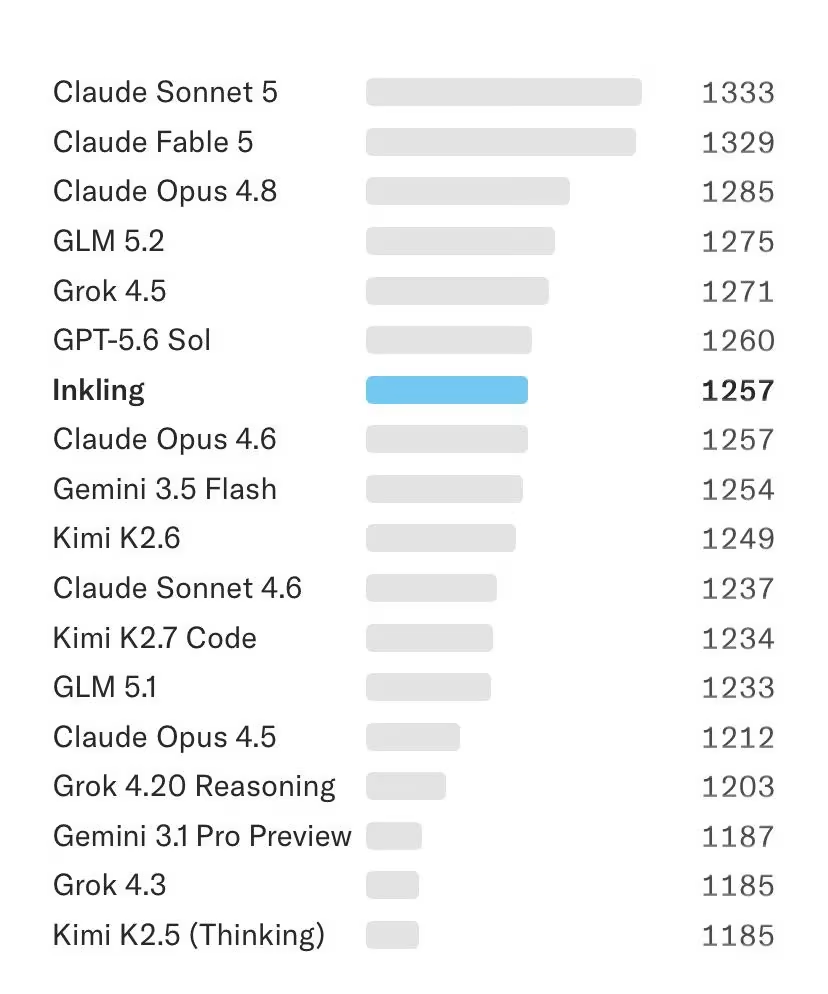
Thinking Machines Debuts Its First AI Model
Inkling is designed to give enterprises greater control over AI deployments.
| Key Highlights | Details |
|---|---|
| Company | Thinking Machines Lab |
| Founder | Mira Murati |
| Model | Inkling |
| Model type | Open-weight multimodal AI |
| Parameters | 975B total, 41B active |
| Availability | Downloadable open weights |
The release is the startup’s first major product since raising $2 billion at a $12 billion valuation in 2025.
What Makes Inkling Different?
Unlike closed commercial AI models, Inkling provides developers with direct access to its model weights.
Key capabilities include:
- Open-weight architecture.
- Multimodal understanding.
- Enterprise fine-tuning.
- Agent-oriented workflows.
- On-premises deployment.
- Custom AI development.
Organizations can modify and retrain the model to suit their own applications rather than relying solely on hosted APIs.
Mixture-of-Experts Architecture
Inkling uses a Mixture-of-Experts (MoE) design.
| Feature | Benefit |
|---|---|
| 975B total parameters | Large knowledge capacity |
| 41B active parameters | Lower inference cost |
| Open weights | Full customization |
| Multimodal inputs | Text, images, audio and video |
By activating only a subset of parameters for each request, the model aims to improve efficiency while maintaining strong performance.
Enterprise-Focused Strategy
Thinking Machines is targeting organizations that want greater ownership of their AI infrastructure.
Potential use cases include:
- Enterprise copilots.
- AI coding assistants.
- Customer support automation.
- Knowledge management.
- Internal search systems.
- Autonomous AI agents.
The company also offers Tinker, a platform that allows enterprises to fine-tune Inkling for specialized workloads.
Competing With Frontier AI Models
Inkling enters an increasingly crowded AI market.
Major competitors include:
- OpenAI GPT models.
- Anthropic Claude.
- Google Gemini.
- DeepSeek.
- Moonshot AI Kimi.
- Meta’s Llama family.
Rather than focusing solely on benchmark leadership, Thinking Machines says its strategy emphasizes customization, openness, and enterprise deployment flexibility.
Open Weights vs Closed Models
| Open-weight models | Closed proprietary models |
|---|---|
| Downloadable weights | API-only access |
| Enterprise customization | Limited modification |
| Self-hosting supported | Vendor-managed infrastructure |
| Greater deployment flexibility | Managed service experience |
The release reflects growing enterprise demand for AI models that organizations can fully control and adapt to their own environments.
Challenges Ahead
Despite its ambitious launch, Thinking Machines faces several hurdles.
These include:
- Competing with established frontier AI labs.
- Demonstrating benchmark leadership.
- Building a developer ecosystem.
- Scaling enterprise adoption.
- Supporting long-term model updates.
- Managing infrastructure costs.
Success will depend not only on technical performance but also on attracting developers and enterprise customers.
Outlook
Inkling marks an important milestone for Thinking Machines Lab, transforming the company from one of the AI industry’s most highly funded startups into a producer of frontier AI models. By releasing its first model with open weights, the company is betting that enterprises increasingly value transparency, customizability, and deployment flexibility over purely closed, API-based AI systems.
The launch also intensifies competition in the open-weight AI ecosystem, where Western developers have recently faced stronger competition from Chinese AI companies. If Inkling delivers competitive performance while remaining efficient and customizable, it could become an attractive option for businesses seeking greater control over their AI infrastructure.
What It Means for the AI Industry
Inkling’s debut reinforces the growing momentum behind open-weight AI models. Rather than depending entirely on proprietary cloud-hosted systems, many enterprises now prefer models they can inspect, fine-tune, and deploy within their own environments for reasons including cost, privacy, compliance, and customization.
For the broader AI ecosystem, the release adds another major player to the frontier model race and highlights the industry’s shift toward balancing model capability with openness and enterprise control. As more organizations adopt AI at scale, open-weight models are likely to play an increasingly important role alongside proprietary offerings.
Get the day’s top stories in your inbox
One concise email. No spam, unsubscribe anytime.