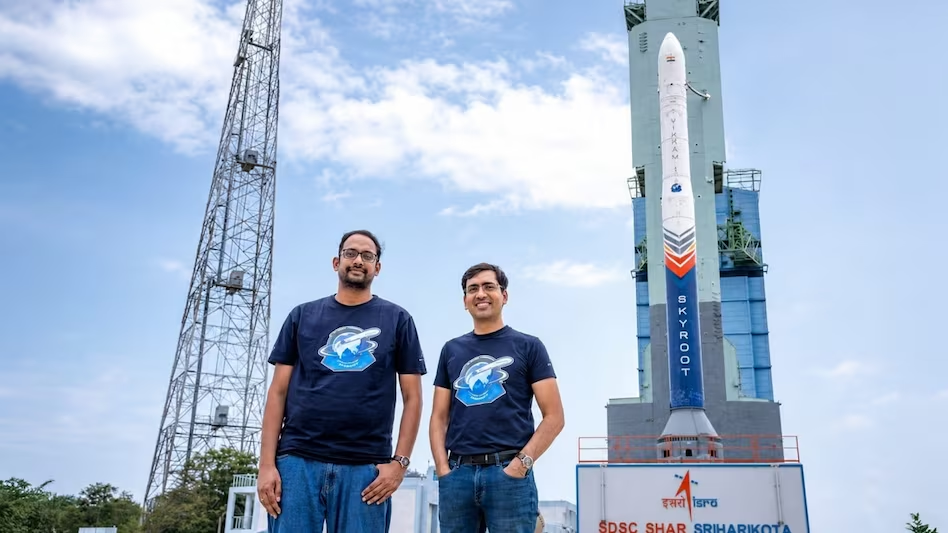
Skyroot Aerospace funding is the fresh money and backing the Indian rocket startup needs to build, test, and launch more often. Skyroot Aerospace funding matters because rockets cost a lot before they earn a rupee. The company now sits at a key stage. It has proved it can launch once, but it must show it can do it again and at scale.
Key takeaways
- Skyroot is moving from early promise to the harder phase of repeat launches.
- New funding could help it build rockets faster, hire talent, and win customers.
- India’s private space market is growing, but rocket businesses still burn cash.
- The big test is not one launch. It is a steady launch schedule.
Why is Skyroot Aerospace funding in the spotlight now?
Skyroot made history in 2022 with Vikram-S, the first privately built Indian rocket to fly. That was a suborbital launch. A suborbital launch goes up to space but does not circle Earth. It was a big moment, but it was only the start.
Now the company needs to turn that first win into a real business. That means bigger rockets, more tests, and regular launches for paying clients. So investors are watching the next funding round closely. They want to know if Skyroot can move from a cool demo to a working launch service.
Rocket startups often need years of spending before strong sales arrive. In simple terms, they pay now and hope to earn later. Engines, fuel systems, software, launch pads, and safety checks all cost money. One delay can push plans back by months.
What does Skyroot actually do?
Skyroot builds launch vehicles, which are rockets that carry satellites into space. A satellite is a machine that circles Earth and sends data. These can help with maps, weather, farming, phones, defence, and internet services.
Its Vikram rocket family aims to serve the small satellite market. Small satellites can weigh from a few kilos to a few hundred kilos. They are cheaper than older, giant satellites. Because of that, more companies and governments want launches that fit smaller payloads.
Skyroot has also talked about using 3D-printed parts. That means some rocket pieces are made layer by layer by machines. This can cut build time and reduce part counts. In theory, that makes rockets faster and cheaper to produce.
Why do rocket startups need so much money?
Space is exciting, but it is brutal on budgets. A rocket must work in extreme heat, pressure, and vibration. If one part fails, the whole mission can fail. So teams must test again and again before launch day.
That is why Skyroot Aerospace funding matters more than a normal startup round. A food app can change code in a week. A rocket company may need months to test one engine. In fact, many space firms spend hundreds of millions of dollars before they become stable.
Here is the simple picture: build, test, fail, fix, repeat. Then do it all again. That cycle eats cash, but it is the only safe way to reach orbit. Orbit means a path around Earth where a satellite keeps circling.
Space startup pathBuildTestLaunchHigher cost and risk
How big is the India space opportunity?
India’s space economy is still small compared with the US, but it is growing fast. The Indian government has opened the sector to private firms in recent years. That change matters because startups can now build, test, and sell more directly.
Official and industry estimates often place India’s space economy near $8 billion today. Some projections say it could reach $40 billion or more by 2040. Forecasts are not guarantees, of course. But they show why investors care.
The number that matters most right now is launch demand. Global satellite launches have jumped as companies build bigger networks. For example, Earth observation firms use satellites to watch crops, roads, and borders. Telecom groups use them to connect remote areas.
India also wants a larger share of the global launch market. That market includes putting satellites into orbit for a fee. ISRO, India’s space agency, built the base. Private firms like Skyroot now want to turn that base into a broad business ecosystem.
What makes this the hard phase for Skyroot?
Getting noticed is hard. Staying trusted is harder. One successful mission can prove skill, but customers usually want a repeatable record. They ask simple questions: Can you launch on time? Can you do it safely? Can you keep prices competitive?
That is where Skyroot Aerospace funding becomes more than a headline. It is fuel for the next proof points. The company needs to show progress on orbital launches, customer bookings, and production speed. Each one tells investors the business is getting real.
A term you may hear is cadence. Launch cadence means how often a company can launch. In space, cadence is a huge deal because customers do not want to wait forever. A rocket that is cheap but always late may still lose business.
| What Skyroot needs | Why it matters |
|---|---|
| More funding | Pays for testing, staff, and rocket production |
| Orbital launch success | Shows it can place satellites around Earth |
| Better launch cadence | Helps win repeat customers |
| Commercial orders | Turns engineering progress into revenue |
How does Skyroot compare with India’s wider startup push?
India has seen strong interest in deep-tech startups. Deep tech means firms built on hard science and engineering. But deep-tech money is tougher to raise than money for consumer apps. Investors wait longer for returns, so they ask stricter questions.
That is true across new industries. For example, chipmaking also needs heavy spending before payoff, which is why policymakers talk about crossing a “psychological bridge” in semiconductors. The same mood exists in space. Once one company proves a model, others get taken more seriously.
Readers tracking India’s industrial push may also want the bigger economic backdrop. Core sectors have shown mixed but important momentum in recent months, as we explained in our report on core infrastructure growth. Government support for critical sectors can shape investor confidence.
There is also a finance angle. India’s external funding tools matter because capital-heavy sectors need money that is patient and reliable. For context, see our explainer on the RBI swap facility, which looked at how the central bank drew in $20.72 billion.
What should readers watch next?
Watch for three things. First, the size and timing of the next round. A large round would suggest strong investor trust. Second, watch for test milestones on the Vikram series. Third, look for customer names and launch contracts.
If Skyroot can show all three, the story changes fast. It stops being only about promise. It becomes about execution, which means doing the hard work on schedule. That is the point where serious space businesses start to stand out.
For primary background on India’s private space framework, readers can check ISRO and IN-SPACe. Both help explain how the sector is being opened and regulated. Regulation means the rules companies must follow.
Skyroot’s next chapter is simple to describe but hard to deliver: it must turn one headline-grabbing launch into a steady rocket business with repeat launches, paying customers, and enough cash to survive the long build.
FAQs
What is Skyroot Aerospace funding?
Skyroot Aerospace funding is the money the startup raises from investors. It helps pay for rocket design, tests, staff, and launches.
Why does Skyroot need more money after one launch?
Because one launch is only proof of concept. Proof of concept means an early demo that shows an idea can work. Real space businesses need many launches.
How is Skyroot different from ISRO?
ISRO is India’s national space agency. Skyroot is a private company. Skyroot can sell launch services commercially, while ISRO has broader national missions too.
When will Skyroot’s next big test matter most?
It will matter most when the company tries regular orbital launches. That is the stage where customers, investors, and rivals all start judging performance closely.
Get the day’s top stories in your inbox
One concise email. No spam, unsubscribe anytime.