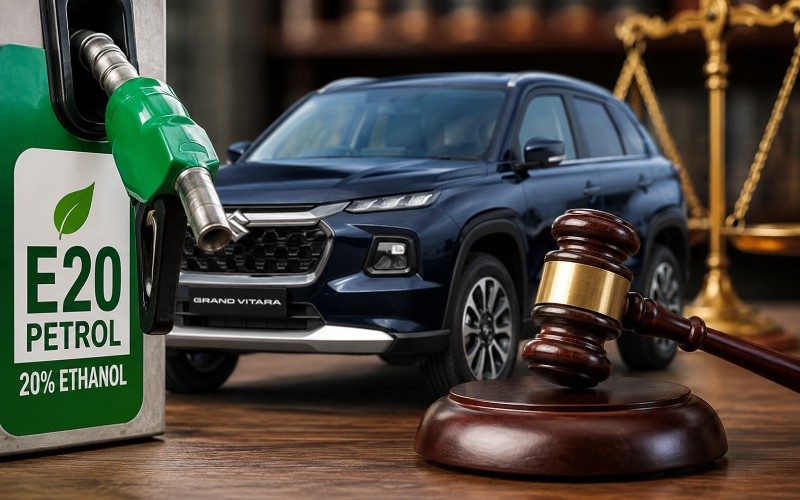
Maruti Suzuki India has announced that it will challenge a landmark order issued by the District Consumer Disputes Redressal Commission in Raipur, which directed the automaker to replace a customer’s Grand Vitara Strong Hybrid with a new E20-compatible vehicle or refund the full purchase price. The company maintains that the SUV was already certified as E20-compatible and argues that fuel contamination—not the vehicle—caused the reported mechanical issues.
The case has attracted nationwide attention because it is widely regarded as India’s first major consumer court ruling linked to E20 fuel compatibility, arriving amid the government’s ongoing rollout of 20% ethanol-blended petrol. The verdict could have significant implications for automakers, fuel suppliers, and consumers as India accelerates its ethanol blending programme.
Key Highlights
| Key Highlights | Details |
|---|---|
| Company | Maruti Suzuki India |
| Court | District Consumer Disputes Redressal Commission, Raipur |
| Vehicle | Grand Vitara Strong Hybrid |
| Court order | Replace vehicle or refund around ₹20.5 lakh |
| Company’s response | Will challenge the order |
| Main argument | Vehicle was already E20-compatible; fuel contamination caused the issue |
What the Consumer Court Ordered
The Raipur consumer commission ruled in favor of the customer, directing Maruti Suzuki and its authorized dealer to:
- Replace the existing Grand Vitara with a new E20-compatible vehicle, or
- Refund approximately ₹20.5 lakh, including registration and insurance costs.
- Comply with the order within the stipulated period specified by the commission.
The complaint alleged that the SUV developed repeated technical problems after being fuelled with E20 petrol, and the commission concluded that the customer was entitled to relief.
Maruti Suzuki’s Stand
Maruti Suzuki has rejected the findings of the commission and said it intends to appeal before a higher forum.
According to the company:
- The Grand Vitara involved was already E20-compatible.
- The vehicle’s owner’s manual clearly stated its E20 compatibility.
- Laboratory evidence indicated contamination in the fuel collected from the vehicle.
- Several material facts were allegedly not reflected in the commission’s order.
The company has stated that it will pursue all available legal remedies under the law.
Why This Case Is Significant
| Issue | Potential Impact |
|---|---|
| E20 fuel compatibility | First major consumer ruling on the issue |
| Consumer protection | May influence future complaints involving ethanol-blended fuel |
| Auto industry | Greater scrutiny of vehicle compatibility claims |
| Ethanol programme | Could shape implementation of India’s E20 rollout |
Legal experts believe the case could become an important precedent as E20 petrol becomes more widely available across the country.
Understanding E20 Fuel
E20 petrol contains:
- 20% ethanol
- 80% petrol
The Indian government is promoting E20 fuel to:
- Reduce crude oil imports.
- Lower carbon emissions.
- Increase demand for domestically produced ethanol.
- Support farmers through higher ethanol procurement.
- Improve energy security.
Automakers have maintained that vehicles certified as E20-compatible are designed to operate safely on fuel meeting prescribed quality standards.
Potential Industry Implications
If upheld by higher courts, the ruling could have broad implications.
Possible outcomes include:
- Increased consumer litigation involving E20 fuel.
- Greater documentation of vehicle compatibility.
- More rigorous quality checks on fuel supplied at retail outlets.
- Stronger coordination between automakers and fuel companies.
- Enhanced disclosure requirements for consumers.
The appeal is therefore expected to be closely watched by the automobile industry and policymakers alike.
Challenges Ahead
Several questions remain unresolved.
These include:
- Whether fuel contamination or vehicle compatibility caused the damage.
- The standard of evidence required in future E20-related disputes.
- Responsibility between automakers and fuel retailers.
- Consumer awareness regarding E20-compatible vehicles.
- Consistency in fuel quality across filling stations.
- Balancing consumer protection with India’s ethanol blending goals.
These issues are likely to be examined further during the appellate proceedings.
Outlook
Maruti Suzuki’s decision to challenge the Raipur consumer court order sets the stage for what could become one of India’s most closely watched legal disputes involving ethanol-blended fuel. The outcome of the appeal may help clarify liability standards for automakers, fuel suppliers, and consumers as E20 petrol becomes the national standard.
Regardless of the final verdict, the case highlights the importance of vehicle compatibility, fuel quality, and transparent consumer disclosures during India’s transition to higher ethanol blending. It may also influence future regulatory guidelines governing E20 certification and dispute resolution.
What It Means for India’s Auto Industry
The Raipur case marks a pivotal moment in India’s shift toward cleaner transportation fuels. As E20 petrol becomes increasingly common, automakers will face greater scrutiny over compatibility claims, while fuel suppliers may be expected to maintain stricter quality assurance standards.
For consumers, the case underscores the importance of understanding manufacturer specifications and maintaining service records when fuel-related issues arise. For the industry, the eventual appellate ruling could establish an important legal precedent governing future disputes involving ethanol-blended fuels, potentially shaping product development, warranty policies, and regulatory compliance across the automotive sector.
Get the day’s top stories in your inbox
One concise email. No spam, unsubscribe anytime.