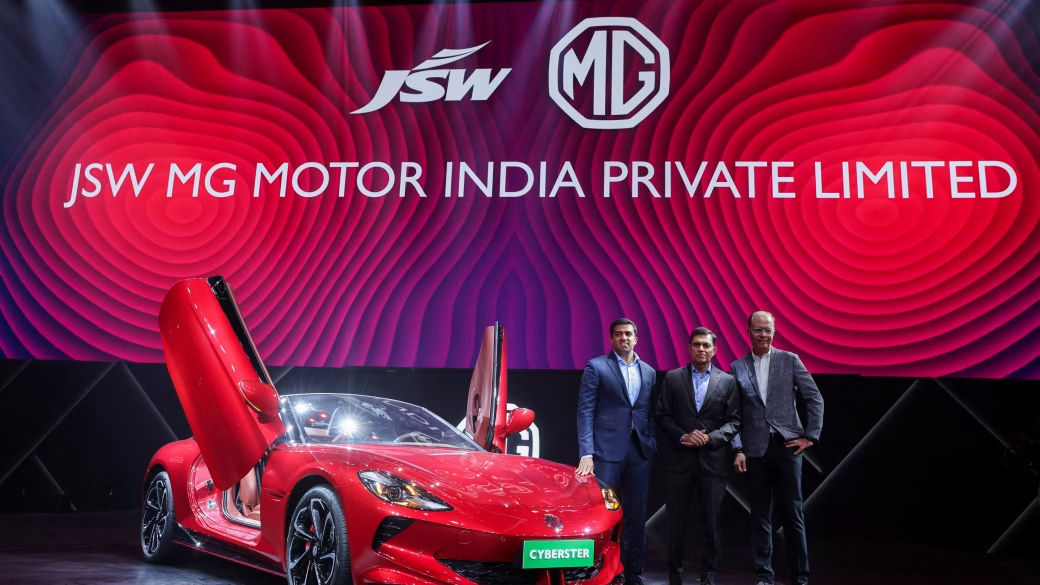
US private equity giant KKR is in advanced talks to invest up to $400 million (approx. ₹3,350 crore) in JSW MG Motor India, according to The Economic Times.
The marquee deal is structured to value the automaker at $3 billion, marking a 100% valuation premium since the joint venture was established in March 2024. If finalized, this will represent the first round of external equity fundraising for the company and only the second major global institutional equity infusion into the Indian EV sector, following TPG and Mubadala’s $1 billion bet on Tata Motors’ EV arm in 2021.
1. Structure of the Proposed Deal
The $400 million investment is not entirely a primary injection; instead, it is a dual-track financial layout designed to reorganize the company’s internal shareholding cap table:
- Primary Capital Growth: A portion of the funds will flow straight into JSW MG Motor’s balance sheet as fresh equity to finance its upcoming capital expenditure pipeline.
- The Chinese Stake Sell-Down (Secondary Transaction): The remaining capital will fund a secondary share purchase from Chinese state-owned automaker SAIC Motor. SAIC is looking to pare down its holdings in the India venture as it prioritizes its domestic Chinese market and European operations, navigating tightening local regulatory friction on Chinese-linked capital inflows.
- JSW Becomes the Controlling Anchor: Following the sell-down by SAIC (which entered the JV holding a 49% stake), the Sajjan Jindal-led JSW Group is poised to emerge as the single-largest shareholder in the automotive brand.
2. Financed for Production Scaling
The primary equity portion of KKR’s investment will plug straight into a ₹3,700-crore capital expenditure layout planned by the automaker over the next two years. The capital is strictly earmarked for heavy manufacturing expansion at its primary hub in Halol, Gujarat:
Plaintext
[ INFRASTRUCTURE EXPANSION TIMELINE ]

Current Production Baseline ──► 120,000 units annually (Halol Plant 1)
                                      │
                                      ▼ (Capex Injection: Plant 2 Construction)
Target Production Capacity  ──► 300,000 units annually (By CY2027)
Alongside the physical plant layout, the board has approved a mandate to push structural localization levels above 70% across both internal combustion engine (ICE) and EV platforms to aggressively immunize its supply chain against global trade bottlenecks.
3. Strong Volume Growth vs. Financial Pressures
KKR’s entry coincides with phenomenal retail momentum for the brand’s electric vehicles, specifically driven by the rapid market adoption of its Windsor EV and its innovative “Battery-as-a-Service” (BaaS) leasing framework, which slashes upfront EV purchasing hurdles by letting consumers rent batteries dynamically at ₹3.5 per kilometer.
The latest financial and volume scorecards showcase a business scaling rapidly despite short-term margin friction:
| Performance Metric | Historical Baseline (FY25) | Recent Fiscal Performance (FY26) |
| Annual Revenue | ₹79.0 billion | ₹87.8 billion (~$1.05 Billion) |
| Net Operational Balance | ₹5.86 billion Loss | ₹10.96 billion Loss (Driven by heavy expansion costs) |
| Annual EV Volume Sales | ~30,600 units | 53,089 units (A massive 73% YoY surge) |
| EV Volume Product Mix | ~35% of total sales | Over 75% of total sales (As of June 2026 data) |
The Geopolitical Tailwinds: Market tracking data points to a sharp 20–25% surge in alternative-fuel vehicle demand in mid-2026. This macro tailwind is heavily influenced by West Asian geopolitical disruptions pushing local diesel and petrol pricing up, driving a wider swathe of Indian consumers to secure electric and hybrid passenger cars.
While JSW MG Motor India remains the country’s third-largest electric passenger vehicle manufacturer overall, its market share during the first two months of FY27 saw a temporary compression down to 19.8% (from 29.8% a year prior) due to a temporary gap in new model launches. The KKR capital cushion is positioned precisely to reverse this trend, giving the company the financial muscle to rapidly launch a pipeline of next-generation high-localization New Energy Vehicles (NEVs) ahead of the festive season.
KKR Investment and India’s EV Shift Analysis
This business breakdown details how KKR’s proposed multi-million dollar transaction facilitates the replacement of Chinese state capital with Western private equity amid India’s broader green transition.
Get the day’s top stories in your inbox
One concise email. No spam, unsubscribe anytime.