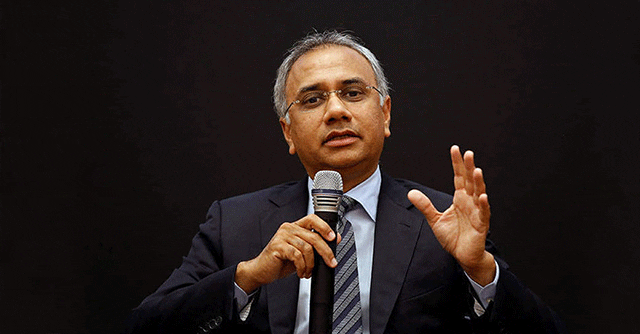
Solidifying his standing as one of the highest-paid corporate leaders in the Indian technology landscape, Infosys Chief Executive Officer and Managing Director Salil Parekh received a total compensation of ₹82.6 crore for the financial year 2025–26.
According to the IT major’s newly released integrated annual report, Parekh’s total package logged a modest 2.5% increase from the ₹80.62 crore compensation sheet filed during the preceding fiscal year. The executive disclosure comes at a milestone operational juncture for the Bengaluru-headquartered firm, which officially crossed the $20 billion annual revenue threshold for the first time in its corporate history.
Dissecting the Compensation Matrix: Stock Incentives Dominate
Reflecting standard institutional governance frameworks designed to tie executive wealth directly to cumulative shareholder returns, the absolute majority of Parekh’s compensation was driven by long-term equity performance rather than basic cash components:
- Fixed Salary & Retirals: His baseline fixed salary stood at ₹8.50 crore, which encompasses a base pay component of ₹7.97 crore and core retirement benefits totaling ₹0.53 crore.
- Variable Compensation: Bonuses, direct performance incentives, and variable execution payouts accounted for ₹23.35 crore.
- Exercised Stock Options (RSUs): The largest singular weight in the package came via the perquisite value of exercised Restricted Stock Units (RSUs), translating to a massive ₹50.75 crore.
During the fiscal year, Parekh exercised 2,72,400 RSUs under the company’s legacy 2015 stock incentive plan alongside 64,690 units tied to the 2019 scheme. Furthermore, to secure his alignment with forward-looking corporate goals, the board authorized fresh equity grants linked directly to business milestones, environmental, social, and governance (ESG) targets, and long-term shareholder return metrics.
The Pay Ratio Disconnect: 742x the Median Employee Salary
The publication of the compensation matrix has turned fresh attention toward structural income distribution gaps across the domestic software export sector.
The annual report explicitly notes that after factoring in the realized gains from exercised stock awards, Parekh’s total remuneration package commands a ratio 742 times the Median Remuneration of Employees (MRE) at Infosys. If stock option execution events are completely isolated from the calculation, the operational pay gap scales down to a more standard 289 times the median worker baseline.
Concurrently, the median compensation for an average Infosys employee ticked up by 4% to settle at ₹11,13,024 (up from ₹10,72,008 in FY25). When accounting for structured mid-career promotions and localized compensation corrections, the average annual salary increase for active staff stationed inside India tracked at roughly 11%.
The data highlights a highly distinct executive compensation strategy compared to its largest domestic rival, Tata Consultancy Services (TCS). While TCS operates at a vastly superior overall revenue and net profit profile, its CEO, K Krithivasan, received a comparatively conservative ₹28 crore package for FY26—meaning Parekh took home nearly triple the compensation of his TCS counterpart due to Infosys’ heavy structural reliance on stock-linked wealth generation.
Operational Health: Navigating the “AI-First” Macro Pivot
The financial backdrop supporting Parekh’s performance metrics indicates structural resilience despite a highly compressed corporate spending environment across Western banking and retail sectors. For the full year ended March 31, 2026, Infosys delivered:
- Consolidated Revenue: Reached ₹1.78 lakh crore, showcasing a steady 3.1% annual growth line broadly matching baseline market projections.
- Net Profit Baseline: Settled at a highly stable ₹29,440 crore.
- Deal Pipeline Velocity: Secured an expansive $14.9 billion in large deal Total Contract Value (TCV), confirming a steady stream of multi-year operational commitments.
In parallel executive letters published alongside the report, both Parekh and Chairman Nandan Nilekani focused heavily on the company’s rapid transformation into an “AI-first” services platform. To combat the emerging threat of automated coding tools, Infosys revealed that 84% of its 3.28 lakh global workforce is now fully “AI-enabled,” with active artificial intelligence programs currently deployed across 90% of its top 200 blue-chip clients.
Nilekani emphasized that the true enterprise opportunity over the back half of 2026 does not rest on superficial AI experimentation, but rather on performing deep “root-and-branch surgery” to securely integrate advanced AI agents with legacy, brownfield software stacks—a technical modernization push that Infosys is betting will fuel its next major multi-year billing cycle.
Get the day’s top stories in your inbox
One concise email. No spam, unsubscribe anytime.