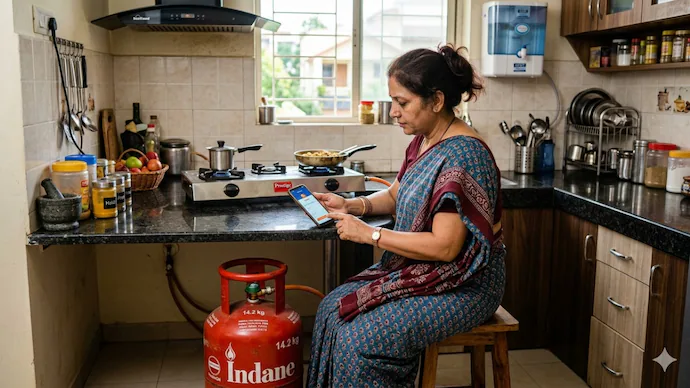


In the second such increase in three months, the price of domestic liquefied petroleum gas (LPG) has been hiked by ₹29 per 14.2-kg cylinder. The revision, which comes into effect today, directly reflects the ongoing volatility in global energy markets and supply chain constraints.
With this latest revision, the retail price for a standard domestic LPG cylinder in Delhi rises from ₹913 to ₹942.
The Catalyst: Geopolitical Strain and the Saudi CP Surge
The price correction is a direct byproduct of the ongoing conflict in West Asia, which began in late February and has severely choked critical trade choke points, including the Strait of Hormuz. India imports roughly half of its natural gas requirements, making its domestic pricing highly vulnerable to overseas shocks.
According to a government statement released on Sunday, India’s LPG import costs—benchmarked to the Saudi Contract Price (CP)—have skyrocketed by 46% since February. The blended benchmark surged from $543 a tonne in February prior to the disruptions, pushing up the global cost of raw procurement.
The ₹29 hike follows a larger ₹60-per-cylinder increase on March 7, bringing the cumulative price increase since the start of the West Asia crisis to ₹89.
Retail Price Matrix Across Major Metros
Because local distribution costs and state-level levies vary, the effective price of a non-subsidised 14.2-kg cylinder shifts marginally depending on the region:
| Region / Metro City | Legacy Retail Price | New Retail Price (Effective June 7, 2026) |
| New Delhi | ₹913.00 | ₹942.00 |
| Mumbai | — | ₹941.50 |
| Bengaluru | — | ₹944.50 |
| Kolkata | — | ₹968.00 |
| Hyderabad | — | ₹994.00 |
Note on Commercial Cylinders: While domestic consumers face higher outlays, the prices of 19-kg commercial LPG cylinders used by restaurants and industries were kept unaltered in this specific tranche. Commercial cylinders were last hiked on June 1 by ₹42, bringing the price in Delhi to ₹3,113.50.
Absorbing the Shock: Massive Under-Recoveries for OMCs
Even with the back-to-back price hikes, state-run Oil Marketing Companies (OMCs)—including Indian Oil (IOCL), Bharat Petroleum (BPCL), and Hindustan Petroleum (HPCL)—are absorbing the vast majority of the global market premium to shelter households from hyperinflation.
Industry data shows that before this revision, OMCs were losing approximately ₹703 on every single domestic cylinder sold. Government sources state that if local retail rates were allowed to float in complete lockstep with the actual international market, a single 14.2-kg cylinder would cost consumers more than ₹1,600.
The gap between the global import baseline and what consumers actually pay at the pump has driven the government’s estimated domestic LPG under-recovery burden from ₹41,338 crore in the prior year up toward ₹60,000 crore for the current cycle.
Impact on Ujjwala Scheme Beneficiaries
To protect economically vulnerable segments, the pricing architecture for the Pradhan Mantri Ujjwala Yojana (PMUY) remains structured via a targeted Direct Benefit Transfer (DBT) subsidy:
- Subsidized Outlay: PMUY beneficiaries will continue to receive a ₹300 subsidy per refill.
- Effective Price: This brings their net cost to ₹642 per cylinder for the designated quota, presenting a steep 60% discount compared to actual import values.
- Quota Revision: The government clarified that the ₹300 subsidy structure applies strictly to the first four refills annually, matching the audited average annual usage metrics of a typical Ujjwala household.
A Broader Trend of Fuel Revisions
The domestic cooking gas hike coincides with a broader, coordinated upward revision of energy lines across India as OMCs attempt to balance their books against $100-per-barrel Brent crude:
- Petrol & Diesel: Retail transport fuels have climbed by a cumulative ₹7.50 per litre since mid-May. OMCs are currently logging under-recovery losses of roughly ₹11 per litre on petrol and ₹33.60 per litre on diesel.
- Compressed Natural Gas (CNG): Rates for automative natural gas lines have climbed by about ₹6 per kg over the same multi-week window.