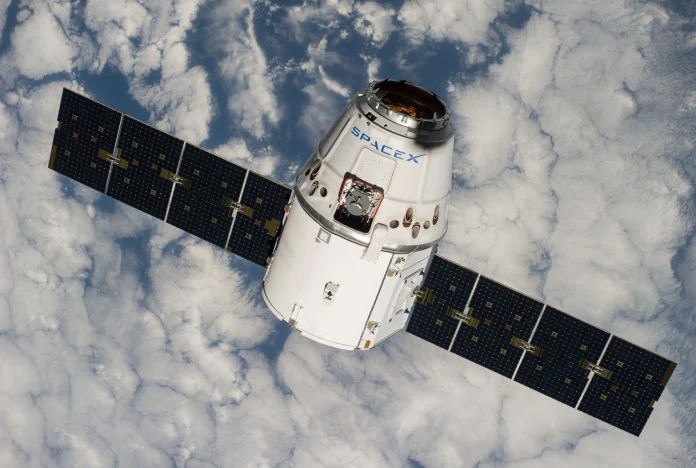


Russia is actively moving to challenge Elon Musk’s dominance on two major fronts: satellite internet technology and reusable launch vehicles.
Rather than deploying a single entity, Moscow is utilizing a mix of private tech conglomerates and the state space agency, Roscosmos, to build its domestic answers to SpaceX and Starlink.
1. The Starlink Challenger: Bureau 1440’s “Rassvet”
Russia’s most immediate, commercially active alternative to SpaceX’s technology is a satellite broadband system developed by Bureau 1440, a subsidiary of the private tech company IKS Holding.
The venture is building out Rassvet, a low-Earth orbit (LEO) satellite communications network designed to mirror Starlink’s core functionality.
- The Blueprint: While SpaceX currently commands thousands of active operational satellites, Bureau 1440 is pursuing a more targeted layout. The initial phase targets roughly 288 to 292 satellites to establish baseline coverage, scaling up to a full network of 900 satellites over several years.
- Current Status: The hardware is actively deploying. Bureau 1440 successfully transitioned from experimental testing to its core operational layout by launching its first batch of 16 production-grade Rassvet satellites via a Soyuz-2.1b carrier rocket.
- The Timeline: Testing phase completion will lead straight into targeted commercial functionality. The platform has officially locked in a 2027 commercial launch deadline to begin serving paying subscribers.
- Specs and Reach: The Rassvet hardware features 5G non-terrestrial network capabilities, inter-satellite laser links, and plasma thrusters. The network is targeting download speeds between 50 Mbps and 1 Gbps, aiming to capture up to 2 million subscribers within Russia and up to 12 million global users across 70 countries.
2. The Launch Challenger: Reusable Rocket Development
To match SpaceX’s industry-defining cost efficiency, the Russian state space agency, Roscosmos, is restructuring its launch development timeline around reusable first-stage boosters.
Roscosmos Chief Executive Dmitry Bakanov explicitly highlighted the economic shift, noting that Elon Musk’s model has proven that discarding rocket stages as scrap is no longer economically viable.
- Project Amur-LNG: Russia’s primary reusable vehicle project is the Amur-LNG, a partially reusable methalox (methane/liquid oxygen) medium-lift rocket. The technical specifications for the booster were approved by Roscosmos, with the architecture engineered to support a life cycle of up to 100 flights per vehicle.
- Project Korona: On the futuristic end of the R&D spectrum, the Makeyev Design Bureau under Roscosmos is researching Korona, a conceptual Single-Stage-to-Orbit (SSTO) rocket designed for vertical takeoff and landing utilizing advanced composite shells and hydrogen-oxygen fuel pathways.
3. The Financial and Strategic Backing
The Russian government has designated these aerospace programs as vital pillars of its national digital transformation initiatives. The fiscal layout allocated to support the space communications sector includes:
| Funding Entity | Financial Commitment | Target Window |
| Russian Federation State Budget | 102.8 Billion Rubles (~$1.26 Billion) | Dedicated Framework |
| Bureau 1440 (Private Capital) | 329 Billion Rubles (~$4 Billion) | Co-investment through 2030 |
The Geopolitical Impetus
The domestic acceleration of these programs carries significant strategic urgency. Military analysts note that Russia’s push for sovereign satellite broadband follows the intensive use of Starlink-connected assets in regional conflicts. Because Starlink hardware is officially banned and fineable inside Russian territory, creating a secure, completely domestic alternative is viewed by the Kremlin as a non-negotiable step toward infrastructure safety.