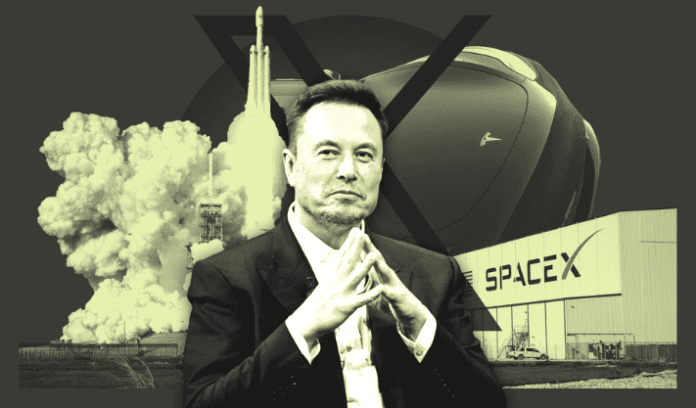


In what is set to become the largest and most highly anticipated initial public offering (IPO) in financial history, Elon Musk’s SpaceX has filed its investor prospectus to go public on the Nasdaq exchange. The aerospace, satellite, and artificial intelligence giant is seeking to raise an unprecedented $75 billion, anchoring the company to an implied baseline valuation of $1.75 trillion.
The fundraising could swell to as much as $86 billion at a $1.78 trillion valuation if underwriters exercise their over-allotment (greenshoe) options.
Trading under the ticker SPCX, the blockbuster stock market debut is currently primed for June 12, 2026.
Shattering Conventional IPO Mechanics
SpaceX is entirely upending the traditional Wall Street roadshow playbook in two major ways:
- Fixed Pricing: Rather than pitching institutional investors a flexible price range and adjusting based on demand, SpaceX handed the market a fixed price of $135 per share for 555.6 million shares.
- Rapid Private-to-Public Escalation: A valuation of $1.75 trillion is more than double the $800 billion valuation implied during the company’s private secondary tender offer in December 2025. It also marks a steep premium over the $1.25 trillion valuation pegged during its merger with Musk’s xAI startup in February 2026.
If successful, SpaceX will leap directly into the global top ten most valuable companies on day one, sitting just behind semiconductor titan TSMC. It will also shatter the previous global IPO record held by Saudi Aramco, which raised $25.6 billion in 2019 at a $1.7 trillion valuation.
Musk Retains Supreme Voting Control
While public and retail investors are being allocated a significant portion of the float, the corporate governance structure ensures Elon Musk maintains an iron grip on the company.
SpaceX is utilizing a dual-class share structure. Public investors will receive Class A shares, which carry one vote per share. Meanwhile, Musk and select company insiders will hold Class B shares, which command 10 votes per share.
Ultimately, Musk is not selling any of his personal equity. He will retain 82.4% of the total voting power while simultaneously serving as CEO, Chief Technical Officer, and Chairman of the Board. Financial analysts note that the listing will almost certainly cement Musk’s trajectory toward becoming the world’s first trillionaire, pushing his paper net worth past $1 trillion.
The Three Pillars Driving the $1.75T Bull Case
The sprawling SpaceX empire pitching Wall Street will be structurally split into three core segments:
1. Starlink Satellite Broadband (The Financial Anchor)
Accounting for 61% of total corporate revenue ($11.4 billion out of $18.7 billion in 2025), Starlink is the highly profitable foundation of the IPO. The satellite internet division generated $4.42 billion in operating profit in 2025 alone. Wall Street backers like Cathie Wood’s ARK Invest argue that Starlink’s high-margin, recurring subscription model alone is enough to justify the trillions in valuation.
2. The AI Infrastructure Play
Following the absorption of xAI, SpaceX has aggressively repositioned itself as an AI powerhouse. The prospectus reveals that its newly built Colossus 1 data center secured a massive cloud-compute hosting contract with AI lab Anthropic worth $1.25 billion per month through 2029. The company is also exploring the commercialization of orbital, space-based data centers to power the global AI boom.
3. Core Launch Services
SpaceX performed more than 50% of all global rocket launches by 2025. The capital proceeds from the IPO will be heavily funneled into expanding production for its next-generation, fully reusable Starship launch vehicle.
The Bears: Extreme Multiples and Deep Net Losses
Despite the massive hype, a $1.75 trillion valuation commands an aggressive premium—trading at roughly 92 times its annual sales. This is a far richer multiple than traditional Magnificent Seven tech peers.
Furthermore, the overall company remains heavily loss-making. Because SpaceX is plowing tens of billions into capital expenditures for AI chips and deep-space infrastructure, the group posted a consolidated net loss of $4.94 billion in 2025 and a staggering $4.28 billion loss in just the first quarter of 2026.
Independent research groups, including Morningstar, have issued cautious warnings, setting a fundamental standalone fair value estimate of $780 billion—roughly 48% below the public listing target—citing high execution risks on unproven AI segments. Nevertheless, global demand remains white-hot; the private retail placement tranches in Japan and South Korea reportedly sold out within minutes of opening ahead of the June 12 Nasdaq debut.