In a direct bid to recapture the frontier performance crown, AI pioneer Anthropic has officially launched Claude 4.8 Opus.
The release marks a significant evolutionary step for Anthropic’s flagship tier. Moving away from the raw pattern-matching mechanics of early generative systems, Claude 4.8 Opus introduces an architecture optimized explicitly for autonomous multi-agent orchestration, complex mathematical verification, and long-context logic density.
The upgraded model is rolling out immediately to Claude Pro and Team subscribers via the web interface, alongside general availability across the Anthropic API, Amazon Bedrock, and Google Cloud Vertex AI.
Technical Specifications: The 500k Frontier
Claude 4.8 Opus introduces several architectural overhauls engineered to handle complex, enterprise-grade development pipelines:
- 500,000-Token Context Window: Expanding significantly on its predecessor, the 4.8 framework can ingest, cross-reference, and remember over 375,000 words in a single prompt. This allows technical teams to upload entire multi-file codebases, legal libraries, or multi-year financial ledgers without risking context degradation.
- 40% Latency Reduction: Anthropic has integrated a proprietary hardware routing layer that sharply minimizes Time-to-First-Token (TTFT). The structural tuning mitigates the “sluggishness” historically associated with early Opus models, bringing its operational speed closer to its lightweight sibling, Sonnet.
- Native Tool Orchestration: Rather than relying on fragile, third-party software wrappers to execute multi-step scripts, 4.8 Opus features native loop execution. The model can autonomously spin up, monitor, debug, and chain together complex software tools in a sandboxed environment to fulfill long-horizon developer objectives.
Benchmarks: Outperforming the Multi-Agent Landscape
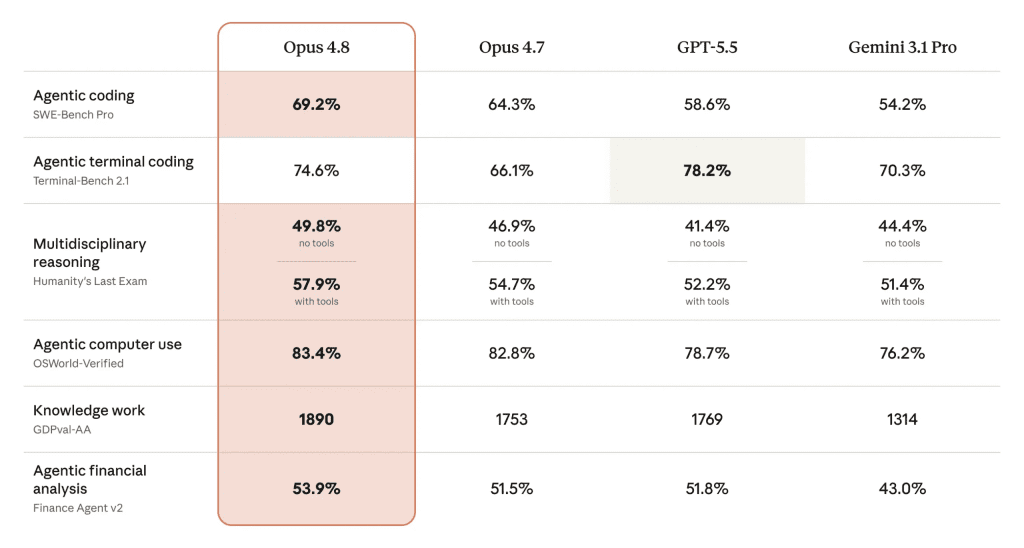
According to evaluation telemetry released by Anthropic’s research division, Claude 4.8 Opus establishes fresh industry baselines across core reasoning matrices, outperforming contemporary iterations of Google Gemini and OpenAI’s reasoning frameworks:
SWE-bench Verified (Autonomous Coding)
On the industry-standard benchmark that tests an AI’s capacity to autonomously resolve real-world software issues in live GitHub repositories, 4.8 Opus achieved a 54.2% resolution score. This marks a massive leap over legacy baselines, driven by the model’s enhanced capacity to self-correct code execution errors without human intervention.
GPQA (Graduate-Level Google-Proof Q&A)
In tracking elite, multi-disciplinary scientific reasoning spanning quantum physics, organic chemistry, and advanced biology, the model registered a 67.8% accuracy rate. Crucially, the model displays a marked reduction in false-certainty hallucinations when processing dense, non-obvious logical traps.
MMLU-Pro (Hardened Multi-task Language Understanding)
Evaluating raw academic and professional problem-solving across specialized disciplines, 4.8 Opus reached an authoritative 81.4% accuracy baseline, highlighting its reliable utility across corporate legal, medical, and financial analysis vectors.
Pricing Matrix and API Architecture
To accommodate the compute-heavy requirements of its expanded reasoning layers, Anthropic is maintaining a premium enterprise pricing tier for its flagship model via the API block, while introducing a distinct financial option for high-volume caching:
| Token Input Type | Standard API Rate | Prompt Caching Rate |
| Input Tokens (Per Million) | $15.00 | $3.75 |
| Output Tokens (Per Million) | $75.00 | N/A |
By leveraging the Prompt Caching architecture, development teams building continuous-turn agent applications or running high-frequency document analysis can lower their data input costs by up to 75%, significantly reducing the financial hurdles tied to maintaining massive context layers.
Consistent with Anthropic’s strict Constitutional AI development framework, the 4.8 Opus model profile explicitly excludes user API data from being utilized for downstream frontier model training, ensuring comprehensive intellectual property isolation for enterprise clients.
Get the day’s top stories in your inbox
One concise email. No spam, unsubscribe anytime.