

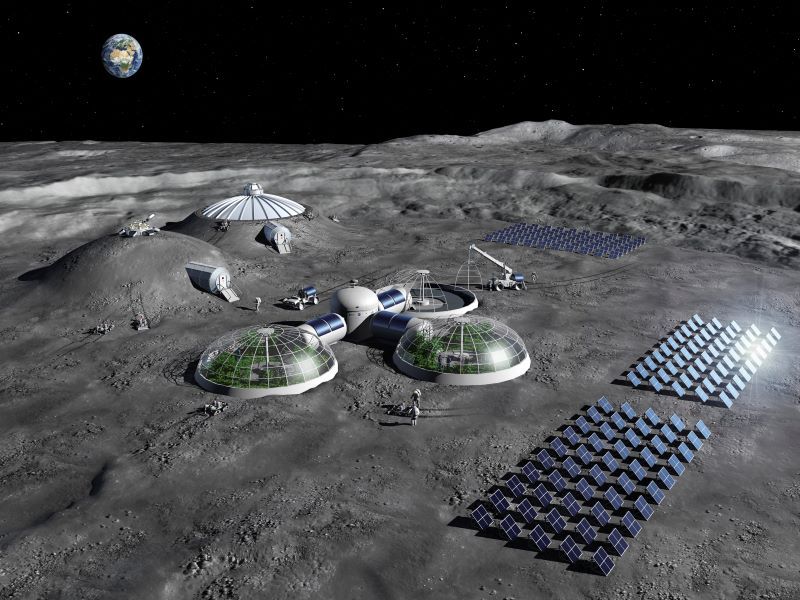
Humanity’s return to the Moon is set to become permanent as NASA plans to build a permanent Moon base by 2030, according to program roadmaps and mission planning under the Artemis initiative. The ambitious project represents a major shift from short-duration lunar missions to long-term human presence beyond Earth.
The Moon base is expected to serve as a foundation for deep-space exploration, scientific research, and future missions to Mars.
What NASA’s Permanent Moon Base Will Look Like
Under the plan, NASA’s permanent Moon base will consist of modular habitats, power systems, research facilities, and mobility infrastructure located near the Moon’s south pole. This region is strategically important due to the presence of water ice, which can be used for life support, fuel production, and long-term sustainability.
The base will not be built all at once. Instead, it will grow gradually through multiple missions, adding living quarters, laboratories, and storage units over time.
Why the Moon Base Is Being Built
NASA views the Moon as a critical stepping stone for deeper space exploration. Establishing a permanent base allows astronauts to live and work in deep space for extended periods, testing technologies and human endurance needed for Mars missions.
The Moon base will also enable advanced scientific studies, including geology, astronomy, and experiments that are difficult or impossible to conduct on Earth.
Role of the Artemis Program
The Moon base plan is a central pillar of NASA’s Artemis program, which aims to return humans to the lunar surface and establish a sustained presence. Artemis missions will deliver astronauts, cargo, and infrastructure components using new-generation rockets and landers.
International space agencies and private companies are expected to play key roles, making the Moon base a global collaboration rather than a purely national project.
Technology Powering the Lunar Base
The permanent Moon base will rely on cutting-edge technology, including solar power arrays, nuclear power sources, advanced life-support systems, and autonomous robots. These systems are designed to operate in the Moon’s extreme environment, where temperatures vary sharply and radiation exposure is high.
Robotic construction and AI-assisted operations will help reduce risks to astronauts during early deployment phases.
International and Commercial Partnerships
NASA plans to work closely with international partners and commercial space companies to build and operate the Moon base. This collaborative approach spreads costs, accelerates innovation, and strengthens global cooperation in space.
The Moon base could also support commercial activities such as resource extraction, technology testing, and future space tourism experiments.
Scientific and Strategic Importance
A permanent lunar presence gives scientists unprecedented access to the Moon’s resources and environment. It also strengthens strategic leadership in space at a time when multiple nations are expanding lunar ambitions.
By committing to a Moon base by 2030, NASA signals long-term intent to lead the next phase of space exploration.
Challenges Ahead
Despite its promise, the Moon base faces major challenges. Technical complexity, budget constraints, launch delays, and safety risks all pose significant hurdles. Sustaining human life on the Moon for long durations will require flawless integration of systems and constant resupply planning.
Timelines may shift, but NASA has emphasized that the goal is long-term presence, not just meeting a single deadline.
What This Means for the Future of Space Exploration
If successful, NASA building a permanent Moon base by 2030 could redefine humanity’s relationship with space. The base would act as a launchpad for Mars missions, deep-space science, and possibly a future space economy.
It represents a move from exploration to settlement—one of the most profound transitions in human history.
Conclusion
NASA’s plan to build a permanent Moon base by 2030 marks a historic turning point in space exploration. By establishing a sustained human presence on the Moon, NASA is laying the groundwork for the next giant leap—reaching Mars and beyond.
As technology, international cooperation, and ambition converge, the Moon may soon become humanity’s first permanent home beyond Earth.