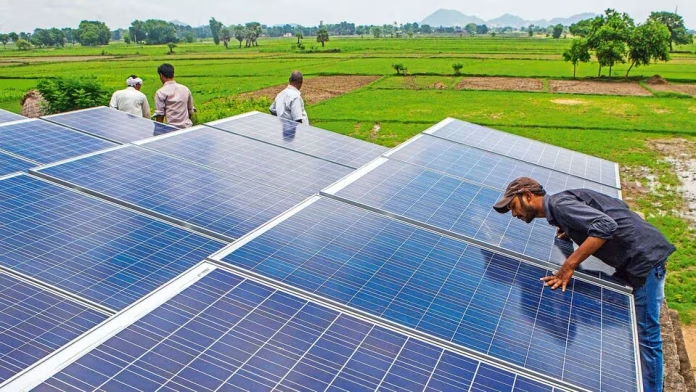


After years of aggressive cost deflation that transformed India into one of the cheapest solar energy markets globally, the sector is experiencing a sharp reversal. The total construction and capital expenditure (CAPEX) costs for large-scale and industrial solar projects across India have surged by roughly 20% over the first half of 2026.
The unexpected inflationary cycle is caught in a pincer movement between geopolitical supply-chain disruptions, raw commodity price rallies, and tightening domestic-content regulations enforced by the Ministry of New and Renewable Energy (MNRE).
For engineering, procurement, and construction (EPC) firms and green energy developers, this cost escalation is compressing margins and threatening the financial viability of low-tariff power purchase agreements (PPAs) signed in previous quarters.
The Perfect Storm: Drivers Behind the 20% Cost Escalation
Solar modules and inverters historically dictate up to 70% of an entire project’s budget. Sharp spikes across both global input commodities and local regulatory fees have severely upended project-level mathematics.
1. The Global Metals and Petrochemical Surge
Driven in part by prolonged logistics disruptions and shipping detours stemming from ongoing geopolitical tensions in West Asia, key manufacturing inputs have seen major rallies.
- Aluminum and Copper: Developing 1 gigawatt (GW) of solar capacity requires approximately 20 kilotonnes of extruded aluminum for panel frames and mounting structures. With aluminum fluctuating at multi-year highs on the London Metal Exchange (LME) and copper surging, the foundational cost of Balance of System (BOS) electrical cabling and structure frames has expanded heavily.
- Silver and Petrochemicals: Silver, vital for the conductive metallization tracks inside photovoltaic cells, has hit record-breaking highs. Concurrently, petrochemical input constraints have escalated the cost of protective backsheets and encapsulant materials.
2. China’s Policy Shift on Wafers and Incentives
India still relies heavily on imported Chinese upstream components, such as ingots, wafers, and cells. Since late December, imported module prices have surged over 30%. This near-term shock was heavily accelerated by Beijing’s industrial reorganization, which included a tightening of silicon wafer production quotas and the reduction of its long-standing 9% value-added tax (VAT) export refund incentive—effectively transferring that cost margin directly onto international buyers.
3. The Local Cell Sourcing Bottleneck (ALMM List-II)
On the domestic front, regulatory policies aimed at building a self-reliant “Make in India” supply chain have further strained current project budgets. The strict enforcement of the Approved List of Models and Manufacturers (ALMM) mandate has transitioned into its next phase. Projects under government schemes or utilizing net-metering are required to source not just locally assembled panels, but domestically manufactured solar cells as well.
Because India’s domestic solar cell manufacturing capacity is still scaling to catch up with massive demand, developers face structural premiums. Projects relying on Domestic Content Requirement (DCR) compliant hardware currently run 24% to 38% more expensive than those relying entirely on non-restricted imported modules.
Impact on Project Financials and PPA Deadlocks
The sudden capital expenditure overrun is generating friction within project financing channels. Industrial developers building captive 1-megawatt (MW) systems are seeing complete installation quotes rise well into the ₹3.5 to ₹4 crore range, including composite GST.
For utility-scale developers who won massive corporate or state tenders based on historical historic-low equipment pricing assumptions, the reality is stark:
- Financing Renegotiations: Multiple projects under active construction have blown past their initial contingency budgets. Developers are currently being forced back to the negotiating table with institutional lenders to restructure financial closure terms, which increases borrowing costs.
- Delayed ROI & Tariff Pressure: Slower procurement cycles and holding out for price stabilization can erode internal rates of return (ROI). Industry analysts warn that developers may have to push for higher base tariffs in future state auctions to safely offset the higher baseline cost of technology transitions, like moving from legacy Mono-PERC configurations to advanced N-type TOPCon bifacial modules.
While newly introduced domestic manufacturing tax reliefs on specific capital goods and raw materials from the Union Budget provide minor cushioning for local module glass producers, the immediate relief to field-level project construction remains minimal. Until domestic cell capacities scale up significantly to lower internal premiums, developers will continue to operate under a hyper-cautious procurement environment through the remainder of the year.