

India’s headline retail inflation, measured by the Consumer Price Index (CPI), experienced a notable acceleration in May 2026, climbing to 3.93% on a year-on-year basis.
According to provisional data released by the Ministry of Statistics and Programme Implementation (MoSPI), the latest print marks a 45-basis-point jump from the 3.48% recorded in April. While the reading remains marginally below the Reserve Bank of India’s (RBI) medium-term target of 4.0%, macroeconomists flag this as the steepest single-month acceleration since the launch of the revised CPI base-year index series.
The Rural vs. Urban Split
The impact of rising commodity prices continues to play out unevenly across geographical segments. Rural households are bearing a heavier inflationary burden compared to their urban counterparts, primarily driven by localized essential supply imbalances.
| Inflation Gauge | April 2026 (Final) | May 2026 (Provisional) | Change (Basis Points) |
| All-India CPI (Combined) | 3.48% | 3.93% | +45 bps |
| Rural Inflation | 3.74% | 4.25% | +51 bps |
| Urban Inflation | 3.16% | 3.53% | +37 bps |
| Consumer Food Price Index (CFPI) | 4.20% | 4.78% | +58 bps |
Core Inflation Drivers: What’s Pushing the Index?
The primary catalyst behind the headline spike is a sharp acceleration in the food basket, paired with the cascading impact of domestic fuel price restructuring.
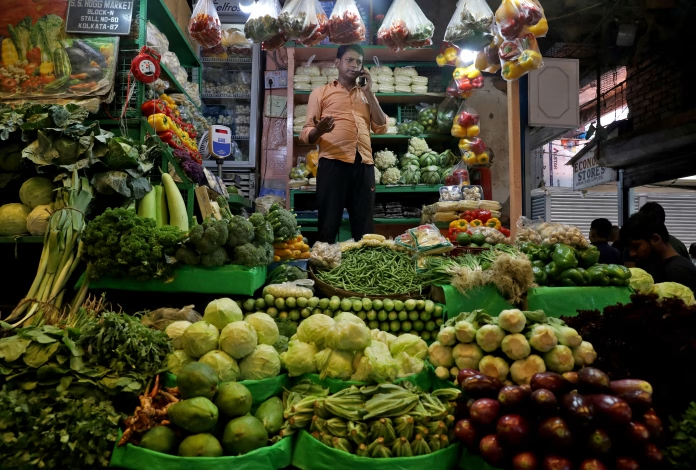
- The Food Spike: Food inflation (CFPI) jumped to 4.78% in May from 4.20% in April. Tomato prices led the surge with an inflation rate of 48.43%, heavily aggravated by unseasonal rains in primary crop-producing states. Ginger also spiked significantly to 32.49%.
- The Fuel Pass-Through: State-owned Oil Marketing Companies (OMCs) executed four consecutive hikes to retail petrol and diesel prices over the course of May—marking the first structural adjustments in nearly four years. This has injected immediate upward pressure into broader transport and logistics indices.
- The Precious Metals Factor: Driven by shifting global asset allocations, the “personal care and miscellaneous goods” division posted the highest broad-division inflation at 18.46%, heavily impacted by a massive 155.23% surge in silver jewellery and a 40.93% rise in gold/diamond items.
Conversely, certain kitchen staples offered cooling relief. Potato prices remained deeply embedded in deflationary territory at minus 23.71%, while green peas recorded an inflation rate of minus 11.47%.
RBI Policy Calculus and Future Outlook
While core inflation (excluding volatile food and fuel items) remained relatively well-anchored at 3.4%, the upward trajectory of the headline print has drawn cautious assessments from institutional analysts.
Last week, the RBI proactively adjusted its full-year inflation projection for the current fiscal to 5.1%, citing input cost pressures from global energy shocks. Principal economists at ratings firm CRISIL warn that headline retail inflation could edge closer to the 5.0% threshold over the upcoming quarters as monsoon distribution patterns materialize and secondary fuel-hike effects percolate into household budgets.
Given these shifting dynamics, the Monetary Policy Committee (MPC) is widely expected by Wall Street desks to maintain the benchmark repo rate at 6.25%, completely ruling out any near-term monetary easing.