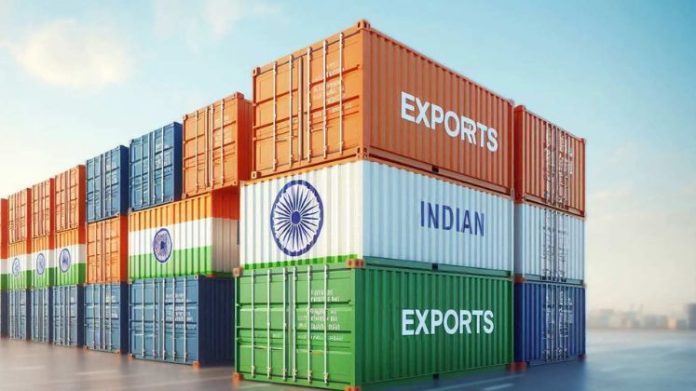


Driven by an aggressive manufacturing surge and a significant recovery in regional trade corridors, India’s export sector has achieved a major milestone. According to official trade data released by the Ministry of Commerce and Industry, merchandise exports jumped 18% year-on-year to hit an all-time monthly record high of $45.20 billion in May 2026.
The performance marks the sharpest pace of outbound shipping growth recorded in six months, demonstrating immense manufacturing resilience despite high baseline logistics friction across global waters.
Sectoral Drivers: What Powered the May Surge
The record-breaking export performance was anchored heavily by strong global demand across four primary domestic manufacturing verticals.
- Petroleum Products (Up 54.89%): Leading total growth in absolute value, outbound shipments of refined petroleum products rocketed to $8.42 billion from $5.44 billion in May last year.
- Engineering Goods (Up 24.48%): Remaining India’s largest individual export component, heavy engineering items brought in $12.31 billion in external revenue.
- Electronic Goods (Up 11.62%): Sustaining its upward smartphone-driven structural curve, electronics shipments added $5.10 billion to the ledger.
- Drugs & Pharmaceuticals (Up 6.13%): Baseline global pharma volume allocations held stable, bringing in $2.62 billion.
Conversely, traditional primary sectors recorded minor contractions, with tea, tobacco, spices, and marine products logging negative growth metrics for the month.
The Import Drag: Trade Deficit Widens to $28.2 Billion
While outbound merchandise logged historic numbers, a parallel acceleration in domestic demand and elevated energy costs pushed the country’s import bill higher, widening the merchandise trade deficit to $28.21 billion (up from $21.88 billion in May 2025).
| Trade Metric (May 2026) | Realized Monthly Value | Year-on-Year Growth | Core Underlying Driver |
| Merchandise Exports | $45.20 Billion | +18.00% | Engineering, petroleum, and smartphone hubs |
| Merchandise Imports | $73.41 Billion | +20.60% | Elevated crude oil bills and gold inflows |
| Services Exports | $36.76 Billion | +13.24% | Software outsourcing and professional consulting |
| Services Imports | $19.06 Billion | +14.13% | External technical infrastructure costs |
| Combined Trade Balance | -$10.51 Billion | — | Services surplus cushioning the goods deficit |
Crucially, the cumulative two-month data for the current fiscal year (April–May) outlines massive underlying commodity volume trends. Gold imports surged by 60% to hit $9.04 billion, while crude oil import outlays expanded 16.5% to reach $41.30 billion due to regional volatility before the recent U.S.-Iran peace framework cooled global pricing.
Strategic Shift: Mitigating Regional Shipping Crises
A major structural highlight of the May data is how Indian exporters successfully navigated ongoing West Asia supply chain chokepoints. Total exports to West Asian markets settled marginally lower at $5.30 billion compared to $5.38 billion last May—effectively matching normal volumes despite active regional shipping blockades.
To bypass volatile transit lanes, the Commerce Ministry confirmed that Indian logistics networks actively rerouted cargo through three strategic alternative ports in Oman: Duqm, Sohar, and Salalah. This tactical multi-port pipeline allowed exporters to steadily push shipments into the wider region without absorbing severe delivery delays.
Commerce Secretary Rajesh Agrawal noted that given the sequential jump from April’s $43.56 billion baseline, India’s outbound trade engine is positioned well to capitalize on stabilizing shipping costs as global energy lanes prepare to fully normalize.