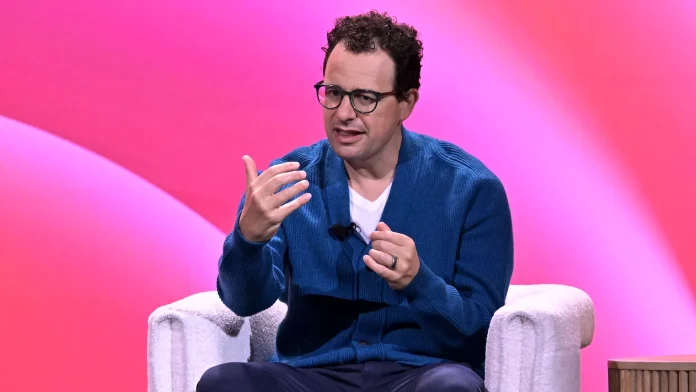


In a dramatic forecast that alters the timeline for humanity’s transition to superintelligence, Anthropic CEO Dario Amodei has stated that if current artificial intelligence scaling laws hold true for just one to two more years, the industry will cross the threshold into Artificial Superintelligence (ASI).
Speaking at a technology infrastructure summit in California, Amodei outlined an exponentially compressing horizon for AI development. He posited that the compounding effects of raw compute scaling, algorithmic refinements, and data synthesis are moving at a velocity that could unlock systems vastly smarter than the collective intelligence of humanity before the end of the decade.
The prediction arrives at a high-stakes moment for the San Francisco-based safety research lab, which recently saw its market valuation surge to $965 billion following the viral enterprise success of its advanced Claude Fable 5 model and dedicated software engineering utilities.
The Mathematics of Exponential Ascent
Amodei’s thesis rests entirely on the empirical durability of “scaling laws”—the foundational principle in deep learning dictating that an AI model’s intelligence, reasoning capability, and operational accuracy scale predictably in relation to increases in computing power, training dataset size, and parameter count.
While several industry skeptics have spent the past year warning that the tech sector is hitting a “data wall” due to the exhaustion of high-quality human text on the public internet, Amodei remains firmly in the optimist camp.
- The Two-Generation Leap: Amodei clarified that the industry is currently moving through the development of “Generation 5” frontier models. He projects that scaling these frameworks by another 10x to 100x in compute clusters will yield “Generation 6” models by late 2027, and “Generation 7” architectures by 2028 or 2029.
- The Intelligence Overlap: According to Anthropic’s internal forecasting models, a Generation 7 system operating under current scaling curves would not simply match human capabilities; it would exceed the cognitive throughput of the smartest human specialists across every known academic and professional discipline simultaneously.
“If you just look at the straight mathematical curves of compute inputs and intelligence outputs, we are a very short distance away from systems that can out-think Nobel Prize winners,” Amodei noted during the panel session. “If these laws do not break—and we see no structural reason why they should over the next 24 months—ASI is an inevitability on a three-to-four-year horizon.”
The Agentic Catalysts: From Text to Self-Evolution
The transition from modern Large Language Models (LLMs) to a true Artificial Superintelligence will not look like a bigger chatbot. Instead, Anthropic’s engineering roadmap views the rise of autonomous, self-correcting agent swarms as the primary catalyst that will bridge the remaining gap.
As these multi-step agentic workflows mature, they fundamentally alter the training loop in three revolutionary ways:
1. Synthetic Data Generation at Scale
Instead of relying strictly on human-authored text, Generation 6 models will use highly disciplined, fact-verified synthetic environments. Advanced models can hold structured debates, run trillions of complex logical simulations against each other, and generate pristine training data entirely from scratch, bypassing the limitations of the physical internet.
2. Autonomous Chip and Systems Design
The scaling of AI hardware is currently bottlenecked by physical engineering limitations. Amodei projects that within the next 18 months, advanced AI agents will take over the micro-architecture design of next-generation semiconductor nodes and the complex layout of data center optical networks—effectively allowing the AI to engineer its own future hardware foundations.
3. Automated Software Innovation
Once AI agents can independently code, test, and deploy software architectures at thousands of operations per second, the pace of algorithmic optimization shifts from human speed to machine speed. The AI will systematically audit its own weights, discover more efficient neural network configurations, and execute continuous self-evolution loops without human intervention.
A High-Stakes Financial and Geopolitical Arms Race
Amodei’s timeline directly explains the staggeringly aggressive capital deployment currently unfolding across Silicon Valley. If ASI is truly achievable within three to four years, the tech giant that secures the foundational infrastructure first will command an unassailable geopolitical and economic moat.
This reality has triggered an unprecedented war of economic attrition. Frontier players are rapidly building sprawling data center complexes that demand gigawatts of electricity and tens of billions of dollars in specialized hardware. OpenAI, fresh off its confidential IPO filing, is preparing drastic price reductions to lock in enterprise workflows, while Google is diversifying its hardware supply chain by tapping Samsung to manufacture key components of its next-generation custom AI processors.
For Anthropic, which has historically prioritized a hyper-cautious, safety-first alignment methodology, the proximity of ASI introduces profound regulatory urgency. Amodei concluded his remarks by emphasizing that the final 24 months of the scaling journey will require unprecedented global governance and cryptographic containment protocols. If the industry fails to build flawless containment boundaries before the first Generation 7 clusters are turned on, the transition to superintelligence could easily slip away from human steering entirely—turning the final leg of the scaling race into the most precarious technological pivot in human history.