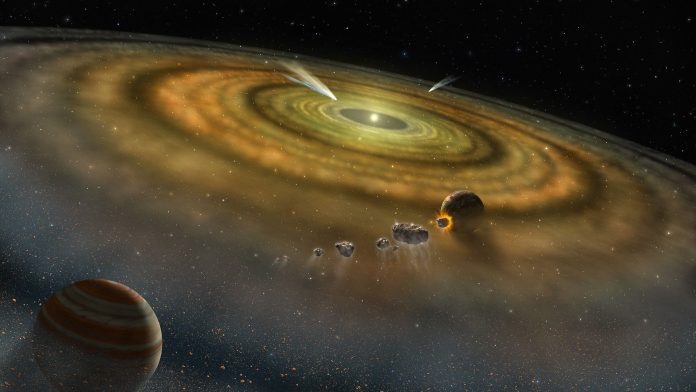


Complicating long-held assumptions about the early architecture of our solar system, a newly published study reveals that a rare meteorite recovered from the Sahara Desert holds the first definitive evidence of a long-lost proto-world. The ancient planetary embryo, which rivaled Earth’s moon and potentially approached the size of Mars, existed and was catastrophically destroyed just a few million years after the solar system formed 4.5 billion years ago.
The groundbreaking research, published in Earth and Planetary Science Letters by a team of geoscientists at the University of Colorado Boulder, details how deep-seated pressure signatures trapped within a tiny, one-pound space rock are rewriting the timeline of planetary evolution.
The Sahara Fragment that Defied Textbook Chemistry
The space rock at the center of the discovery is designated Northwest Africa (NWA) 12774, a dark, unassuming fragment discovered in the sands of the Sahara Desert in 2019. Under a microscope using cross-polarized light, the rock shimmers like a kaleidoscope, revealing a rare mineral composition.
Scientists classify NWA 12774 as an angrite—an exceptionally scarce group of stony, ancient volcanic meteorites that account for just 0.09% of all 80,000 space rocks recovered on Earth. For decades, angrites puzzled planetary scientists because they contain remarkably low levels of silicon dioxide (silica), the fundamental compound that makes up sand, quartz, and the crusts of large rocky worlds like Earth and Mars.
Because of this severe silica deficiency, astronomers universally assumed that the Angrite Parent Body (APB)—the original home world of these rocks—had to be a modest, chemically simple asteroid measuring no more than 124 miles (200 kilometers) in radius. Smaller asteroids lack the gravitational mass and internal heat required to undergo complex planetary “differentiation,” where melting causes heavy metals to sink to a core while silicates float up to create a crust.
Crystalline Clues Reveal Subterranean Pressures
The CU Boulder research team shattered this long-standing assumption by zeroing in on a specific mineral embedded within NWA 12774: clinopyroxene.
While clinopyroxene commonly exists within Earth’s mantle, the specific crystals trapped inside the Sahara meteorite were strangely rich in aluminum. To determine exactly how these crystals formed, the researchers developed a specialized thermodynamic computer model called a CaTs-liquid geobarometer.
The results were staggering. The aluminum-packed structures required an environment with a minimum internal pressure of 17.5 kilobars to form. For comparison, that is more than 17 times the crushing weight felt at the bottom of the Mariana Trench, the deepest point on Earth’s ocean floor. A typical asteroid measuring 100 to 200 miles across is physically incapable of generating that level of gravitational force within its core.
Reconstructing a Lost Moon-to-Mars Sized Embyro
To calculate the size of the parent planet required to generate 17.5 kilobars of internal pressure, the team ran the geological data backward, uncovering an even more surprising structural anomaly.
- The Depth Delusion: If the rock had crystallized deep within the dense, molten core of a smaller planet, the intense, prolonged heat would have smeared and softened the mineral’s composition over millions of years.
- The Surface Signature: Instead, the clinopyroxene crystals within NWA 12774 featured incredibly sharp, delicate edges and intact chemical patterns. This is a definitive volcanic signature of rapid cooling, meaning the rock crystallized at a relatively shallow, near-surface depth of less than 124 miles (200 kilometers).
For a planet to exert 17.5 kilobars of crushing pressure so close to its outer surface, the total mass of the world had to be gargantuan. The team’s math establishes a baseline radius of at least 1,118 miles (1,800 kilometers) for the lost parent body, making it slightly wider than Earth’s moon. Upper-range estimates from the study suggest the world may have stretched up to a radius of 3,300 kilometers—nearly a perfect match for the size of Mars.
“The materials that formed the angrite parent body are fundamentally different from the ingredients of Earth and Mars,” explained study lead author Aaron Bell, an experimental petrologist at CU Boulder. “It points to a distinct and separate evolutionary path in planetary formation in the early history of our solar system. It’s incredible to think there was once a world this large, and we only know it existed because a few fragments of it happened to land on Earth.”
What Happened to the Solar System’s Forgotten World?
The discovery provides physical proof that the infant solar system was far more crowded, chaotic, and violent than the stable layout of eight planets observed today. Within just four million years of the sun’s birth, the solar nebula was already rapidly generating fully formed, moon-sized planetary embryos that followed entirely unique chemical recipes.
What ultimately happened to this ancient angrite world remains a mystery, though its end was undoubtedly cataclysmic. Scientists theorize the protoplanet was obliterated during the “demolition derby” phase of the early solar system, shattered by a colossal collision with another primordial world.
While the majority of the planet’s wreckage was likely absorbed into the growing mass of other rocky inner planets—meaning pieces of this lost world may technically sit deep inside modern Earth—NWA 12774 survived as a pristine, frozen time capsule. The success of the study suggests that more secrets of these vanished worlds are likely waiting to be uncovered, sitting completely unstudied in museum storage drawers worldwide.
CU Boulder Lab Analysis: Examining Primitive Meteorite Textures
This look into advanced planetary petrology demonstrates how researchers utilize electron microprobes and cross-polarized light microscopy to map chemical compositions and unlock ancient environmental data trapped within meteorites.