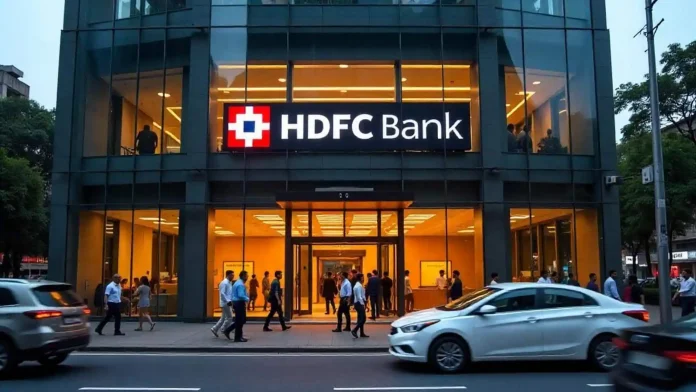


In a significant restructuring of its third-party sourcing channels, HDFC Bank, India’s largest private sector lender, has officially prohibited its external agents from mobilizing funds from government entities.
The bank has issued an internal directive to its Direct Selling Associates (DSAs), business correspondents, and business facilitators, explicitly ordering them to cease all sourcing of Fixed Deposits (FDs) and Current Account, Savings Account (CASA) funds from government bodies, effective July 1, 2026.
Zero Commission on Inadvertent Sourcing
To ensure strict compliance with the new mandate, HDFC Bank’s management made it clear that the restriction is absolute. The internal communication sent to its partners stated:
“We request you to please take note that no commission payout shall be applicable for CASA and (FD) business sourcing under (the govt) segment going forward even where such sourcing got done inadvertently.”
The channel was initially established to drive retail market penetration, granular acquisition, and financial inclusion. However, following a thorough internal assessment of operational, regulatory, strategic, and reputational factors, the bank observed an over-concentration of business flowing from the government segment, particularly across various state capitals.
Context: The MSRDC Controversy and Regulatory Scrutiny
While HDFC Bank maintains that this decision is a forward-looking strategy aligned with its evolving governance framework, the policy pivot arrives amid intense media and regulatory scrutiny.
The ban closely follows allegations that HDFC Bank paid a ₹45 crore incentive to the Maharashtra State Road Development Corporation (MSRDC) to secure large institutional deposits. Reports suggested that the bank allegedly camouflaged these differential interest payouts under its “marketing expense” budget, utilizing local vendors under the guise of funding a road safety campaign.
The Regulatory Friction Points
Under Reserve Bank of India (RBI) regulations, commercial banking institutions are strictly forbidden from offering varied or customized interest rates to specific institutional depositors outside of standard published rate cards.
| Aspect of Conflict | Details / Allegations | HDFC Bank Stance |
| The Trigger Event | Alleged ₹45 crore payment to MSRDC to draw bulk deposits. | Policy shift was planned weeks prior and is independent of this matter. |
| Accounting Treatment | Allegations that excess interest payouts were masked as marketing spends. | Firmly rejects claims of any internal accounting camouflaging or wrongdoing. |
| Agent Commissions | Substantial payouts to third parties for corporate/govt accounts. | Completely banned for government entities from July 1, 2026. |
HDFC Bank has strongly denied all claims of administrative malpractice, stating that it possesses robust internal audit, oversight, and control processes, and that legal reviews have yet to uncover material lapses.
Shift to In-House Branch Mobilization
The bank’s corporate communications team explained that the decision to cut out third-party agents from the government segment is fully supported by the aggressive expansion of its proprietary physical network.
As of March 31, 2026, HDFC Bank’s footprint has expanded to 9,689 physical branches spanning 4,175 cities and towns across India. Armed with this vast physical network, the lender believes its in-house corporate and institutional banking teams can directly manage public sector relationships without relying on external intermediaries—thereby eliminating high commission payouts and mitigating third-party operational and reputational risks.
Going forward, the bank’s external agent and business correspondent networks will be redirected exclusively toward their original mandate: expanding granular retail deposit sourcing and advancing rural banking reach.