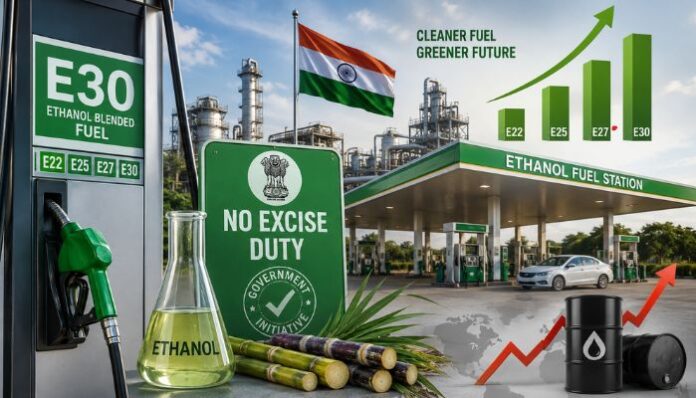


In a major fiscal push to accelerate India’s transition toward green energy, the Ministry of Finance has officially exempted petrol blended with high concentrations of ethanol from all central excise duties.
According to the gazette notification, the waiver applies specifically to petrol blends containing 22%, 25%, 27%, and 30% ethanol (commonly referred to as E22, E25, E27, and E30 fuel variants). Under the new framework, the basic central excise duty, special additional excise duty, road and infrastructure cess, and Agriculture Infrastructure and Development Cess (AIDC) on these specific high-blend categories have all been set to “Nil.”
The landmark tax relief arrives immediately after the Bureau of Indian Standards (BIS) formalised fuel-quality specifications for these advanced blends, signaling a aggressive move to scale India’s biofuel ecosystem well beyond the current E20 national mandate.
Insulating the Economy from a $100 Oil Market
The government’s decision to scrap duties on higher-tier biofuels is a direct, defensive countermeasure against extreme volatility in global energy markets. Driven by the ongoing West Asia crisis, international crude oil prices have rallied past the $100-per-barrel mark, forcing state-run Oil Marketing Companies (OMCs) to increase retail petrol and diesel prices by nearly ₹7.50 per litre.
Because India relies on foreign imports to satisfy nearly 90% of its domestic crude requirements, the economic hit from raw energy inflation is severe. By stripping away excise taxes on E22 through E30 slabs, the central government is deliberately altering the underlying economics of fuel manufacturing:
- Commercial Viability for OMCs: Eliminating the tax burden makes it significantly cheaper for oil refiners and fuel retailers to procure, blend, and distribute higher volumes of domestically produced ethanol.
- Tapping Into Surplus Capacity: The distilling industry has widely welcomed the policy signal. According to the All India Distillers Association, the tax exemption establishes a long-awaited commercial pathway to deploy India’s surplus ethanol manufacturing capacity, which currently sits well above local E20 requirements.
The Broader Rollout: E85 and Flex-Fuel Ambitions
The tax exemption for E22–E30 fuels follows closely on the heels of another massive alternative energy milestone: the official launch of the E85 fuel variant (85% ethanol blended with 15% traditional petrol).
To heavily incentivize early adoption among consumers operating compatible flex-fuel vehicles, the Ministry of Petroleum and Natural Gas has introduced a steep pricing strategy. State-run OMCs are rolling out E85 at a ₹20 per litre discount relative to standard E20 fuel, a pricing buffer explicitly designed to compensate motorists for the fact that ethanol possesses roughly one-third lower energy density than pure gasoline.
The infrastructure rollout is already moving through phased targets:
- Near-Term Target: An initial network of 50 to 100 dedicated ethanol dispensing stations is currently being deployed across major high-density automotive corridors, including Delhi-NCR, Mumbai, Mumbai-Nagpur, and Pune.
- Mid-Term Projections: The government aims to rapidly scale the distribution network to 500 functional stations by the close of 2026, with an ultimate target of 5,000 active alternative fuel outlets by the end of 2027.
Will Daily Commuters See Immediate Price Relief?
For the average Indian motorist, the immediate financial impact at the pump will remain unnoticeable for now. The standard fuel dispensed at the vast majority of retail outlets across the country remains E20 (20% ethanol, 80% petrol), a tier that does not qualify for this new high-blend “Nil” excise status.
Furthermore, utilizing E22 through E30 blends requires specialized automotive hardware calibration. While the automotive industry has successfully engineered passenger cars and utility vehicles to handle E20 seamlessly from 2023 onward, older internal combustion engines face structural wear and mileage degradation if exposed to higher ethanol corrosiveness without manufacturer-certified flex-fuel modifications.
Consequently, this tax elimination operates primarily as a strategic supply-side intervention. It guarantees that as vehicle manufacturers roll out next-generation flex-fuel platforms over the coming months, the high-blend infrastructure will already be financially insulated and commercially operational—moving India a massive step closer toward reducing its multi-billion dollar foreign oil import bill.