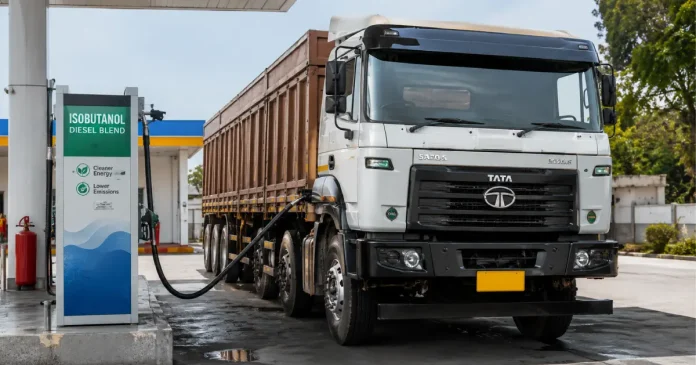


Following the rapid nationwide rollout of E20 (20% ethanol-blended petrol), the Government of India is shifting its focus to the diesel segment. Road Transport and Highways Secretary V. Umashankar and Union Minister Nitin Gadkari confirmed that the government is seriously evaluating a regulatory mandate to permit a 15% isobutanol-diesel blend later this year.
This structural pivot is directly aimed at bolstering energy security. Because India’s diesel consumption is nearly double that of petrol, successfully blending the diesel supply chain will have a far greater impact on reducing the country’s multi-billion-dollar crude oil import bill.
Why Isobutanol Over Ethanol for Diesel?
The government previously attempted to pioneer an ethanol-diesel blending program (targeting a 10% mix), but the initiative was officially declared a failure due to severe chemical incompatibilities. Ethanol simply does not mix easily with diesel, resulting in phase separation (where the fuel splits in the tank) and heavy fuel-system corrosion.
Isobutanol—a second-generation biofuel typically produced via advanced fermentation of agricultural biomass or synthetic processing of ethanol—brings distinct chemical advantages to commercial transport:
- Higher Energy Density: Ethanol contains roughly 21.3 MJ per litre, leading to noticeable fuel efficiency drops. Isobutanol boasts an energy density of 29.2 MJ per litre, which closely mirrors the energy profile of conventional diesel.
- Moisture Resistance: Unlike highly hygroscopic ethanol, isobutanol does not aggressively absorb water from the atmosphere. This significantly reduces the risk of rust and corrosion inside fuel injectors, vehicle pipelines, and underground retail storage tanks.
- Stability: Isobutanol blends seamlessly with diesel, remaining completely stable in cold weather without separating or causing sudden ignition knocking.
Performance, Mileage, and Fleet Impact
For the average passenger car owner or heavy commercial fleet operator, initial data from testing agencies offers reassuring benchmarks:
1. Minimal Mileage Penalty
Because of isobutanol’s high energy density, the drop in fuel efficiency (mileage) at a 15% blending ratio is projected to be entirely marginal. Most drivers will not notice a distinct change in their daily running costs.
2. Cleaner Emissions Profile
According to baseline research by the Automotive Research Association of India (ARAI), adding isobutanol promotes a cleaner, more complete combustion process. At a 15% ratio, the fuel triggers a significant reduction in carcinogenic particulate matter (soot), hydrocarbons, and carbon monoxide—the traditional environmental pain points of diesel combustion.
3. The NOx & AdBlue Tradeoff
There is a slight mechanical catch for modern BS6-compliant vehicles. While soot decreases, the higher oxygen content in alcohol blends can raise cylinder temperatures during heavy acceleration, potentially increasing Nitrogen Oxide ($NO_x$) emissions. This will likely cause a vehicle’s Selective Catalytic Reduction (SCR) system to work harder, meaning owners may find themselves replenishing their AdBlue (Diesel Exhaust Fluid) reserves faster than usual.
Seamless Logistics vs. Supply Scaling Challenges
From an infrastructure perspective, moving to an isobutanol blend is relatively straightforward. Because the biofuel is less corrosive and structurally stable, existing oil refineries, transport tankers, and retail fuel pumps can distribute the blended fuel with virtually zero retrofitting or hardware modification.
The immediate bottleneck for the Ministry of Petroleum and Natural Gas is scaling up domestic production capability. Generating enough isobutanol to support 15% of India’s massive daily heavy-transport and agricultural demand requires a monumental ramp-up in commercial bio-refineries.
To prepare for the transition, state-run Bharat Petroleum (BPCL) is already running advanced strategic research trials, while the government has commissioned ARAI to study “flex-fuel diesel engines” engineered to run safely on up to 100% pure isobutanol in industrial applications like generator sets.