
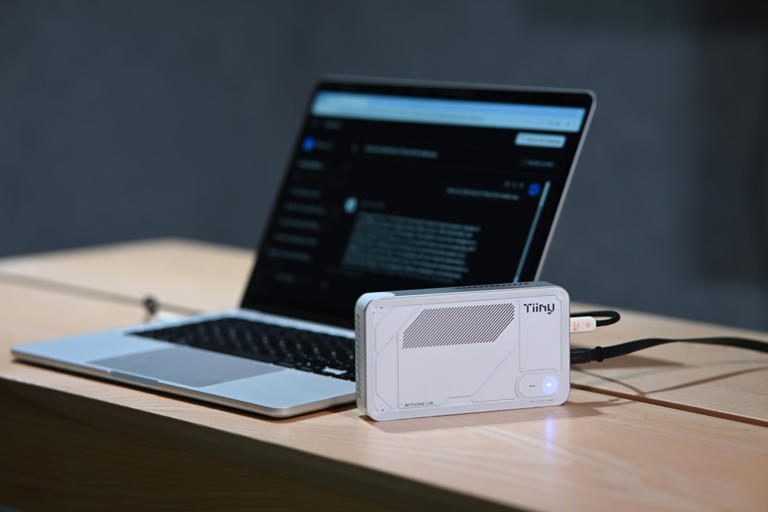
Tiiny AI launches world’s smallest personal AI supercomputer ‘Pocket Lab’, marking a breakthrough moment in edge computing and personal artificial intelligence. The compact device is designed to bring high-performance AI processing directly to individuals—without relying on cloud servers or massive data centers.
The launch reflects a growing shift toward private, on-device AI as users demand faster performance, data security, and independence from cloud-based systems.
What Is Pocket Lab and Why It Matters
Pocket Lab is a miniaturised AI supercomputer that fits in the palm of a hand while delivering powerful AI compute capabilities.
According to Tiiny AI, Pocket Lab is built for:
- Developers and researchers
- Students and educators
- Startups and AI hobbyists
- Privacy-focused users
It allows users to train, test, and deploy AI models locally—anytime, anywhere.
Key Features of the Pocket Lab
The biggest reason Tiiny AI launches world’s smallest personal AI supercomputer Pocket Lab is its unique mix of size and performance.
Highlighted features include:
- Ultra-compact, portable design
- Dedicated AI acceleration hardware
- Support for popular AI frameworks
- Offline AI processing with full data privacy
- Low power consumption
This makes Pocket Lab suitable for real-time AI experimentation without internet dependency.
Why Personal AI Supercomputers Are Gaining Attention
Traditional AI workloads depend heavily on cloud platforms. However, this comes with challenges:
- High recurring costs
- Data privacy concerns
- Latency issues
- Dependence on internet access
By enabling local AI compute, Pocket Lab addresses all these concerns—explaining why Tiiny AI launches world’s smallest personal AI supercomputer Pocket Lab is drawing global attention.
Use Cases Across Industries
Pocket Lab can be used in multiple real-world scenarios:
- AI model testing and prototyping
- Robotics and IoT development
- Healthcare research and diagnostics
- Smart city and edge computing projects
- Education and hands-on AI learning
Its flexibility makes it a powerful tool beyond traditional labs.
How Pocket Lab Competes in the AI Hardware Market
Most AI computing solutions today are either:
- Large and expensive servers, or
- Cloud-based platforms with usage fees
Pocket Lab sits in a new category—personal AI compute hardware—making advanced AI accessible to individuals and small teams.
Industry experts say this could democratise AI innovation the same way personal computers transformed computing decades ago.
Challenges Ahead
Despite its promise, Pocket Lab faces challenges such as:
- Scaling production
- Competing with big AI hardware players
- Ensuring developer ecosystem adoption
Long-term success will depend on performance benchmarks, pricing, and software support.
What This Means for the Future of AI
The fact that Tiiny AI launches world’s smallest personal AI supercomputer Pocket Lab signals a larger industry shift toward:
- Decentralised AI
- Edge-first computing
- User-controlled data and models
This trend could reshape how AI is built, deployed, and governed globally.
Conclusion
The launch where Tiiny AI launches world’s smallest personal AI supercomputer ‘Pocket Lab’ represents a major step toward making powerful AI tools personal, portable, and private. If widely adopted, Pocket Lab could redefine how individuals interact with artificial intelligence—bringing supercomputer-level capability straight into their hands.