
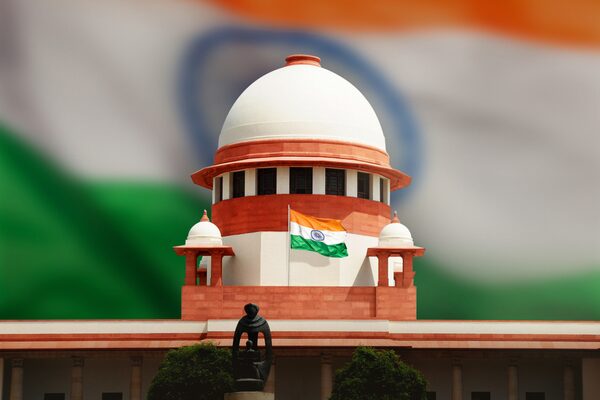
In a landmark judgment delivered on February 13, 2026, the Supreme Court of India ruled that telecom spectrum is a “material resource of the community” and cannot be sold or transferred under the Insolvency and Bankruptcy Code (IBC) to repay private lenders. A bench comprising Justice P.S. Narasimha and Justice Atul Chandurkar held that airwaves belong to the citizens of India, with the Union government acting solely as a trustee.
The verdict effectively shuts the door on banks and financial institutions—led by the State Bank of India (SBI)—who had sought to monetize the spectrum of bankrupt telcos like Aircel and Reliance Communications (RCom) to recover their dues.
The “Public Trust” vs. “Corporate Asset” Debate
The core of the legal dispute was whether the “right to use” spectrum constitutes an intangible corporate asset that can be liquidated during insolvency proceedings.
| Perspective | Argument | Supreme Court’s Verdict |
| Lenders (SBI/Banks) | Spectrum is a commercially valuable intangible asset and should be sold to maximize creditor recovery. | Rejected: Spectrum is a sovereign natural resource; it cannot be treated as an ordinary corporate asset. |
| Government (DoT) | Spectrum is a national asset; if statutory dues (AGR, etc.) are unpaid, it must revert to the government. | Upheld: The government has the “paramount authority” and regulatory control over airwaves. |
| Insolvent Telcos | The IBC moratorium should protect spectrum from government recovery during restructuring. | Rejected: The IBC cannot “make inroads” into the exclusive legal regime governing telecommunications. |
Key Legal Observations
The court’s judgment, spanning over 60 pages, emphasized that “as naturally as water knows the slope,” the IBC cannot be the guiding principle for the ownership and control of spectrum.
- No Proprietary Interest: The court clarified that telecom service providers (TSPs) do not own spectrum; they merely hold a “limited, conditional, and revocable privilege” to use it.
- IBC Limits: The IBC excludes assets over which a corporate debtor has no ownership rights. Since the government holds the legal title, spectrum cannot form part of the “liquidation estate.”
- Sovereign Dues vs. Operational Debt: The bench ruled that license fees and spectrum usage charges (SUC) are regulatory considerations, not standard commercial debts. Therefore, they cannot be “haircut” or deferred under a resolution plan.
Ramifications for the Telecom Sector
This ruling is a significant blow to the banking sector and highly indebted telecom players, as it eliminates their primary collateral.
- Bank Haircuts: Lenders to Aircel and RCom—who were already facing an 89% haircut—now face even steeper losses as the spectrum, once valued at thousands of crores, can no longer be sold to third-party resolution applicants.
- Impact on Vodafone Idea (Vi): Analysts suggest the ruling disproportionately affects indebted firms like Vi. It reinforces the government’s leverage, making it impossible for telcos to use the IBC as a “clean slate” to bypass massive Adjusted Gross Revenue (AGR) liabilities.
- Future Lending: Banks are expected to drastically re-evaluate how they price risk in the telecom sector, as spectrum-linked security is no longer a guaranteed avenue for recovery.
“Public wealth cannot be sacrificed to settle private debt. The path becomes clear by ensuring spectrum and its benefits subserve common good, not uncommon good.” — Supreme Court of India.