

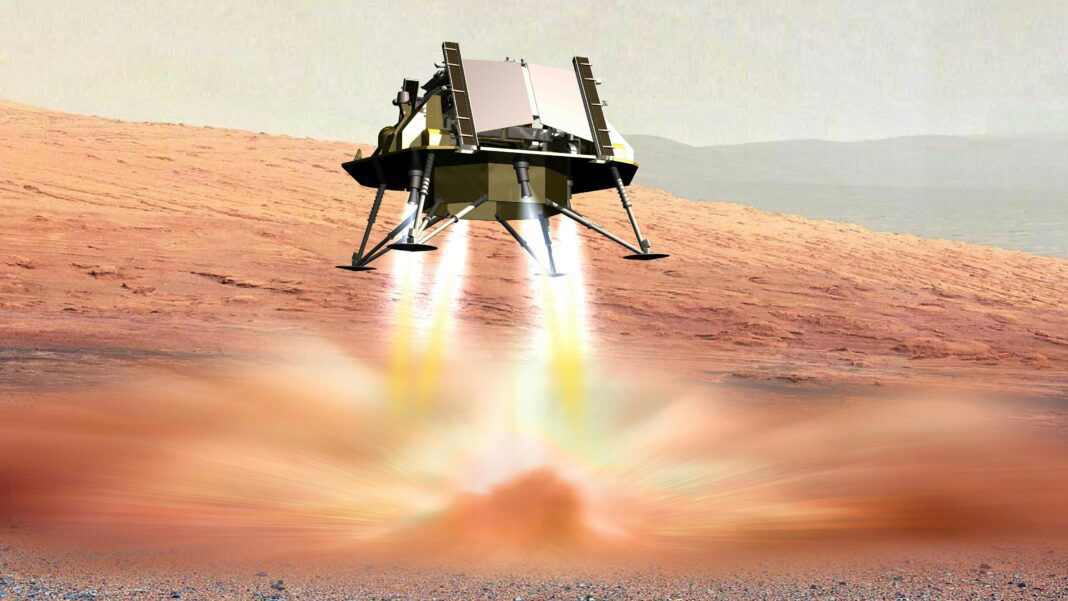
NASA has officially selected SpaceX to provide launch services for the European Space Agency’s (ESA) Rosalind Franklin rover, the centerpiece of the long-delayed ExoMars mission. The rover is now scheduled to lift off aboard a Falcon Heavy rocket in late 2028, marking a significant milestone in international cooperation to find signs of life on the Red Planet.
The announcement follows the approval of the Rosalind Franklin Support and Augmentation (ROSA) project, a framework through which NASA will provide critical mission components that were originally to be supplied by Russia before the partnership was dissolved in 2022.
1. The Mission: Drilling for Ancient Life
The Rosalind Franklin rover is uniquely designed to solve the “radiation problem” of Mars exploration. While previous rovers have scraped the surface, this mission will go much deeper.
- Two-Meter Drill: The rover is equipped with a specialized drill capable of reaching two meters (6.5 feet) beneath the Martian surface. Scientists believe that subsurface samples may contain organic material protected from the harsh radiation and extreme oxidizing conditions of the surface.
- Landing Site (Oxia Planum): The mission will target Oxia Planum, an ancient region rich in clay minerals that were likely deposited in a water-rich environment billions of years ago—an ideal location for preserving microbial biosignatures.
- MOMA Instrument: The rover’s primary laboratory is the Mars Organic Molecule Analyzer (MOMA), which includes a sophisticated mass spectrometer provided by NASA to identify complex organic compounds in collected soil.
2. NASA’s Expanded Role
After the ESA cut ties with Roscosmos (Russia) in November 2022, NASA stepped in to prevent the mission from being scrapped. Under the 2024 Memorandum of Understanding, NASA is contributing:
- Launch Services: Selecting the Falcon Heavy for a high-energy delivery to Mars.
- Braking Engines: Providing the propulsion systems for the lander platform to ensure a soft landing.
- Heating Units: Contributing Radioisotope Heater Units (RHUs) to keep the rover’s delicate electronics warm during the frigid Martian nights.
- Advanced Electronics: Providing core processing units for the mission’s landing and navigation systems.
3. The Falcon Heavy Advantage
The choice of the Falcon Heavy highlights the mission’s technical requirements. Launching a heavy lander and rover toward Mars requires significant lift capacity, especially since the mission must now carry European-built landing hardware that replaces the original Russian design.
| Detail | Specification |
| Launch Vehicle | SpaceX Falcon Heavy |
| Launch Window | No earlier than late 2028 |
| Launch Site | LC-39A, Kennedy Space Center, Florida |
| Mission Lead | European Space Agency (ESA) |
| Support Partner | NASA |
4. A Decade of Delays and Redemption
The ExoMars mission has faced nearly a decade of setbacks, including the crash of the Schiaparelli test lander in 2016 and the 2022 suspension due to geopolitical conflicts.
“This mission epitomizes humankind’s thirst for knowledge and curiosity as they seek answers to the most ancient puzzles about our universe,” noted an industry report on the 2028 launch. “With SpaceX, NASA, and ESA now aligned, the search for Martian life has entered its most resilient phase yet.”
What Happens Next?
- FY2027 Budget: While NASA has secured the SpaceX contract, there is ongoing debate regarding the mission’s long-term funding in the White House’s FY2027 budget proposal.
- Technical Reviews: The project recently cleared its Preliminary Design Review, confirming that the new landing platform and NASA-integrated systems are on track for the 2028 window.