

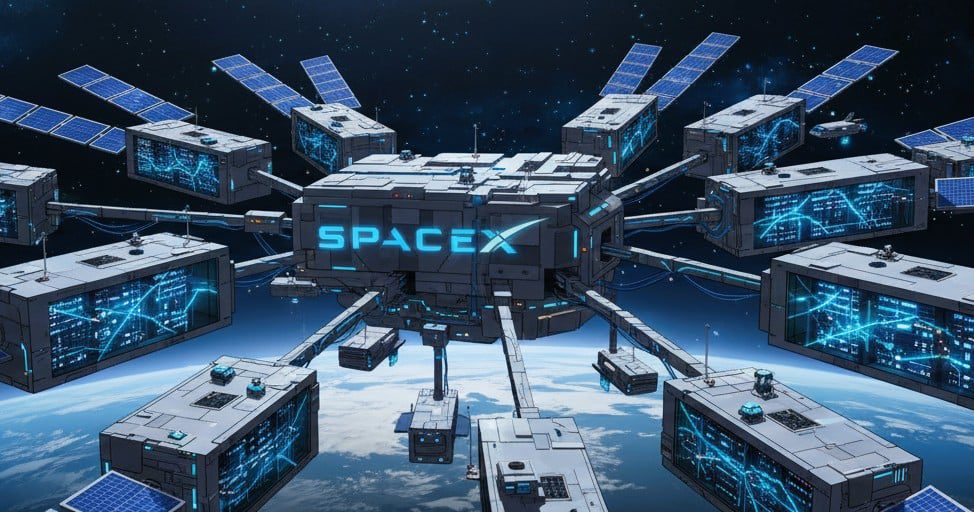
The focus keyword “SpaceX data centre” is back in the headlines as Tesla-founder Elon Musk and his company SpaceX confirm intentions to build data-processing and storage infrastructure in space using their satellite network. This could mark a major shift in how and where data centres operate.
What’s Been Confirmed: SpaceX’s Data Centre Ambition
Here are the key details of the announcement:
- Musk stated publicly that “simply scaling up Starlink V3 satellites … would work” to build large-scale data-processing facilities in orbit.
- The statement came in response to growing interest in space-based computing infrastructure and aligns with similar predictions by other tech leaders.
- While no full blueprint has been released, the concept aims to leverage SpaceX’s existing satellite and laser-link network to host compute and storage off-Earth.
- It is distinct from ground stations or terrestrial data centres — this is about orbiting/space-based infrastructure, not just satellites for connectivity.
Background: Why Space, and Why Now?
Several factors make a space-based data centre concept compelling:
- Data volumes and computing needs (especially AI workloads) continue to grow rapidly, increasing pressure on terrestrial infrastructure.
- Space offers potential advantages: solar power availability (especially in certain orbits), natural cooling in vacuum, and physical isolation (for security/disaster resilience).
- SpaceX already operates the massive Starlink constellation and has ground-station and network edge relationships with companies like Google Cloud and Microsoft.
- Other firms (e.g., Lonestar Data Holdings) are already working to deploy data-centre infrastructure to the moon, signalling broader industry movement. Reuters
Potential Implications of the SpaceX Data Centre Move
Here are six key implications if the plan takes off:
- Global compute & storage re-imagined – Data centres no longer need to be strictly Earth-bound; orbiting infrastructure could host major workloads.
- Edge computing elevated – Having data/compute “in space” reduces dependency on Earth cables or localized centres, enabling new connectivity models.
- Security & resilience – Off-Earth data centres may offer stronger physical resilience (e.g., from terrestrial disasters, potential cyber threats).
- New business models & markets – SpaceX (and partners) could open new revenue streams: “space data centre as a service,” specialised compute/AI in orbit.
- Regulation & infrastructure challenges – Orbital data centres introduce new regulatory, technical and logistics hurdles (launch costs, radiation/cooling, latency, space debris).
- Impact on terrestrial data-centre industry – If viable, ground-based data centres may face competitive pressure, especially for niche use-cases (disaster backup, high-security storage).
What to Watch: Key Questions & Risks
- When and where? – SpaceX hasn’t publicly specified a launch timeline or orbit for the full data-centre facility. The “will be doing this” statement is still high-level.
- Latency & connectivity – For many workloads (real-time, interactive), latency from orbit may be a limiting factor. The business may target storage/disaster-recovery first.
- Cooling & maintenance – Operating compute hardware in space brings unique thermal, radiation and servicing challenges. Repairs/upgrades are much harder than on Earth.
- Launch & cost economics – Even with cheaper launches, sending large compute/storage hardware into orbit remains expensive; economics must work.
- Regulatory & sustainability concerns – Space traffic, orbital hosting agreements, debris mitigation, and jurisdiction issues will matter.
- Proof-of-concept vs commercial rollout – It’s one thing to say an orbiting data centre will happen, another to execute at scale profitably. Skepticism remains.
Conclusion
The confirmation of a possible “SpaceX data centre” marks a bold step into what could become a new frontier of computing infrastructure: orbit. While many details remain unconfirmed, the ambition is clear—and it signals how space- and cloud-based frameworks are converging. Whether this becomes commercially viable or remains an experimental concept will depend on technical, economic and regulatory execution over the coming years.