
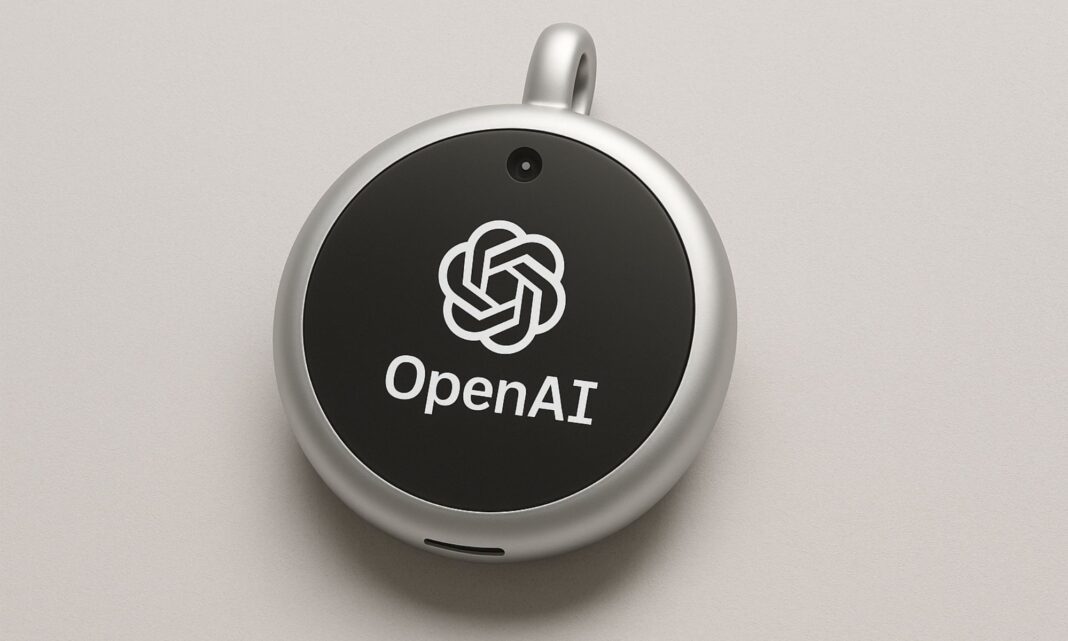
A series of major leaks and patent filings confirmed that OpenAI’s long-awaited debut into consumer hardware will be a pair of AI-powered earbuds named Dime.
Internally codenamed “Sweetpea,” the project is the first tangible result of the $6.5 billion collaboration between Sam Altman and former Apple design chief Jony Ive, whose startup io merged with OpenAI in 2025.
1. The Design: An “Unprecedented” Wearable
Leaked patents and supply chain reports from early 2026 describe a device that moves away from traditional in-ear aesthetics:
- Behind-the-Ear Form Factor: Unlike AirPods, the “Dime” features a behind-the-ear design with two removable, capsule-shaped modules. This allows for larger batteries and better thermal management for “always-on” AI processing.
- Premium Materials: The charging case is reportedly pebble-shaped and made of high-quality metallic or ceramic materials, reflecting Jony Ive’s signature minimalist style.
- Screen-Free Interface: Sam Altman has described the device as “peaceful and calm,” emphasizing voice-first interactions and environmental sensing over distracting screens.
2. Strategic Pivot: Why Earbuds?
Originally, OpenAI was rumored to be building a “phone-killer” or a complex standalone AI computer. However, 2026’s economic reality forced a “start simple” strategy:
- HBM Memory Shortage: Massive global shortages of High Bandwidth Memory (HBM) and rising component costs made a high-end “AI phone” too expensive to produce at scale in 2026.
- The “From Easy to Difficult” Path: By launching an audio-only device first, OpenAI can establish a hardware foothold and gather real-world usage data while waiting for component prices to stabilize.
- Always-On Assistant: The Dime is positioned as an always-available ChatGPT interface, capable of real-time translation, meeting summarization, and hands-free task execution.
3. Technical Powerhouse
Despite being “just earbuds,” the Dime is rumored to pack hardware far beyond standard audio gear:
- 2nm Processor: Early leaks suggest the use of a 2nm smartphone-grade chip (potentially a custom Samsung Exynos solution) to handle local AI tasks.
- Siri Integration: A custom chip is reportedly being developed to allow the device to bypass traditional ecological barriers and execute commands directly on a tethered iPhone via voice.
- Environmental Sensing: The device is expected to “listen” to the environment to provide context-aware help, such as identifying music playing in a room or summarizing a conversation you just had.
4. Launch and Production
- Expected Reveal: A “leaked” Super Bowl ad (which was ultimately pulled in favor of a Codex showcase) suggested a reveal in early 2026, with a formal launch around September 2026.
- Mass Production: OpenAI reportedly aims to manufacture 40 to 50 million units in the first year through partners like Foxconn and Luxshare.
- Price Point: While the final price is unknown, the branding “Dime” (referring to a 10-cent coin) is speculated to reflect either the device’s compactness or a competitive “entry-level” price strategy.
Conclusion: The “AirPods of the AI Era”
The Dime represents OpenAI’s attempt to move beyond the app and become a physical presence in users’ daily lives. By teaming up with Jony Ive to create a “peaceful” wearable, OpenAI is betting that the future of AI isn’t another screen in your pocket, but a constant, intelligent companion in your ear.