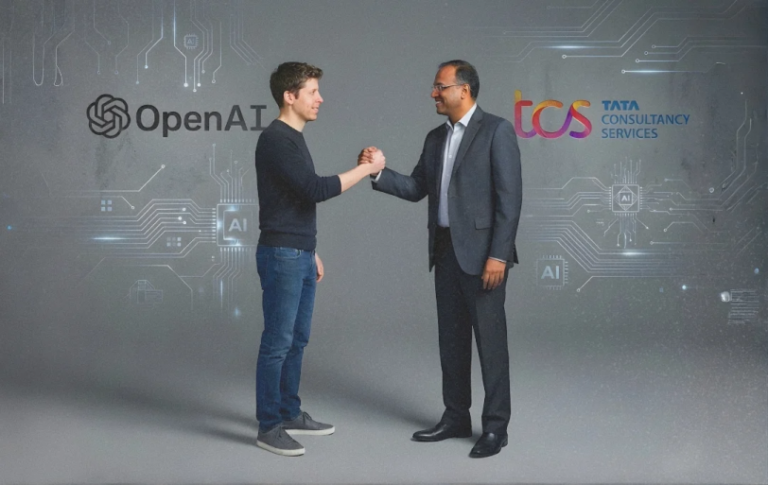
Global AI leader OpenAI is reportedly in advanced discussions with Tata Consultancy Services (TCS) to lease substantial data-centre capacity in India. The plan involves OpenAI becoming an anchor client at TCS’s new data-centre arm HyperVault, leveraging at least 500 MW of data-centre capacity for training and running its AI models locally.
If finalised, this would mark the beginning of OpenAI’s India expansion effort via its global infrastructure initiative Stargate — often referred to as “Stargate India.”
What the Deal Entails: Infrastructure + AI Services
- Data-Centre Lease: OpenAI is negotiating to lease around 500 MW of compute capacity from HyperVault — a large allocation sufficient to run advanced model training and deployment
- Anchor Client Status: As anchor tenant, OpenAI would get preferential access, while HyperVault aims to serve hyperscalers, major enterprises, government agencies, and other AI companies as well.
- Agentic AI Solutions for Enterprises: Beyond infrastructure, the collaboration also aims to co-develop “agentic AI” solutions — i.e. advanced AI tools for enterprise use — targeting sectors like banking, retail, manufacturing and consumer goods.
Why This Matters: For OpenAI, TCS and India’s AI Ecosystem
🇮🇳 Boost to India’s AI Infrastructure
India has been rapidly expanding its data-centre capacity. By hosting OpenAI’s compute infrastructure in India, the country could emerge as a global AI hub — reducing reliance on foreign data-centres, improving data-localization compliance, and enabling faster access to advanced AI models for Indian businesses.
🏢 Transformation for TCS: From Services to AI Infrastructure Leader
For TCS, this is a strategic pivot — a chance to move beyond traditional IT services toward becoming a core AI-infrastructure provider. The firm aims to leverage this deal to cement ambitions of becoming the world’s largest “AI-led services company.”
🚀 Faster AI Adoption for Enterprises
With local compute resources and advanced models available domestically, Indian enterprises in banking, retail, manufacturing and other sectors could deploy AI solutions faster and tailor them to local needs. This could sharply reduce entry barriers for AI, particularly for companies lacking dedicated GPU infrastructure.
🌍 Global Significance: OpenAI’s International Expansion
For OpenAI, “Stargate India” is part of a broader global strategy to decentralize compute infrastructure, improve data-localization, and expand its user footprint outside the US. Having local infrastructure in one of its largest markets enhances performance, compliance, and reach. mint
What’s Next — What to Watch
- Final deal announcement: Reports say a formal announcement may come by the end of 2025, once commercial terms are finalised.
- Actual infrastructure rollout: Building or retrofitting data-centre facilities, ensuring stable power and cooling, and meeting compliance/regulatory requirements will be a major undertaking.
- Enterprise uptake: How quickly Indian businesses — from startups to large corporations — adopt agentic AI solutions from OpenAI + TCS will determine the long-term impact on India’s AI landscape.
- Competition with other global AI-cloud players: As local compute capacity grows, competition from other hyperscalers and AI infrastructure firms (domestic and international) will likely intensify.
What This Means for India’s Tech Future
If the deal goes through, the OpenAI-TCS partnership could catalyze a major shift in India’s AI ecosystem. Indian businesses — big and small — may get access to cutting-edge AI models and infrastructure without heavy upfront investments in GPU clusters. This could democratize AI innovation, speed up enterprise AI adoption, and help India catch up in the global AI race.
Meanwhile, TCS would emerge not just as a software services giant, but as a foundational player in AI infrastructure — helping India build sovereign AI capability and technological independence.
For OpenAI, “Stargate India” offers a strong footprint in one of the world’s fastest-growing AI markets — with local infrastructure, compliance, and a vast user base.
In short: this isn’t just a data-centre deal. It’s a potential turning point for how AI is built, deployed, and used in India — and a big step toward making India a global AI powerhouse.