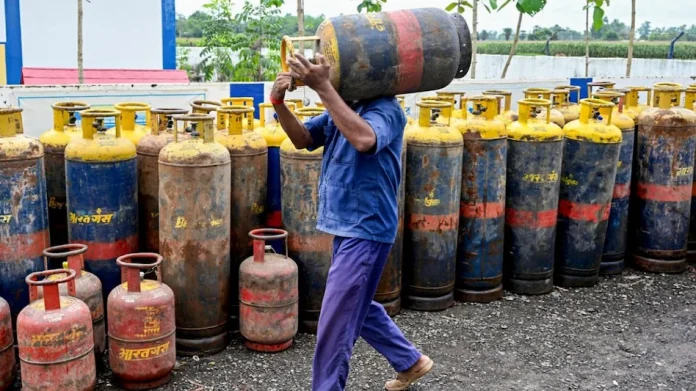


The Ministry of Petroleum and Natural Gas confirmed that state-run Oil Marketing Companies (OMCs)—including Indian Oil (IOCL), Bharat Petroleum (BPCL), and Hindustan Petroleum (HPCL)—continue to suffer an under-recovery of approximately ₹700 on every 14.2-kg domestic LPG cylinder sold. This deficit remains a staggering burden despite the consecutive consumer price hikes of ₹60 on March 7 and ₹29 on June 7, 2026.
1. The Real Cost of Supply vs. Regulated Retail
The under-recovery is driven by a deep structural mismatch between what it actually costs to put a cylinder in an Indian kitchen and what the consumer is legally required to pay at the counter.
- The Actual Cost Structure: The comprehensive cost to procure, land, refine, and distribute a single domestic LPG cylinder has scaled past ₹1,600.
- The Retail Reality: Even after the June 7 increase, a general consumer in New Delhi pays ₹942 for that exact cylinder.
- The Subsidy Blanket: Pradhan Mantri Ujjwala Yojana (PMUY) beneficiaries pay an effective ₹642 once their ₹300 direct benefit transfer (DBT) subsidy kicks in.
Ultimately, general consumers receive a 45% discount relative to international cost-reflective pricing, while vulnerable Ujjwala households receive a 60% discount. The remaining balance represents the ~₹700 structural deficit absorbed directly by OMCs.
2. The Catalyst: The Saudi CP Surge & The Strait of Hormuz Crisis
India depends on foreign imports to cover roughly 54% to 60% of its total domestic LPG consumption. This massive import reliance leaves local energy markets heavily exposed to international volatility
Because India’s landed import bills track the Saudi Contract Price (CP) set by Saudi Aramco at the start of each month, domestic costs have moved in lockstep with the West Asia crisis. The baseline LPG propane-butane blend skyrocketed 46%—surging from $542.50 per tonne in February to $790 per tonne in June 2026. This supply pressure was worsened by shipping freezes in the Strait of Hormuz, forcing Indian refiners to scramble for alternative, longer-haul cargoes from regions like the US, Australia, and Russia.
3. The Commercial Disparity: Market Pricing in Action
To understand what un-modulated market pricing looks like without government intervention, one only needs to look at the 19-kg commercial cylinders utilized by hotels, restaurants, and heavy industries.
Unlike household cooking gas, commercial fuel is allowed to float dynamically with international trends. Driven by five successive rate hikes since the geopolitical crisis broke out, a commercial cylinder in Delhi retails at ₹3,113.50—translating to roughly ₹164 per kg. By contrast, the heavily guarded domestic consumer pays a mere ₹66 per kg.
4. Financial Fallout and Corporate Coping Mechanisms
The fiscal toll on state-run fuel providers has severely strained corporate balances, requiring unprecedented state interventions and strict demand management controls:
Fiscal Under-Recovery Escalation
Because OMCs have absorbed the bulk of global price increases, the cumulative under-recovery burden for domestic LPG has exploded exponentially over the past two fiscal years:
| Financial Year Cycle | Total National LPG Under-Recovery |
| FY 2023-24 (FY24) | ₹1,338 Crore |
| FY 2024-25 (FY25) | ₹41,338 Crore |
| FY 2025-26 (FY26) | ₹60,000 Crore |
To prevent a liquidity crunch that could disrupt fuel procurement and capital expenditures, the Union Cabinet approved an emergency ₹30000 crore budgetary support package to partially offset these balance-sheet losses.
Supply and Demand Adjustments
To manage limited stocks and prioritize essential cooking gas for households, the government and OMCs have introduced structural restrictions:
- Industrial Rationing: Supplies to industrial and commercial segments have been actively rationed.
- Booking Buffer Zones: The mandatory wait times between household cylinder refill bookings have been deliberately widened to 25-to-45 day cycles to prevent hoarding.
- Refinery Redirection: Domestic oil refineries are maximizing their localized LPG output to reduce dependence on vulnerable maritime import pathways.