

For the first time in the history of the internet, humans are no longer the primary generators of web traffic. Data from global web infrastructure giants confirms that automated bits and bytes have officially eclipsed human clicks, keystrokes, and digital interactions.
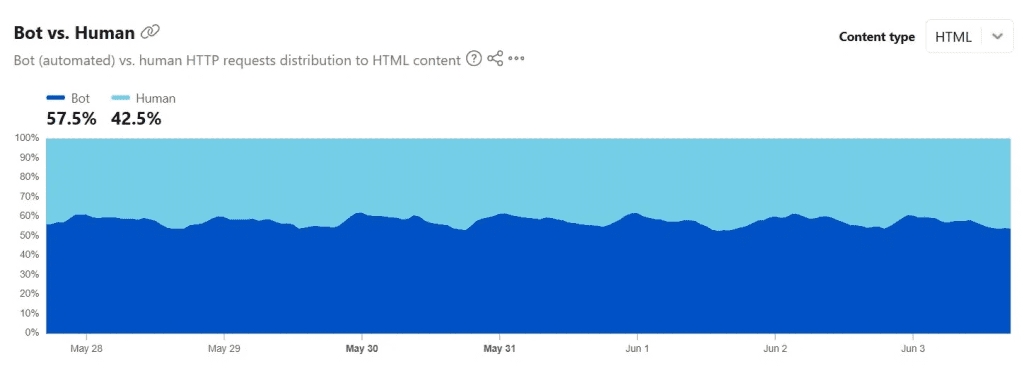
While security firms tracked initial, localized flips as early as late 2024, the broader dam broke wide open recently. According to real-time worldwide intelligence data published by Cloudflare, bots now account for approximately 57.4% of global internet traffic (measured via HTTP requests), leaving humans as the minority at 42.5%.
The Unexpected Acceleration: The Rise of AI Agents
The sudden flip caught even top industry gatekeepers off guard. Cloudflare CEO Matthew Prince admitted that he didn’t expect automated activity to overtake humans until 2027.
“Welp, that happened faster than I predicted,” Prince posted on X. “Thought it would be end of 2027, then early 2027, but agentic traffic growing so fast that bots have now passed human traffic online for the first time in the Internet’s history.”
The Technical Math Behind the Surge
This doesn’t mean there are suddenly more AI bots in existence than actual people. Rather, it highlights the staggering volume disparity in how humans and AI navigate software:
- Human Browsing: If you are shopping for a digital camera or comparison-shopping for flights, you might open five or ten browser tabs, read through them, and make a decision.
- Agentic Browsing: When you prompt an autonomous AI agent or chatbot to find you the best camera deal, the underlying agent reads, scrapes, and indexes thousands of websites simultaneously in a matter of seconds to fulfill that single request.
This hyper-efficient, highly automated multi-step looping generates a colossal amount of traffic and server load that traditional websites are now forced to deal with.
Good vs. Bad: The Darker Side of Automation
The surge isn’t just driven by friendly AI assistants ordering your food or search engine crawlers indexing the news. Security intelligence firm Imperva’s detailed threat reporting shows a parallel, aggressive rise in malicious automation fueled by accessible AI programming tools.
- The Malicious Baseline: “Bad bots”—automated scripts built for data harvesting, credential stuffing, scraping intellectual property, or buying up limited retail stock—comprised a staggering 37% of all global internet traffic over the last year.
- The “As-a-Service” Shift: Generative AI tools have lowered the technical barrier to entry so significantly that even low-skilled bad actors can now deploy highly adaptive, simple bot scripts at a scale never seen before.
- The Hardest-Hit Sectors: The travel and retail industries face the steepest automated battles. Cybercriminals use scripts to target e-commerce checkout platforms and simulate fake flight bookings to manipulate airline seat pricing algorithms.
Geographics: Where Are the Bots?
Interestingly, the digital takeover isn’t uniformly distributed across the globe. Highly automated tech hubs skew heavily toward bot activity, while mobile-first emerging markets tell a completely different story.
| Region / Country | Percentage of Bot Traffic | Percentage of Human Traffic | Context & Infrastructure Footprint |
| Gibraltar | 92.1% | 7.9% | Globally ranks first; deeply saturated by automated financial and data services. |
| Singapore | 76.4% | 23.6% | Massive density of automated tech nodes and localized data center clusters. |
| North America / Europe | High Domination | Low Representation | Driven by mainstream enterprise adoption of AI agent frameworks. |
| India | 15.6% | 84.4% | A major outlier. Traffic remains overwhelmingly human-driven due to a mobile-first ecosystem centered heavily on real-time social apps and media consumption. |
The Visual vs. Textual Divide
The silver lining for real people? Humans still comfortably rule the internet when it comes to bandwidth and rich media consumption.
While bots dominate HTML/text-based page requests (reading articles, scanning databases, and fetching raw data matrices), humans generate roughly 65% of total web activity across apps and media platforms. AI agents are read-and-run scrapers; they aren’t loading maps for directions, streaming 4K video content, or scrolling through photo-heavy social feeds.
Nevertheless, as tech giants look ahead to an internet increasingly built for AI agents to talk directly to other AI agents via APIs, the entire infrastructure and monetization of the public web is hurtling toward a massive, systemic redesign.