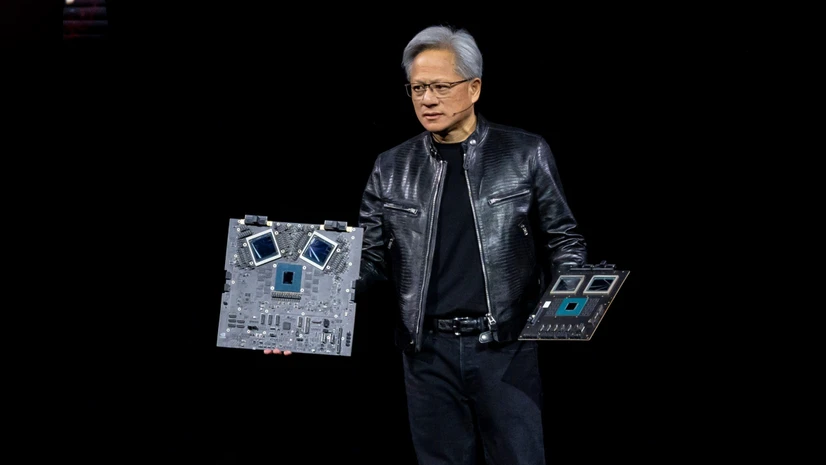

At the GTC 2026 keynote on March 16, 2026, NVIDIA CEO Jensen Huang officially announced that the company is “boldly taking intelligence where it has never gone before.” The center of this mission is the Space-1 Vera Rubin Module, a computing unit engineered specifically for the harsh, radiation-heavy environment of low-earth orbit (LEO).
Moving AI to the “Ultimate Edge”
Traditionally, satellites act as “data pipes,” sending raw imagery and sensor data to Earth-based servers for processing. This creates massive latency and bandwidth bottlenecks. NVIDIA’s strategy is to move the data center to the source.
- Performance Leap: The Space-1 module delivers 25x more AI computing performance than the H100 for space-based inferencing.
- SWaP Optimization: Designed for strict Size, Weight, and Power (SWaP) constraints, allowing high-performance LLMs and foundation models to run directly on small-form-factor satellites.
- Autonomous Discovery: Real-time on-orbit analytics will enable satellites to identify and react to events—such as natural disasters or military movements—without waiting for ground instructions.
The Orbital Ecosystem
NVIDIA isn’t building the satellites itself but is acting as the primary technology provider for a new breed of “Orbital Data Centers” (ODCs).
Six major space-tech partners are already integrating NVIDIA’s space-grade platforms:
- Aetherflux: Developing solar-powered orbital compute clusters.
- Starcloud: Scheduled to launch a “Starcloud-1” satellite in November 2026, which will feature the cosmic debut of the Vera Rubin module.
- Kepler Communications: Using Jetson Orin to manage real-time data routing across its constellation.
- Axiom Space & Planet Labs: Leveraging the platform for mission-critical edge processing and geospatial intelligence.
The Vera Rubin Space Stack
NVIDIA’s space strategy is tiered based on mission complexity:
| Platform | Best For | Key Feature |
| Space-1 Vera Rubin | Orbital Data Centers | 25x faster LLM processing in orbit. |
| IGX Thor | Mission-Critical Edge | Functional safety and secure boot for spacecraft. |
| Jetson Orin | Small Satellites | Ultra-compact vision and navigation processing. |
| RTX PRO 6000 (Blackwell) | Ground Processing | Analyzing space data on Earth 100x faster than CPUs. |
“Poor Economics” or the Future?
While Jensen Huang admitted during a recent earnings call that space computing currently has “poor economics,” he expects the market to reach an inflection point as launch costs fall. The goal is to solve the “energy demand” problem on Earth by tapping into the constant, unfiltered solar energy available in orbit.
“Space computing, the final frontier, has arrived,” Huang stated. “Intelligence must live wherever data is generated.”