
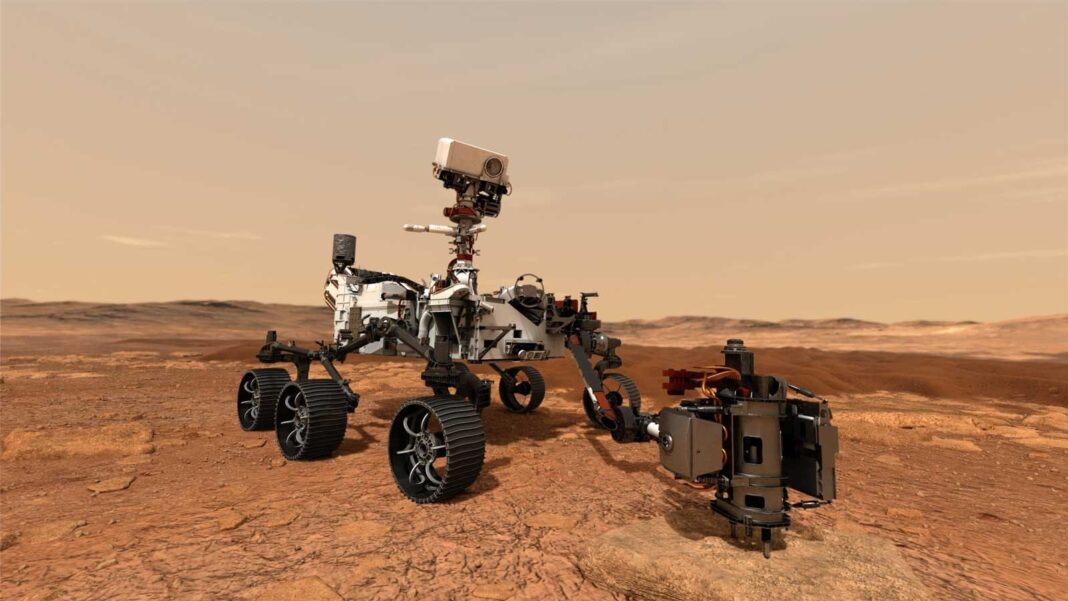
In a groundbreaking milestone for space exploration, NASA officially confirmed on February 2, 2026, that the Perseverance rover successfully completed its first-ever drives on Mars using routes planned by Anthropic’s Claude AI.
The demonstration, led by the Jet Propulsion Laboratory (JPL), saw the rover navigate a total of 456 meters (roughly 1,500 feet) across the rim of Jezero Crater in December 2025. This marks the first time a generative AI model has been used to chart a course for a vehicle on another planet.
1. How Claude “Drove” on Mars
It is important to note that Claude did not “joystick” the rover in real-time. Instead, it acted as a high-level navigator and coder:
- Analyzing Data: Engineers provided Claude with years of mission data and high-resolution orbital imagery from the Mars Reconnaissance Orbiter.
- Generating Code: Using its Claude Code agent, the AI analyzed terrain hazards (like bedrock and sand ripples) and wrote a sequence of waypoints in Rover Markup Language (RML)—the specialized XML-based code NASA uses for its rovers.
- Waypoints: Claude created a “breadcrumb trail” of 10-meter segments, which are fixed coordinates the rover aims for before taking its next set of instructions.
2. The “Safety First” Protocol
Because a $2.4 billion rover cannot be left entirely to a chatbot, NASA implemented rigorous guardrails:
- Digital Twin Verification: Before the commands were beamed to Mars, JPL ran Claude’s route through a virtual replica of Perseverance, testing over 500,000 telemetry variables to ensure the instructions wouldn’t tip or beach the rover.
- Minor Human Tweaks: Engineers made only minor adjustments to Claude’s plan. For example, human drivers used ground-level images (which Claude hadn’t seen) to refine a path around some particularly tricky sand ripples.
3. Why This Matters for 2026
This wasn’t just a publicity stunt; it was a response to critical mission challenges:
- Time Efficiency: JPL estimates that using Claude cuts route-planning time in half. This allows operators to fit in more drives and more science per day.
- Distance Barriers: With a communication lag of up to 24 minutes one-way, “real-time” driving is impossible. AI allows the rover to be more autonomous as it moves farther from Earth.
- Staffing Constraints: Following a 20% workforce reduction at NASA in 2025 due to budget cuts, autonomous tools like Claude have become a “force multiplier” for a smaller engineering team.
4. From “Pokémon” to “Planets”
The tech community has noted the irony of Claude’s rapid evolution. As recently as mid-2025, early versions of the model struggled to navigate the simple 2D world of Pokémon Red. Less than a year later, its successor is successfully navigating the 3D, rock-strewn wilderness of an alien world.
Conclusion: A Glimpse of the Future
NASA roboticist Vandi Verma stated that this is a “blueprint” for future missions. The success of the Perseverance test suggests that future rovers on Europa or Titan—where the signal delay is even longer—will rely heavily on “Agentic” AI to make split-second decisions without waiting for a signal from Earth.