

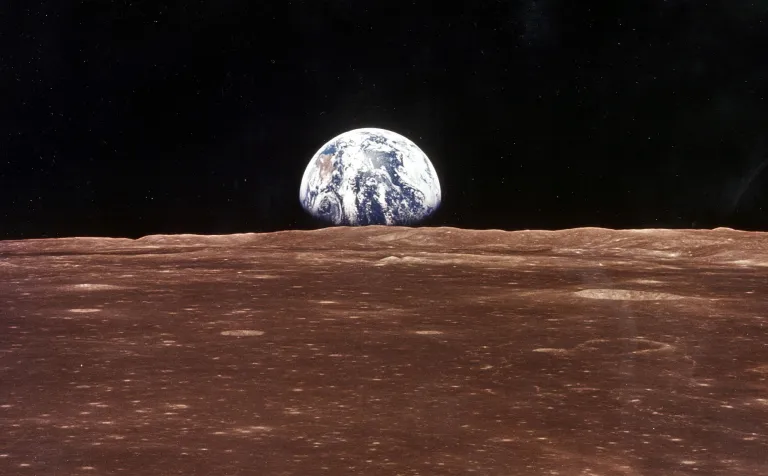
For decades, scientists were puzzled by the presence of “Earth-like” elements in lunar soil samples brought back by the Apollo missions. On January 14, 2026, a study published in Nature Communications Earth & Environment finally provided the answer: the Moon isn’t just a dead rock; it has been quietly absorbing molecules from Earth’s atmosphere for over 3.5 billion years.
The “Magnetic Funnel” Effect
Traditionally, it was believed that Earth’s magnetic field (the magnetosphere) acted as a wall, preventing our atmosphere from leaking into space. However, advanced computer simulations by Professor Eric Blackman and his team at the University of Rochester have flipped this narrative.
- The Mechanism: When the solar wind hits Earth’s magnetosphere, it creates a long “magnetic tail” that stretches past the Moon.
- The Transit: For about five days every month (during the Full Moon phase), the Moon passes through this tail.
- The “Meal”: During this window, ions of oxygen, nitrogen, and hydrogen are stripped from Earth’s upper atmosphere and funneled along magnetic field lines directly into the lunar regolith (soil).
The Moon as Earth’s “Chemical Diary”
Because the Moon has no wind, rain, or plate tectonics to “erase” its surface, the molecules it has “eaten” remain trapped in the soil in chronological layers. This makes the Moon a pristine archive of Earth’s ancient history.
| Element | Source | Significance for Future Missions |
| Nitrogen | Earth’s Atmosphere | Essential for plant growth in lunar colonies. |
| Oxygen | Earth’s Atmosphere | Can be extracted for breathable air and rocket fuel. |
| Water (H₂O) | Earth-Moon Exchange | Potential life-support resource in shadowed craters. |
Why This Discovery Matters for 2026 and Beyond
This research isn’t just about the past; it has massive implications for the future of space exploration and the Artemis missions:
- On-Site Resource Utilization (ISRU): Future astronauts may not need to bring all their nitrogen and oxygen from Earth. They can “mine” the very atmosphere that Earth has been leaking onto the Moon for eons.
- Tracking Life’s Evolution: By analyzing different depths of lunar soil, scientists can “read” how Earth’s atmosphere changed during major biological events, such as the Great Oxidation Event or the rise of land plants.
- Planetary Habitability: The study helps us understand “atmospheric escape” on other planets.16 For instance, it explains why Mars—which lacks a strong magnetic field—lost its atmosphere much faster than Earth.
Conclusion
The Moon is more than just our satellite; it is a chemical twin that has been preserving pieces of our world for billions of years. As we prepare to return to the lunar surface in 2026, we are not just exploring a new frontier—we are visiting a “vault” that contains the forgotten history of our own air.