

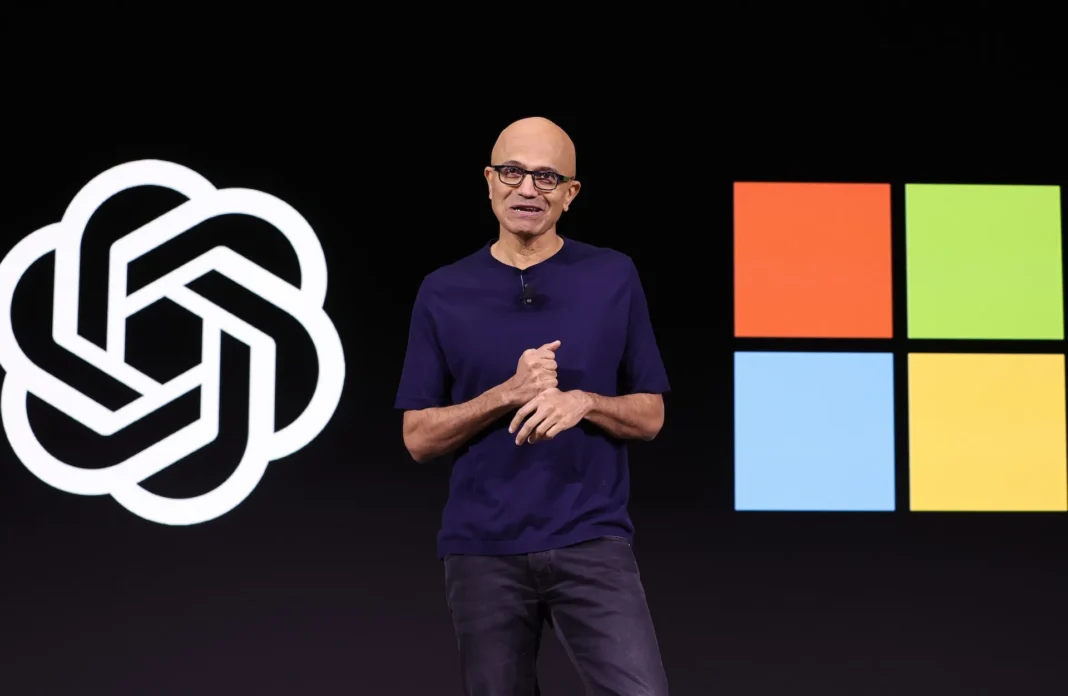
The “open marriage” between Microsoft and OpenAI is facing its most severe stress test yet. According to a Financial Times report on March 18, 2026, Microsoft is actively considering legal action against Amazon and OpenAI over their recently announced $50 billion strategic partnership. Microsoft executives allege the deal violates the exclusivity terms of their long-standing partnership, which mandates that OpenAI’s models be routed primarily through the Azure cloud platform.
The $50 Billion “Frontier” Deal
The dispute centers on OpenAI’s new enterprise platform, Frontier, which allows organizations to deploy fleets of autonomous AI agents.
- The Amazon Deal: Last month, Amazon committed to investing $50 billion in OpenAI, with a key provision making Amazon Web Services (AWS) the “exclusive third-party cloud distribution provider” for Frontier.
- The Technical Loophole: To bypass Microsoft’s Azure exclusivity, OpenAI and Amazon are developing a Stateful Runtime Environment (SRE). This allows AI agents to maintain memory and context (“state”) while operating within a customer’s existing AWS infrastructure.
“Stateful” vs. “Stateless”: The Two Words That Could Launch a Lawsuit
The legal battle hinges on a technical distinction in OpenAI’s contract with Microsoft:
- Stateless APIs (Microsoft’s Claim): Microsoft’s contract grants it exclusivity over OpenAI’s “stateless” models—standard APIs that don’t remember previous interactions. Microsoft insists that even if a product is “stateful,” the underlying intelligence is still powered by the stateless models that belong on Azure.
- Stateful Products (OpenAI’s Defense): OpenAI argues that Frontier is a “first-party product,” not a raw API. Under their revised October 2025 agreement, OpenAI reportedly gained the right to develop “non-API products” with third parties.
“We know our contract. We will sue them if they breach it,” a person familiar with Microsoft’s stance told the Financial Times. “If Amazon and OpenAI want to take a bet on the creativity of their contractual lawyers, I would back us, not them.”
A Relationship in “Phase Three”
This friction follows a major restructuring of the Microsoft-OpenAI relationship in early 2026:
- Equity & Investment: Microsoft currently holds a 27% stake in the newly formed OpenAI Group PBC, valued at approximately $135 billion.
- Diversification: In a sign of the growing rift, Microsoft recently added Anthropic’s Claude to its Copilot ecosystem, ending its “OpenAI-only” era.
- Infrastructure Independence: OpenAI has committed to purchasing an incremental $250 billion in Azure services over the next decade, but Microsoft no longer holds a “right of first refusal” for all of OpenAI’s compute needs.
| Party | Stance | Strategic Interest |
| Microsoft | “Frontier is a breach.” | Protects Azure’s dominance and its $135B investment. |
| OpenAI | “It’s a first-party product.” | Seeks to diversify cloud partners and lower compute costs via Amazon’s Trainium chips. |
| Amazon | “It’s an integration.” | Aims to use OpenAI to drive AWS sales toward a projected $600 billion annual run rate. |
Market Impact
The news has introduced fresh volatility to the tech sector. While Amazon (AMZN) shares rose 1.75% on the strength of CEO Andy Jassy’s bullish $600 billion AI projections, Microsoft (MSFT) saw a slight dip as investors weighed the risk of a protracted legal battle with its most important AI partner.