
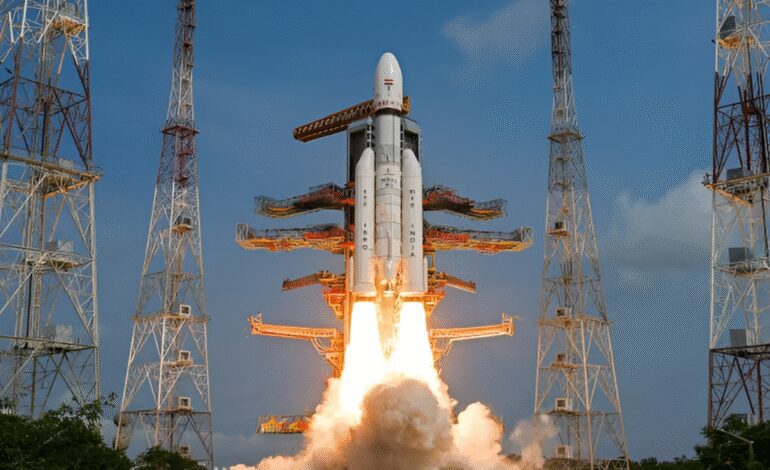
The Indian Space Research Organisation (ISRO) had set an ambitious target of seven major missions between December 2025 and March 2026, but the agency has faced a significant bottleneck, completing only one of those seven objectives as of today.
The information, originally outlined in a government briefing by Union Minister Jitendra Singh, highlights a “pile-up” of critical missions that have now shifted into the second half of 2026.
1. The “1-for-7” Scorecard
Of the seven major missions planned for this four-month window, only one was successfully executed.
| Status | Mission | Date | Description |
| ✅ Success | LVM3 M6 / Blue Bird | Dec 24, 2025 | A commercial mission by NewSpace India Ltd (NSIL) to deploy the Blue Bird Block 2 constellation. |
| ❌ Delayed | Gaganyaan G1 | Was March 2026 | The first uncrewed test flight of India’s human spaceflight program. |
| ❌ Delayed | PSLV C62 / EOS-N1 | Was Jan 2026 | Failed to achieve the intended trajectory during its January 12 attempt. |
| ❌ Delayed | GSLV F17 / EOS-05 | Delayed | A critical Earth Observation satellite launch using the GSLV Mk II. |
| ❌ Delayed | PSLV C63 / TDS-01 | Delayed | Technology Demonstration Satellite mission. |
| ❌ Delayed | PSLV-N1 / EOS-10 | Delayed | The first PSLV built entirely by an Indian industry consortium (NSIL). |
| ❌ Delayed | SSLV-L1 / NSIL | Delayed | An operational commercial flight for the Small Satellite Launch Vehicle. |
2. The Gaganyaan “G1” Setback
The most high-profile delay is the Gaganyaan G1 mission. Originally slated for March 2026, it is now expected to launch in the second half of 2026 (H2 2026).
- Reason for Delay: ISRO is prioritizing “Zero-Failure” reliability. While the mission is 90% complete, the agency is conducting an additional 8,000 ground and structural tests to ensure the human-rated LVM3 rocket and crew module are perfect.
- The Payload: This mission is critical as it will carry Vyommitra, the humanoid robot designed to simulate human behavior and monitor life-support systems during re-entry.
3. Technical Troubles: The NavIC Crisis
Compounding the launch delays is a growing concern regarding India’s indigenous GPS system, NavIC (IRNSS).
- Clock Failures: In March 2026, the atomic clock on the IRNSS-1F satellite failed after completing its 10-year life.
- The “3-Satellite” Limit: Currently, only three satellites in the NavIC constellation have fully functional atomic clocks. While the system still works, its precision is degraded, making the upcoming NVS-02 (GSLV F15) launch—intended to refresh the constellation—a top priority for 2026.
4. Recent Small Wins (March 2026)
While the major launches were missed, ISRO did achieve several technical milestones last month:
- CE20 Engine Test: Successfully completed a 22-ton thrust hot test for the cryogenic engine that will power the Gaganyaan missions.
- ESA Partnership: Signed a new agreement with the European Space Agency for joint Earth Observation data calibration.
5. What’s Next?
The “launch jam” means that the remaining nine months of 2026 will be incredibly dense. ISRO is expected to attempt a “launch-a-month” pace starting in May to clear the backlog of Earth Observation (EOS) and commercial satellites.