

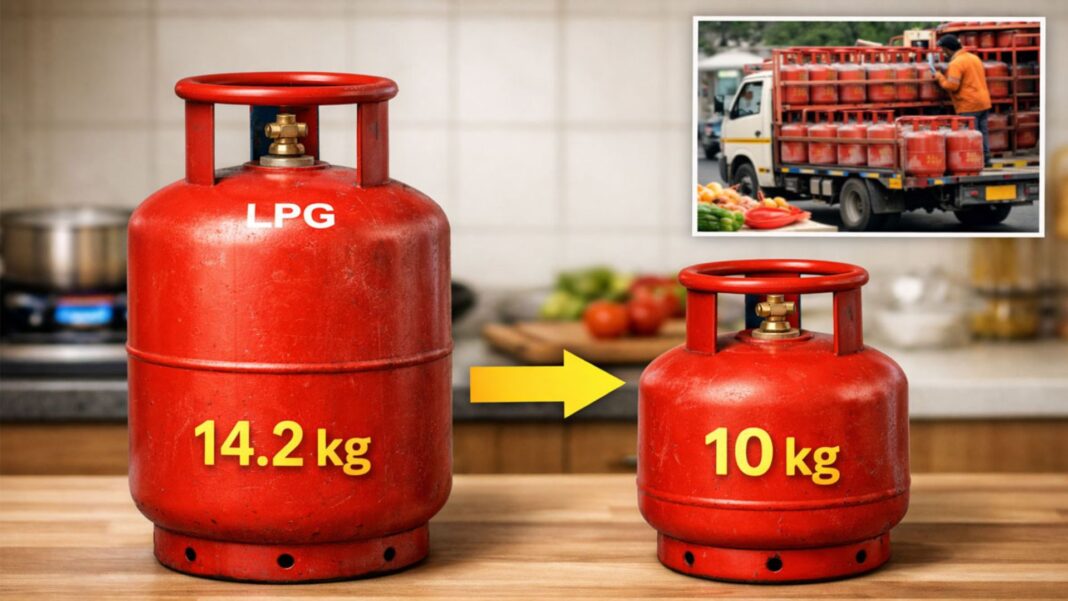
In a move to manage the most severe energy crisis in recent history, the Government of India and state-run Oil Marketing Companies (OMCs) are reportedly exploring a proposal to supply only 10 kg of LPG in the standard 14.2-kg domestic cylinders. As of March 23, 2026, this contingency plan is being considered to ensure equitable distribution as inventories fall to critical levels due to the Strait of Hormuz blockade.
The Rationale: Stretching the Stock
The “lesser-fill” strategy is rooted in basic arithmetic to prevent a total dry-out of domestic stocks.
- Wider Coverage: A standard 14.2-kg cylinder typically lasts a household 35–40 days. By reducing the fill to 10 kg, the same amount of bulk LPG can serve 40% more households, extending the national stock buffer.
- Monthly Cycle: A 10-kg refill is estimated to last a typical family nearly a month, which aligns with the current mandatory 25-day booking interval in urban areas.
- Proportionate Pricing: If implemented, the price of the cylinder would be slashed proportionately, ensuring consumers only pay for the 10 kg of gas they receive.
Comparison: Standard vs. Emergency Supply
| Feature | Standard Supply | Proposed Emergency Supply |
| Quantity | 14.2 kg | 10 kg (Potential for 7 kg in high-stress zones) |
| Duration | 35–40 Days | ~25–28 Days |
| Cylinder Type | Existing 14.2-kg Steel | Existing 14.2-kg Steel (with revised labeling) |
| Price (Delhi) | ~₹913 | ~₹645 (Estimated proportional price) |
| Booking Interval | 25 Days (Urban) / 45 (Rural) | Likely to be revised to 30 days |
Technical and Regulatory Hurdles
While the plan is being discussed as a “Plan B,” industry executives from IOCL, BPCL, and HPCL have flagged several operational challenges:
- Recalibration: All bottling plants nationwide would need to recalibrate their electronic weighing and filling systems for the lower target weight.
- Labeling: To prevent confusion and allegations of “pilferage” (theft), every cylinder would require a new, highly visible Revised Quantity Sticker.
- Regulatory Approval: The shift requires formal clearance from the Petroleum and Explosives Safety Organization (PESO) and an amendment to the LPG Control Order.
- Political Sensitivity: With key state elections approaching, the government is wary of the optics of “giving less for more frequent bookings,” even if the unit price is lower.
The Supply “Drought” (March 2026 Stats)
The Petroleum Ministry has described the current supply situation as “worrisome.”
- Import Reliance: India imports 60% of its LPG, with 90% previously coming through the Strait of Hormuz.
- Tanker Status: Only two carriers (carrying ~92,700 tonnes) crossed the Strait last week—barely enough to cover one day of national consumption.
- Strategic Reserves: India’s current stocks are estimated to last roughly 20–25 days at current restricted consumption levels.
“The focus is on conserving supplies while maintaining access for households,” an industry executive told The Economic Times. “Supply conditions may worsen in the coming weeks, leaving us with very few options other than smaller refills.”