

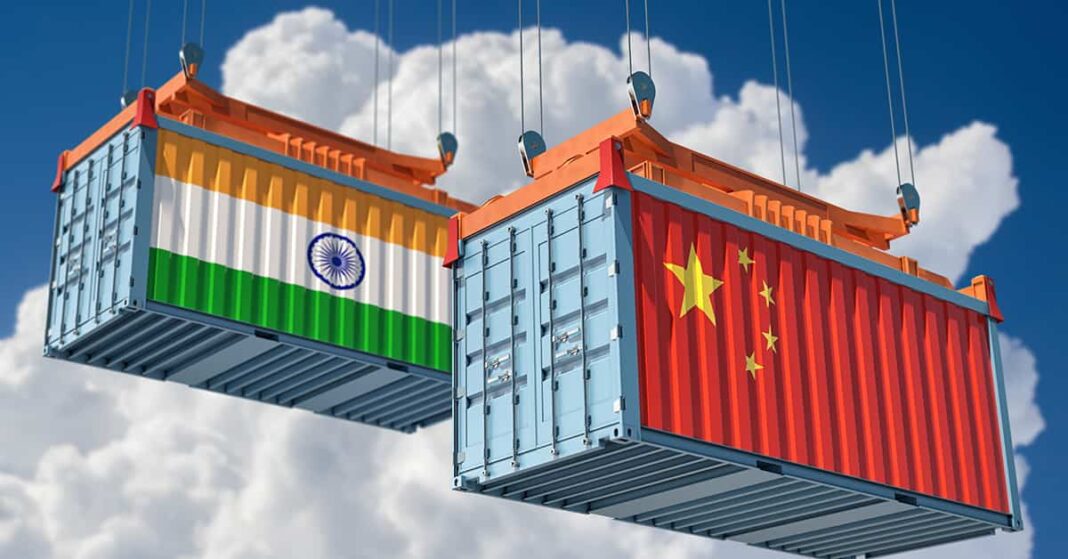
India’s economic ties with its largest trading partner are coming under sharper focus as India’s trade deficit with China is projected to hit $106 billion by 2025, according to trade estimates and industry analysis. The widening gap reflects India’s heavy dependence on Chinese imports despite efforts to boost domestic manufacturing and diversify supply chains.
The trend has sparked renewed debate around trade policy, self-reliance, and strategic dependence.
India–China Trade Deficit Set to Widen
Data and projections suggest that India’s imports from China are growing much faster than its exports, pushing the trade deficit toward the $106 billion mark by 2025. This would represent one of the highest bilateral trade deficits India has with any country.
While overall trade volumes continue to rise, the imbalance remains a key concern for policymakers.
Why India’s Trade Deficit With China Is Rising
Several factors are driving the projection that India’s trade deficit with China to hit $106B by 2025:
- Heavy imports of electronics, machinery, and components
- Dependence on China for APIs and pharmaceutical inputs
- Large inflow of consumer electronics and EV components
- Slower growth in Indian exports to China
- Price competitiveness of Chinese manufacturing
China remains deeply embedded in India’s industrial supply chains.
Key Sectors Driving Imports From China
India’s imports from China are concentrated in strategic and high-volume sectors such as:
- Electronics and smartphones
- Solar panels and renewable energy equipment
- Electrical machinery and capital goods
- Chemicals and pharmaceutical ingredients
- Auto and EV components
These imports are critical for India’s manufacturing and infrastructure growth, making rapid substitution difficult.
Exports Lag Behind Imports
While India exports iron ore, cotton, chemicals, and some engineering goods to China, export growth has not kept pace with rising imports. Market access barriers, limited product diversification, and China’s domestic production capacity constrain Indian export expansion.
This imbalance is central to why India’s trade deficit with China to hit $106B by 2025 is becoming increasingly likely.
Impact on India’s Economy
A widening trade deficit can:
- Increase pressure on the current account balance
- Expose the economy to external supply shocks
- Impact currency stability during global volatility
- Raise strategic and geopolitical concerns
However, economists note that imports from China also support domestic manufacturing and consumer demand.
Government Efforts to Reduce Dependence
India has introduced several measures to address the imbalance, including:
- Production-Linked Incentive (PLI) schemes
- Push for domestic electronics manufacturing
- Import monitoring and quality controls
- Encouraging supply chain diversification
- Strengthening trade ties with alternative partners
Despite these efforts, replacing China at scale remains challenging in the short term.
Strategic and Geopolitical Context
The projection that India’s trade deficit with China to hit $106B by 2025 also carries strategic implications. Economic dependence intersects with geopolitical tensions, prompting calls for long-term supply chain resilience rather than abrupt decoupling.
Experts suggest a calibrated approach focused on critical sectors.
What Experts Say
Trade analysts believe narrowing the deficit will require:
- Expanding high-value manufacturing in India
- Improving export competitiveness
- Negotiating better market access
- Investing in technology and scale
- Long-term industrial policy continuity
They caution that trade rebalancing is a multi-year process.
Outlook Beyond 2025
While the deficit may peak in the near term, its trajectory will depend on how quickly India can scale domestic production and diversify imports. Global supply chain shifts, technology investment, and policy execution will play a decisive role.
The $106 billion figure may become a turning point in India’s trade strategy.
Conclusion
The projection that India’s trade deficit with China to hit $106 billion by 2025 highlights the depth of economic interdependence between the two countries. While imports from China remain vital for growth, the rising imbalance underscores the urgency of building stronger domestic manufacturing and export capacity.
How India manages this trade relationship will be critical for its economic and strategic future.