

Indian government has increased the Special Additional Excise Duty (SAED)—commonly known as the windfall profit tax—on the export of diesel and Aviation Turbine Fuel (ATF). The revised rates are officially effective for the fortnight starting June 16, 2026.
The decision follows the government’s standard fortnightly review, which recalibrates export levies based on international oil price volatility and refining margins.
The New Export Duty Architecture
The Ministry of Finance issued a formal gazette notification detailing the upward revisions. The primary target of the latest hike is jet fuel, which absorbed a more aggressive correction:
- Diesel Exports: The SAED has been marginally increased to ₹14.00 per litre, up from the previous rate of ₹13.50 per litre.
- ATF (Jet Fuel) Exports: The duty has been raised sharply to ₹12.50 per litre, marking a ₹3 increase from the previous baseline of ₹9.50 per litre.
- Petrol Exports: The levy remains completely unchanged, holding steady at the low baseline of ₹1.50 per litre.
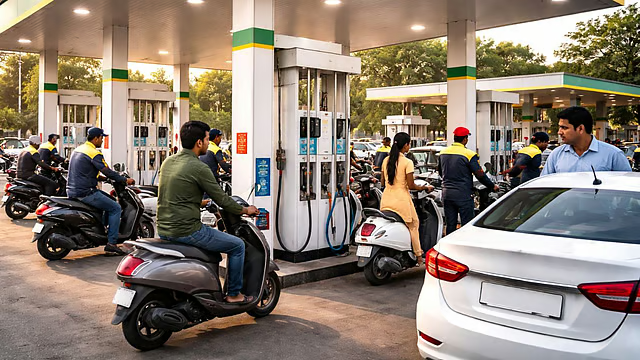
- Domestic Consumer Impact: The government explicitly clarified that there are no modifications to the excise duties on fuel cleared for domestic consumption. Retail prices at the pump for ordinary Indian consumers remain completely unaffected by this specific export adjustment.
The Strategic Intent: Supply Security & West Asia Friction
The export levies were originally reintroduced on March 26, 2026, as a stabilizing measure when the outbreak of conflict in West Asia sent global crude oil and product margins soaring. While the recent announcement of a draft U.S.-Iran peace framework has started to cool benchmark crude futures down toward the $83-per-barrel mark, the domestic supply landscape inside India remains tightly balanced.
The government’s primary objective in raising the duties is twofold:
- Disincentivizing Overseas Shipping: By clipping the export profit margins of large private and public-sector refiners (such as Reliance Industries), the tax makes selling fuel abroad less lucrative. This forces refiners to prioritize routing their production back into the domestic grid.
- Easing Retail Strain: The Ministry of Petroleum recently flagged localized inventory strain at domestic fuel stations. In May, nearly 42 crore litres of diesel consumption abruptly shifted away from commercial bulk-buyer pumps and directly onto retail consumer outlets. By tightening export rules and maintaining separate retail supply caps (currently holding at 200 litres per person per day for commercial buyers), the government is using the windfall tax as a shield to prevent structural domestic fuel shortages while global refining corridors gradually normalize.