
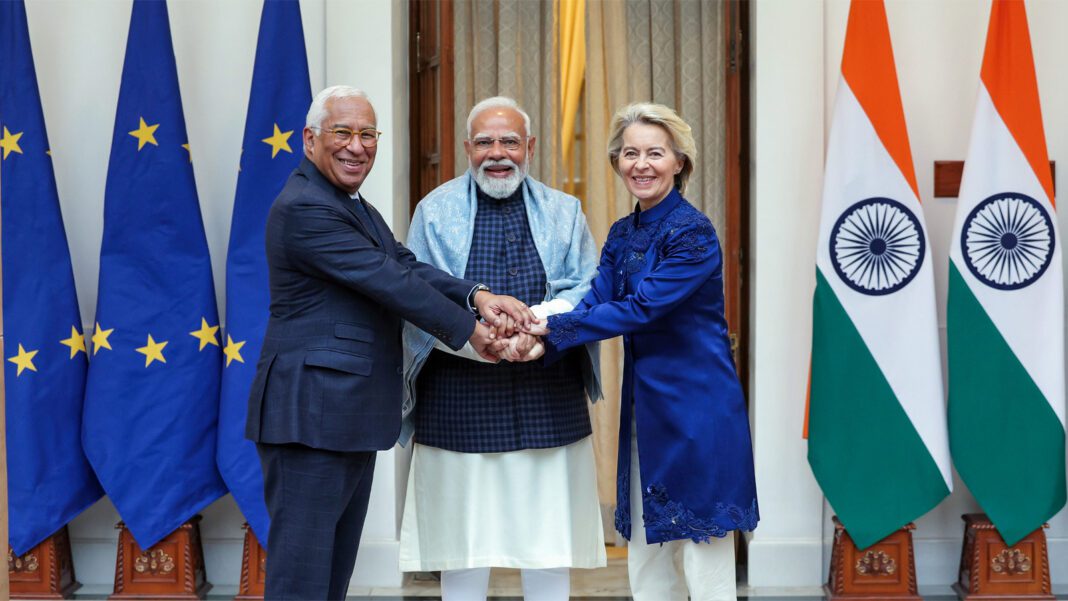
In a historic move hailed as the “mother of all trade deals,” India and the European Union (EU) officially concluded negotiations for their Free Trade Agreement (FTA) on Tuesday, January 27, 2026.
The agreement, finalized during the 16th India-EU Summit in New Delhi, is expected to save European exporters approximately €4 billion ($4.75 billion) annually in customs duties. This landmark pact ends an 18-year journey and creates a free trade zone covering nearly 2 billion people and 25% of global GDP.
1. The €4 Billion Windfall: Where the Savings Come From
The EU expects the agreement to double its merchandise exports to India by 2032 by eliminating or reducing tariffs on 96.6% of EU goods.
Major Industrial Gains
The most significant savings for European industry come from sectors previously hindered by “prohibitive” Indian tariffs:
- Machinery & Electrical Equipment: Duties of up to 44% will be eliminated for almost all products.
- Chemicals: Tariffs of up to 22% will be removed across nearly all product lines.
- Pharmaceuticals: Current 11% tariffs will be mostly abolished, potentially lowering costs for lifesaving therapies.
- Automobiles: In a historic concession, India will slash tariffs on EU-made cars from 110% to 10% (under an annual quota of 250,000 vehicles).
- Aviation: Near-blanket removal of tariffs (up to 11%) on aircraft and spacecraft components.
2. The Agri-Food Reset
European farmers and food producers gain “privileged access” to India’s 1.45-billion-strong consumer market, with duties on many luxury goods falling toward zero.
| Product Category | Current Indian Tariff | New FTA Tariff |
| Wine (Premium) | 150% | 20% (Phased reduction) |
| Spirits (Whisky, Gin) | 150% | 40% |
| Beer | 110% | 50% |
| Olive Oil & Veg Oils | Up to 45% | 0% |
| Processed Foods | Up to 50% | 0% (Chocolates, biscuits, pasta) |
3. Strategic “Quid Pro Quo” for India
While Europe saves on duties, India has secured vital market access to offset its own trade challenges:
- Labor-Intensive Exports: India gains immediate zero-duty access to the EU for textiles, apparel, leather, footwear, and gems & jewelry—sectors currently facing tariffs of 4% to 26%.
- Climate Support: The EU has committed €500 million ($543 million) over the next two years to support India’s green transition and help Indian firms comply with the Carbon Border Adjustment Mechanism (CBAM).
- Talent Mobility: A separate pact on the mobility of Indian professionals was signed, easing visas for researchers, students, and IT experts.
4. Implementation Timeline
Although the “Mother of All Deals” is finalized, the actual savings will follow a structured rollout:
- Legal Vetting: The text will undergo 5–6 months of “legal scrubbing.”
- Formal Signing: Expected in mid-to-late 2026.
- Ratification: Requires approval from the European Parliament and Indian authorities.
- Entry into Force: Most tariff cuts will begin in early 2027, with some (like cars and EVs) following a 5-to-10-year phased reduction schedule.
Conclusion: A Strategic Shield
Prime Minister Modi and EU Commission President Ursula von der Leyen framed the deal as a “strategic shield” against global economic turbulence and a hedge against fragmented trade relations with the US and China. By saving €4 billion annually, European firms can now compete more aggressively in the world’s fastest-growing large economy, while India cements its position as a global manufacturing hub.