
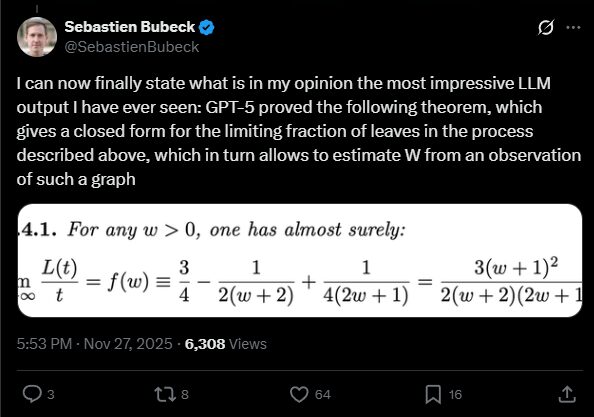
The emergence of GPT-5 has sparked excitement across the AI community. A lead researcher from OpenAI recently claimed that GPT-5 delivers “the most impressive LLM output yet,” citing a dramatic jump in abilities — from mathematical problem-solving to complex code generation and reasoning tasks.
As generative AI grows more integral to work, creativity, and research, GPT-5’s boost could mark a turning point in how we use AI — but it also raises questions about limitations, oversight, and reliability.
What GPT-5 Does Better — Key Advances
✅ Stronger Reasoning, Math & Coding Skills
- On coding benchmarks such as SWE-bench Verified and Aider polyglot, GPT-5 reportedly outperforms previous models significantly
- For complex mathematical tasks, GPT-5 has been credited with helping researchers solve longstanding problems in optimization theory — a task that previously could take months of manual effort
- In real-world codebases, GPT-5 can generate production-ready code, debug software, and handle multi-step, agentic tool usage — offering developers a powerful new assistant.
🔍 Improved Consistency, Reasoning Depth & Reliability
- GPT-5 is designed as a “routed pair” — combining a fast version for quick responses and a “thinking” version for deep reasoning, allowing it to handle both casual and complex tasks effectively.
- In tests involving medical reasoning (e.g. on ophthalmology question-answering), certain configurations of GPT-5 achieved very high accuracy, outperforming earlier models.
- It also shows improved long-context and instruction-following capabilities, helping with multi-step workflows that earlier models struggled with.
📈 Versatile Use — From Research to Real-World Applications
- Because of its strengths, many see GPT-5 not just as an advanced chatbot, but as a general-purpose AI collaborator — able to assist in coding, research, creative writing, data analysis, and more. WIRED
- For organizations and developers, GPT-5 offers a more powerful “AI-on-demand”: whether building software, solving scientific problems, or automating routine tasks, the model can accelerate productivity at scale.
What the “Most Impressive LLM Output Yet” Claim Means
When an OpenAI researcher calls GPT-5 the “most impressive LLM output yet,” it’s a strong signal about how much generative-AI capabilities have shifted. It suggests that:
- We may be entering a new era where AI can reliably assist in advanced reasoning, programming, and research tasks, not just simple writing or chat.
- AI tools might increasingly shift from novelty to practical utility — useful to scientists, developers, businesses, and creatives alike.
- The pace of AI adoption could accelerate — as tools like GPT-5 lower barriers for complex tasks, enabling more people to build software, analyze data, or explore research.
Why Caution Is Still Warranted — Limits & Open Questions
- Though GPT-5 is strong in math and coding, its performance in more subjective or open-ended domains (arts, nuanced writing, complex human-centered reasoning) may still lag — and in those areas it remains “impressive but not perfect.”
- Even with better reliability and fewer “hallucinations,” no AI is infallible — mistakes may still happen, especially in high-stakes domains like medicine, law, or scientific research.
- Over-reliance on AI might introduce risks: ethical concerns, overconfidence in model outputs, insufficient human oversight, or misuse if not properly governed.
- As AI becomes more powerful, broader questions around employment, creativity, intellectual property, and social impact remain critically important.
What to Watch Next — What Comes After GPT-5
- Independent audits and academic evaluations of GPT-5’s performance — especially in real-world settings like scientific research, software development, or medical reasoning.
- How developers and organizations adopt GPT-5: whether it becomes a standard “AI collaborator” for everyday work, not just a toy.
- Regulatory and safety measures for powerful AI — especially as models move from toy-level chatbots to productivity-critical tools.
- Competitors’ responses: other large models (from other labs) trying to match or surpass GPT-5’s capabilities, spurring an arms race in AI capabilities and safety research.
Conclusion
GPT-5 stands out as a major leap forward in generative-AI capability. With stronger reasoning, coding, math, and real-world task performance, it represents what many believe is the “most impressive LLM output yet.” For users, developers, researchers — GPT-5 promises to be more than just a fancy chatbot. It could become a powerful collaborator, capable of speeding up work, unlocking new possibilities, and reshaping how we use AI across domains.
But with great power comes great responsibility. As we embrace GPT-5’s potential, we must also stay mindful of its limits, risks, and societal impact.