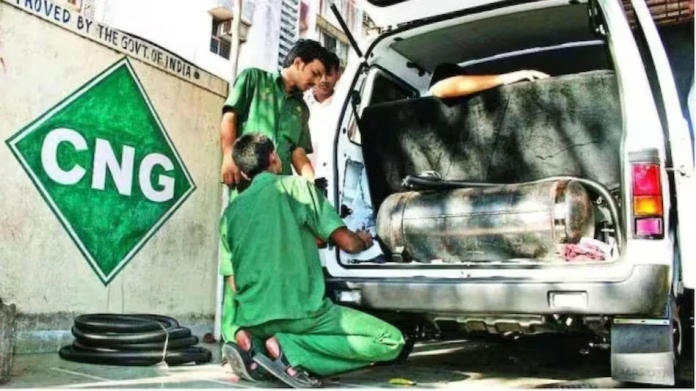


The cost of daily commuting and public transport across urban India is facing intense inflationary pressure. On Tuesday, May 26, 2026, city gas distribution majors led by Indraprastha Gas Limited (IGL) announced a fresh price hike for Compressed Natural Gas (CNG) by ₹2 per kilogram.
With this latest revision, the retail price of CNG in the national capital of Delhi has climbed to a historic ₹83.09 per kg.
The announcement has triggered widespread frustration among auto-rickshaw drivers, taxi aggregators, and commercial logistics operators, as it marks the fourth distinct CNG price hike in less than two weeks, systematically eroding the cost advantage that green fuels traditionally held over fossil alternatives.
The Velocity of the Hike: 4 Price Revisions in 11 Days
The velocity of the recent price revisions has caught consumers completely off guard. After a prolonged period of price stability stretching across more than two years, the domestic fuel pricing mechanism has undergone a rapid series of upward adjustments following systemic global supply shifts.
Even after absorbing this sharp ₹6 cumulative jump, IGL maintained in a consumer brief that CNG still delivers up to 45% running cost savings when compared side-by-side with conventional petrol-powered vehicles at current localized market prices.
Regional Price Variations Across Major Cities
Because retail fuel prices vary significantly from state to state depending on the implementation of local Value Added Tax (VAT) structures and provincial transport levies, the financial impact shifts by geography:
| Metro Region / City | New Retail CNG Price (per Kg) | Primary Network Operator |
| Delhi (NCR) | ₹83.09 | Indraprastha Gas Limited (IGL) |
| Mumbai | ₹84.00 | Mahanagar Gas Limited (MGL) |
| Noida / Greater Noida | ₹89.70 | Indraprastha Gas Limited (IGL) |
| Ghaziabad | ₹89.70 | Indraprastha Gas Limited (IGL) |
While CNG and auto fuels continue their parallel upward trajectories, oil marketing companies (OMCs) have notably left the retail pricing structure of Piped Natural Gas (PNG) supplied to household kitchens and domestic LPG cylinders completely unchanged for the current billing cycle.
Why are Fuel Prices Skyrocketing in India?
The domestic spike is a direct reaction to extreme geopolitical volatility in West Asia. Global energy supply corridors have faced deep disruptions following US-Israeli military strikes on Iran, which led to the virtual closure of the strategically critical Strait of Hormuz since March 1.
Because one-fifth of the world’s liquefied natural gas (LNG) and crude oil shipments navigate through this single narrow waterway, the prolonged maritime blockade has sent international energy benchmarks into a tailspin. International Brent Crude oil prices have surged more than 50% since late February, hovering around $98 per barrel, while West Texas Intermediate (WTI) continues to trade near the $91 per barrel threshold.
The OMC Revenue Strain
State-run fuel retailers—including Indian Oil Corporation (IOC), Bharat Petroleum (BPCL), and Hindustan Petroleum (HPCL)—had artificially shielded domestic consumers from rising import costs for nearly two and a half months to prevent broad-based macroeconomic inflation.
According to Petroleum Ministry disclosures, before the price revision cycle resumed on May 15, India’s OMCs were absorbing staggering collective operational losses of ₹1,000 crore per day. Even after executing four aggressive rounds of retail hikes across petrol, diesel, and CNG, OMCs continue to operate at a daily deficit of slightly less than ₹600 crore.
Broad Impact: Public Transport Braces for Fare Revisions
The compounding fuel price increases have triggered an immediate crisis for urban public transit systems. On Monday, May 25, petrol and diesel prices were similarly raised by up to ₹2.87 per litre, pushing Delhi petrol past the psychological barrier to hit ₹102.12 per litre for the first time since 2022.
With both alternative and standard fuels hitting multi-year highs simultaneously, passenger transport unions are signaling that the status quo is completely unsustainable. Local auto-rickshaw alliances and app-based cab driver associations across Delhi-NCR and Mumbai have already approached local transport authorities to demand an immediate 15% to 20% upward revision in base passenger fares to help operators recover their basic daily operational overheads.