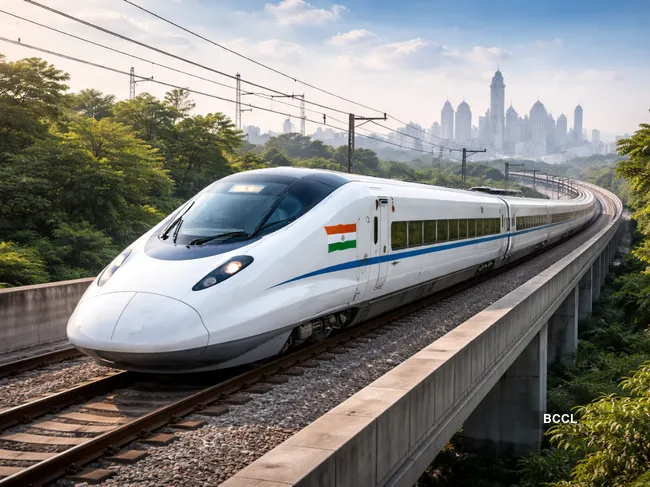
Indian government is significantly overhauling its infrastructure policies to attract private investment for its ambitious bullet train expansion. While the first corridor (Mumbai–Ahmedabad) has been primarily state-funded, the Union Budget 2026–27 has set the stage for a ₹16 lakh crore expansion that relies heavily on a new Public-Private Partnership (PPP) model.
The “Rebooted” PPP Policy (March 2026)
To address the “funding gap” for the seven newly announced high-speed rail (HSR) corridors, the Ministry of Railways today proposed the most significant changes to its PPP framework in over a decade.
- 50-Year Concessions: To ensure private investors can recover their massive capital outlays, the government is extending the “lease” or concession period for rail projects from the current 20–35 years to 50 years.
- Zero Land Risk for Investors: In a major policy shift, the Indian Railways will now bear 100% of the responsibility and cost for land acquisition. Private partners will only enter once the “right of way” is secured, removing the single biggest cause of project delays and cost overruns.
- Asset Monetization: The government is eyeing the monetization of existing rail assets to create a “seed fund” that will de-risk new bullet train projects for private developers.
Target: 7 New Corridors (₹16 Lakh Crore)
The government’s “Viksit Bharat” vision, outlined by Railway Minister Ashwini Vaishnaw on March 3, 2026, aims for a total HSR network of 21,000 km in the long term. The immediate priority is the 4,000 km of new corridors approved this month:
| Corridor | Status (March 2026) |
| Delhi–Varanasi | DPR (Detailed Project Report) complete; fast-tracked for 2026 bidding. |
| Mumbai–Pune–Hyderabad | Identified as a high-density route for private “Build-Operate-Transfer” (BOT). |
| Chennai–Bengaluru | Part of the “Southern HSR Triangle” connecting major tech hubs. |
| Varanasi–Patna–Siliguri | Planned as a strategic connector for Eastern India. |
Mumbai–Ahmedabad (MAHSR) Update
While the new corridors look toward private capital, the first bullet train project remains a government-to-government (G2G) flagship with Japan.
- Cost Surge: The total cost of the Mumbai–Ahmedabad line has reached ₹1.98 lakh crore ($21.5 billion), nearly double the original 2017 estimate.
- Self-Reliance: On March 4, 2026, senior officials confirmed the government will not seek additional JICA loans to cover this overrun; instead, the Indian Railways will absorb the extra ₹90,000 crore through its own capital expenditure.
- Timeline: The Surat–Vapi (100 km) section is on track for an August 2027 launch, with the full line operational by December 2029.
Indigenous “Bullet” Technology
In tandem with private investment, India is pushing for technological sovereignty:
- Vande Bharat 280: The Integral Coach Factory (ICF), in collaboration with BEML, is currently manufacturing indigenous high-speed train sets with a design speed of 280 km/h. These are expected to be the “affordable” alternative for HSR corridors where Shinkansen technology isn’t mandated.
Corporate Activity
Major Indian firms are already positioning themselves for this new private-led era:
- L&T and Siemens: These companies secured the bulk of the civil and signaling contracts for the MAHSR project and are seen as the “lead bidders” for the upcoming PPP corridors.
- Rail Merger: Today (March 9), the Ministry proposed merging RVNL and IRCON International to create a single, integrated “global giant” capable of competing for high-speed rail projects internationally.