
In a move that signals the “TCP/IP moment” for retail, Google CEO Sundar Pichai announced the launch of the Universal Commerce Protocol (UCP) at the 2026 National Retail Federation (NRF) conference. This new open standard is designed to allow AI agents to navigate the entire shopping journey—from product discovery to final payment—across different platforms without the user ever leaving the chat interface.
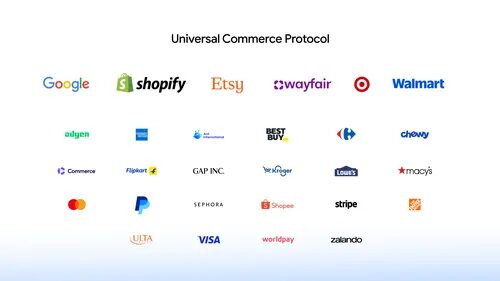
By partnering with retail giants like Shopify, Etsy, Wayfair, Target, and Walmart, Google is laying the groundwork for a world where your AI assistant doesn’t just find products but actually buys them for you.
What is the Universal Commerce Protocol (UCP)?
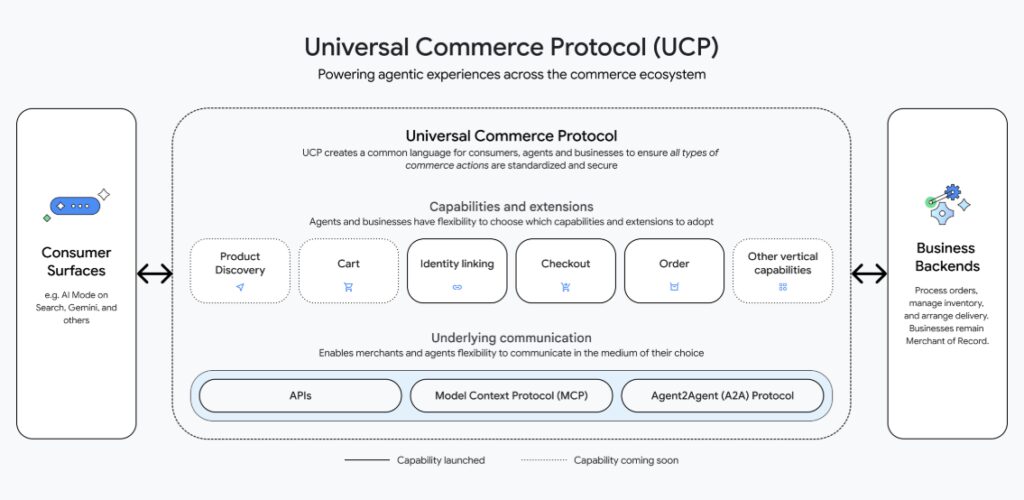
UCP is an open-source, vendor-agnostic standard that creates a “common language” between AI systems (like Gemini) and commerce platforms. Historically, shopping with an AI was fragmented; an agent could find a pair of shoes but couldn’t easily navigate a specific retailer’s checkout flow, apply loyalty points, or confirm local inventory.
UCP solves this by standardizing:
- Product Discovery: Agents can access real-time pricing, availability, and detailed attributes (like compatible accessories).
- Identity & Loyalty: Seamlessly linking user accounts to apply member-only discounts and rewards.
- Native Checkout: Enabling “one-click” purchases directly within Google Search’s AI Mode and the Gemini app.
Key Technical Pillars
| Pillar | Function |
| Interoperability | Compatible with Model Context Protocol (MCP) and Agent2Agent (A2A) standards. |
| Secure Payments | Supports Agent Payments Protocol (AP2) for tokenized, verifiable transactions. |
| Merchant Control | Retailers remain the Merchant of Record, owning all customer data and post-purchase support. |
| Flexibility | Supports “Embedded Checkout” for brands with highly custom or complex purchase flows. |
How It Works: The “Frictionless” Journey
With UCP, the barrier between “searching” and “owning” virtually disappears. A user can give a complex command like: “Find the tent I was looking at yesterday, apply my member discount, and have it delivered to my campsite by Friday.”
The AI agent uses UCP to:
- Retrieve the specific product from the merchant’s backend.
- Negotiate the final price, including taxes, shipping, and loyalty redemptions.
- Execute the payment using secure credentials (starting with Google Pay, with PayPal and others following).
- Confirm the order and provide real-time tracking within the chat.
Why This Matters for the Retail Ecosystem
For Consumers: The End of Tab-Hopping
The biggest pain point in mobile shopping is “cart abandonment” caused by jumping between multiple apps and filling out shipping forms. UCP reduces a 10-minute multi-app process into a 10-second conversation.
For Small & Large Merchants
By adopting a standardized protocol, even small merchants on platforms like Shopify can compete with giants. They gain immediate access to high-intent traffic in Google’s “AI Mode” without needing to build their own custom AI integrations.
For the AI Industry
UCP prevents a “walled garden” scenario where only certain agents can shop at certain stores. Because it is open-source, any AI platform—including those from competitors—can theoretically implement UCP to give their agents shopping capabilities.
Future Roadmap: 2026 and Beyond
Google has already confirmed that UCP will expand rapidly following its U.S. launch. The upcoming roadmap includes:
- Multi-Item Carts: Allowing agents to build a single “shopping trip” across multiple different retailers.
- Complex Subscriptions: Management of recurring orders and service-based commerce.
- Global Rollout: Expansion to European and Asian markets with localized payment handlers.
- Post-Purchase Agents: AI agents that can handle returns, exchanges, and warranty claims using UCP primitives.