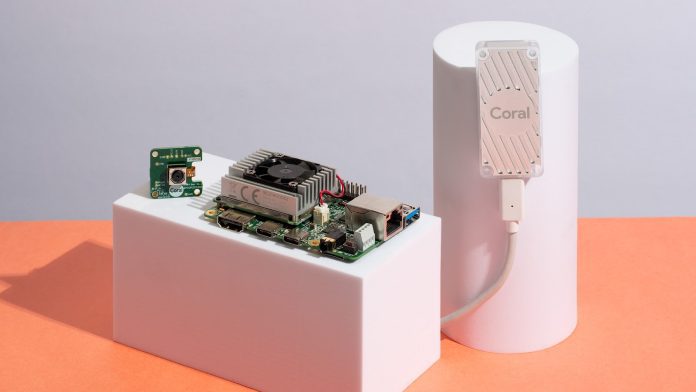


In a major push to move generative machine learning out of resource-heavy cloud data centers and onto ultra-low-power local devices, Google Research—in direct partnership with Synaptics Incorporated—has officially launched the Synaptics Coralboard™.
Introduced as a showcase hardware highlight at Google I/O 2026, the compact development board is engineered to eliminate hardware friction for Internet of Things (IoT) engineers, robotics architects, and original equipment manufacturers (OEMs). The system arrives pre-configured with a plug-and-play, out-of-the-box edge computing environment capable of running localized, private multimodal AI workloads.
The Core Architecture: Synaptics Astra + Coral NPU
The foundation of the Coralboard represents the first physical implementation of Google Research’s hardware-level Coral Neural Processing Unit (NPU) directly integrated into Synaptics’ silicon infrastructure.
- The System-on-Chip: The board is driven by the Synaptics Astra™ SL2619 dual-core System-on-Chip (SoC), running clocks up to 2GHz.
- Memory & Storage Baselines: The limited-edition hardware is packaged with 2GB of DDR4 DRAM and an onboard eMMC flash module, alongside an integrated MicroSD expansion slot for alternative operating system boot images.
- The Dual-NPU Co-Processor: The board houses a highly efficient 1 TOPS (Trillion Operations Per Second) neural processing subsystem. This framework splits workloads across a Convolutional Neural Network (CNN) pipeline and an advanced transformer-capable runtime engine optimized for language modeling.
Built for On-Device Gemma 3 270M
To prove the physical capabilities of the new architecture, Google and Synaptics have heavily optimized the board’s underlying software stack for open-source edge models. The Coralboard features native, hardware-accelerated execution support for Google DeepMind’s newly tailored Gemma™ 3 270M parameter model.
By pairing the specialized, open-source MLIR-based Synaptics Torq™ compiler toolchain with low-footprint target models, developers can compile, compress, and run local vision, speech, and generative text tasks without needing an active internet connection. This zero-connectivity environment ensures total data privacy and lowers latency to millisecond thresholds.
Hardware Connectivity and Expanded I/O
Designed primarily for headless command-line interface (CLI) administration over standard Android Debug Bridge (ADB) or serial connections, the Coralboard includes a broad array of expansion interfaces to support sensory prototyping:
- Camera and Video Input: Features a dedicated 2-lane MIPI Camera Serial Interface (CSI) connector, supporting plug-and-play operations for an included external CSI camera module.
- Display Output: Outfitted with a 4-lane MIPI Digital Serial Interface (DSI) connector to support external visual displays and touchscreens.
- Audio Layering: Includes integrated microphone input pins, onboard dual microphones, an embedded piezo buzzer, and standard stereo speaker terminal rails.
- Sensor HAT Integration: The Google I/O promotional kit ships with a specialized Sensor HAT accessory board, grouping programmable RGB status indicators, sensor arrays, and physical mounts into a neat, unified physical profile.
- Peripherals & Expansion: Includes an M.2 expansion slot for Wi-Fi and Bluetooth connectivity modules, a Qwiic connect layout for $I^2C$ ecosystems, a standard 20-pin GPIO header, and a specialized mikroBUS connector for fast click-board attachments.
+--------------------------------------------------------+
|                      CORALBOARD                        |
|                                                        |
|  [MIPI CSI]           [mikroBUS]            [MIPI DSI] |
|   Camera                Socket               Display   |
|                                                        |
|             +--------------------------+               |
|             |   Synaptics Astra SoC    |               |
|             |      w/ Coral NPU        |               |
|             +--------------------------+               |
|                                                        |
|   [M.2 Slot]         [2GB RAM]         [USB-C Power]   |
|   Wi-Fi/BT             DDR4              & Data Port   |
+--------------------------------------------------------+
The Software Environment: Yocto Linux Foundation
Moving away from the legacy Debian-derived Mendel Linux operating system utilized on older-generation Coral hardware, the new Coralboard officially adopts a highly customized Yocto Linux operating system profile.
Synaptics provides an active Linux Board Support Package (BSP) containing all the essential preboot binaries, device drivers, and low-level kernel abstractions required to securely interface the Yocto kernel with the Astra hardware layout. For application deployment, developers utilize the Synaptics MLIR-based Torq compiler to map standard PyTorch, JAX, or LiteRT models directly into optimized binary streams ready for edge execution.
Deployment On-Ramp
To boot the hardware out of the box in its default headless configuration, developers simply verify that the onboard physical boot switch is set to the eMMC position (‘1’), connect a standard USB-C data cable from their host workstation to the board’s power port, and initialize a local shell via terminal tools:
Bash
# Verify connection to the local board via Android SDK Platform-Tools
adb devices

# Drop directly into the local root shell of the board
adb shell

# Enable network sharing over USB via the host machine to activate DHCP
udhcpc -i usb0
The limited-edition hardware rollouts are scaling up immediately through distribution channels managed by RS Group and Grinn Global, establishing an accessible hardware baseline for engineers looking to design private, always-on ambient computing ecosystems.