
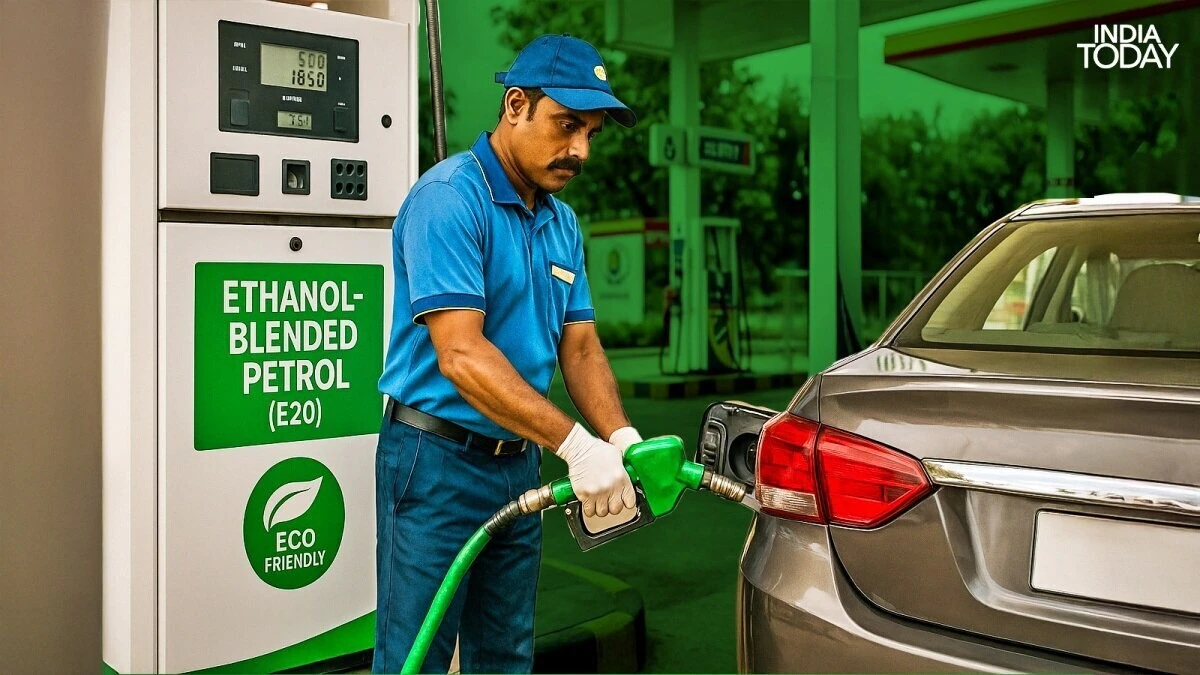
India’s push toward cleaner fuels has gained fresh momentum: in FY25, the country’s ethanol blending in petrol — under the Ethanol Blended Petrol Programme (EBP) — has risen to over 19%, bringing the nation close to achieving the scheduled 20% E20 blending target. Press Information Bureau
This achievement marks an important milestone for India’s energy transition, helping reduce dependence on imported crude, supporting rural economies, and contributing to environmental goals.
What the Numbers Show — Blending Rates & Progress
- As of July 31, 2025, state-run oil marketing companies (OMCs) reported an average ethanol blending rate of 19.05% under the EBP Programme.
- In January 2025, blending had reached a record 19.6%.
- Government data also notes that blending touched as high as 19.93% in July 2025.
- According to the government’s roadmap, India aims to achieve 20% ethanol blending by 2025-26 — a target originally set for 2030.
Why This Matters — Multiple Benefits for India
🌱 Energy Security & Reduced Oil Imports
By blending ethanol with petrol, India reduces its dependence on imported crude oil. Increased domestic ethanol use helps cut foreign exchange outflow and strengthens energy self-reliance.
👨🌾 Support For Farmers & Rural Economy
Rising demand for ethanol encourages use of sugarcane, maize, excess rice, and other agricultural feedstocks — increasing income for farmers and adding value to crop residues and surplus produce
🌍 Environmental & Climate Impact
Higher ethanol blending reduces greenhouse-gas emissions and lowers carbon footprint compared to pure petrol. The shift to E20 (or close to it) aligns with India’s climate commitments and efforts to lower vehicular pollution.
✅ On-track to E20 and Long-Term Biofuel Goals
With blending already over 19%, India is on the verge of hitting its nationally mandated 20% ethanol blending target ahead of schedule — a strong signal of successful policy execution under the EBP Programme.
What Enabled the Progress — Key Policy and Implementation Moves
- Under the amended National Policy on Biofuels 2018 (amended 2022), the blending target was moved forward — from 2030 to 2025-26 — accelerating implementation.
- The government expanded feedstock base: apart from sugar-cane molasses, maize, rice, damaged grains and other biomass are now used to produce ethanol, easing supply constraints and increasing ethanol availability.
- Supportive incentives: reduction in GST on ethanol used in EBP, interest-subvention schemes for ethanol production, long-term supply contracts with dedicated ethanol plants — all helped scale up supply and blending.
What’s Next — Challenges & Watchpoints
- Achieving and sustaining the 20% blend: India needs to ensure steady ethanol supply, production capacity, and distribution infrastructure to maintain or exceed 20% blending in petrol nationwide.
- Feedstock sustainability and crop economics: As blending expands, pressure may increase on agriculture prices and food security. Efficient feedstock management, crop-residue use and alternatives (like cellulosic ethanol) will be critical.
- Vehicle compatibility and public acceptance: Transitioning fully to E20 (or higher) may raise concerns about mileage, engine wear — especially for older vehicles. Government and regulators need to keep transparency and consumer communication strong.
- Infrastructure and biofuel ecosystem growth: Ethanol storage, logistics, distribution networks, monitoring, quality control — these must expand to match rising ethanol demand and consumption.
Conclusion
India’s ethanol blending has now exceeded 19% in FY25 — putting the country within striking distance of its 20% E20 goal, years ahead of the original schedule. This marks a significant achievement for India’s energy-transition aspirations, supporting farmers, reducing import dependence, and contributing to climate targets.
As the country edges toward full E20 adoption, continuity in policy support, sustainable feedstock management, and robust infrastructure will be key to sustaining this momentum and reaping long-term benefits.