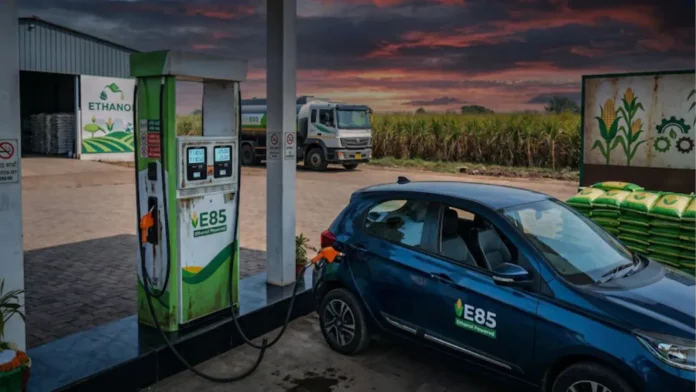


In a major push toward clean energy and sustainable mobility, the Government of India has officially launched E85 fuel in the national capital. Introduced on World Environment Day (June 5) by Union Petroleum and Natural Gas Minister Hardeep Singh Puri, the high-ethanol blend is priced at ₹82.12 per litre.
The retail debut took place at an Indian Oil Corporation (IOCL) outlet on Pusa Road in New Delhi, making the commercial infrastructure for high-level biofuels a reality.
The Value Proposition: ₹20 Cheaper Than Regular Petrol
The primary highlight of the E85 launch is its aggressive pricing structure. At ₹82.12 per litre, E85 retails at exactly ₹20 less than regular E20 petrol, which currently costs ₹102.12 per litre in Delhi.
The significant price markdown is a deliberate fiscal strategy by the government to pass the cost benefits of domestically produced ethanol on to consumers and incentivize early adoption.
Why is E85 cheaper? E85 is a high-biofuel blend consisting of 85% ethanol and 15% conventional petrol. Because ethanol has a lower energy density than pure petrol (roughly one-third less energy), vehicles running on it consume more fuel to cover the same distance. The ₹20 discount is mathematically designed to offset the 25% to 35% reduction in real-world mileage.
Financial and Environmental Impact
The transition to a national flex-fuel ecosystem carries major macroeconomic and environmental benefits:
- Foreign Exchange Savings: India’s ethanol blending program has already saved over ₹1.84 lakh crore in foreign exchange and cut crude oil imports by nearly 302 lakh metric tonnes.
- Massive Carbon Reduction: According to the Ministry of Petroleum, flex-fuel vehicles running on E85 can reduce lifecycle greenhouse gas (GHG) emissions by up to 61% compared to conventional petrol vehicles.
- Agricultural Income: The ministry estimates that if just half of the new two-wheelers and passenger vehicles sold in India transition to flex-fuel technology, it will generate roughly ₹12,403 crore in additional income for domestic farmers supplying agricultural feedstocks.
What’s the Catch? Limited Vehicle Compatibility
While the low pump price is attractive, regular car and motorcycle owners cannot pull up and use E85. E85 is highly corrosive to standard internal combustion engines and requires specially calibrated Flex-Fuel Vehicles (FFVs) built with modified fuel systems, sensors, and gaskets.
Currently, only a handful of mass-market two-wheelers are certified to run on E85 in India:
| Vehicle Model | Segment | Ex-Showroom Price (Delhi) | Status |
| Hero Splendor+ Flex Fuel | Motorcycle (Commuter) | ₹82,710 | Launched; Customer deliveries from July 2026. |
| Hero HF Deluxe Flex Fuel | Motorcycle (Commuter) | ₹72,792 | Launched; Customer deliveries from July 2026. |
| Suzuki Gixxer SF 250 FFV | Motorcycle (Quarter-litre) | ₹1,98,000 | Available. |
Note: In the passenger car segment, Maruti Suzuki has repeatedly showcased its prototype Wagon R Flex Fuel, and Toyota has displayed an Innova FFV, but an official commercial launch for four-wheelers remains awaited.
Infrastructure Roadmap: Target 2026-2027
To prevent consumer confusion, E85 fuel pumps will carry highly distinct, dedicated branding to isolate them from regular E20 dispensers. The rollout will expand sequentially to balance fuel availability with manufacturing pipelines.